
The short answer
Could a telecom network charge a rival the same price while still favouring its own retail business? The selected 2006 and 2008 records make that a question about systems, time, information and enforceable commitments, not price alone.
Original source comparison
Different records answer different questions
Keep the document’s purpose and the claim being tested together.
| Record or test | What it establishes | What remains to be checked |
|---|---|---|
| 2006 package | Policy direction, access proposals and accounting disclosure. | Enacted detail, service timing and actual compliance. |
| 2008 clause 1.2 | Defined equivalence conditions and listed differences. | Whether a real service and exception fit the facts. |
| 2008 backgrounder | Public explanation and intended milestones. | Observed achievement of each promised benefit. |
Chronology
A timeline of the turning points
Policy announcement
Official Budget index identifies this event date; main release web field says 4 May.
Gattung’s tenure ends
Later filing confirms actual employment cessation.
Undertakings provided
The selected original document was provided to the minister.
Plan approved
Separation Day begins a staged implementation programme.
Scheduled transition
Original backgrounder sets later gateways and equivalence milestones.
First distinguish a policy package from an operating obligation
The government’s 2006 broadband package proposed local-loop unbundling, more useful wholesale access, accounting separation and stronger monitoring. Its own Budget index and a later ministerial release date the announcement to 3 May 2006, while the surviving main release page carries 4 May. Those are different date fields, not two separately completed reforms. The package also discussed further consideration of separation options. It did not establish that all rivals already received identical provisioning systems or information. A policy announcement identifies a proposed direction and instruments; implementation requires later records. This distinction matters when connecting the change with Theresa Gattung’s tenure, which ended 30 June 2007.
Read the edition and the defined standard
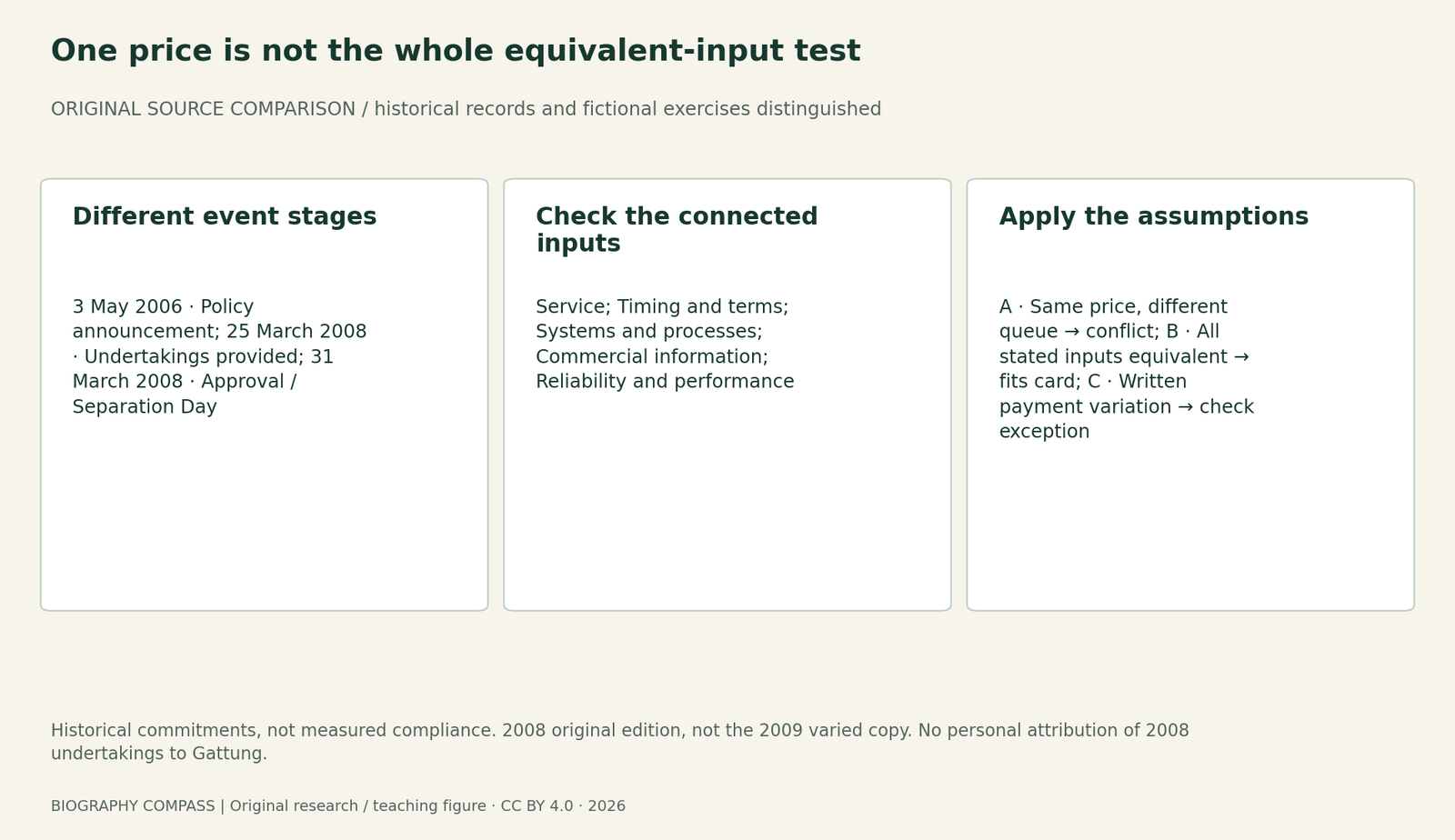
The selected undertakings are the document provided to the minister on 25 March 2008. They are not the 2009 varied copy later filed with US regulators. Clause 1.2 defines equivalence of inputs for a relevant service through several linked conditions: the same service, timescales, terms including price and service levels, systems and processes, and commercial information. It also requires systems that outside providers can use with equivalent reliability and performance. The definition expressly accommodates specified differences, including certain credit, payment and security matters and agreed variations. A reader must therefore inspect both the common standard and the particular exception invoked. A matching price by itself answers only part of the test.
Sources for this section: [3]
Approval did not mean every transition finished that day
The minister announced approval on 31 March 2008, and the document defines that date as Separation Day. The accompanying backgrounder nevertheless sets out a staged programme. Remaining organisational requirements and the oversight group followed in July 2008; business-to-business gateways were scheduled for December 2009; full equivalence for local-loop and bitstream services was scheduled by 2011. These are the original timetable’s commitments, not a finding that every target was achieved. Operational separation distinguished access-network, wholesale and retail functions within the Telecom group. It should not be described as an immediate sale of the network or as evidence that every later service dispute had disappeared.
Original exercise: audit three fictional access cards
Assume a relevant service has reached its applicable equivalence deadline. No specified exception, requested variation or agreed exemption applies unless the card states one. Card A offers both customers the same price, but Telecom retail orders use an automated same-day interface while a rival must email a queue that takes three days. Card B supplies the same service, price, other terms and conditions, service levels, systems and processes, timing and commercial information, with equivalent reliability and performance. Card C also meets those conditions, but the rival asks in writing for a different payment procedure and Telecom agrees. Which card conflicts with the selected definition, which fits the stated conditions, and which requires an exception check? Explain the relevant clause instead of counting only prices.
Sources for this section: [3]
Reference answer: trace the actual difference
Card A conflicts with the stated test on the assumptions given: the ordering route and delivery times differ materially, even though price matches. The evidence needed would include order logs, interface access rules and service-level records. Card B fits the conditions specified in this exercise; that is a conclusion about a complete fictional card, not a historical certification of Telecom’s conduct. Card C should not automatically fail. Clause 1.2 expressly recognises payment-procedure differences and written provider-requested differences agreed by Telecom. Check the scope and documentation of the difference before accepting the exception. An undocumented assertion that the customer wanted it would not establish the stated written-request route.
Sources for this section: [3]
Compare the documents before judging the outcome
The ministerial release explains the government’s intention and approval decision. The undertakings define obligations and permitted differences. The backgrounder translates those arrangements into a public timetable and anticipates benefits. Their purposes differ: official optimism does not independently measure customer experience, and a rule’s existence does not prove compliance. To investigate an actual later failure, the next records would be the applicable edition, service-specific migration date, operational evidence and any regulator or court decision. The exercise stops at interpreting selected historical clauses; it does not decide a live dispute or substitute a modern legal standard for the 2008 text.
Continue the chronology
Related history guides
When Navman Split: Follow the Product Lines
Trace Navman’s staged Brunswick acquisition and 2007 business-line sales, then reconstruct which buyer and event each original record actually identifies.
Read the timeline1998–2006A Pay-TV Signal Needs More Than Programme Rights
Use Sky’s 1998 broadcasting record and 2006 outage account to distinguish programme permissions, transmission capacity and the equipment needed by viewers.
Read the timelineBiography context
Explore New Zealand through connected lives
Connected biographies
People behind these records
1962–
Theresa Gattung
Telecommunications executive and philanthropic founderTheresa Gattung rose through marketing and operational management to lead Telecom during a period of technological and regulatory change.Read biographyQuick answers
Common questions
- Was equal pricing sufficient?
- No. The selected definition also addresses service, timing, terms, systems, information, reliability and performance.
- Did Gattung sign the 2008 plan as chief executive?
- The cited 2007 filing confirms her employment ended 30 June 2007; the 2008 plan belongs to the later period.
- Does Card C prove any real-world exemption?
- No. It is an original fictional example. An actual dispute needs the applicable document and evidence of its conditions.
Primary and institutional sources
How this history was checked
Read the selected historical records with their dates, edition and institutional purpose attached. Fictional exercises are labelled, and each source retains its historical context. This article was reviewed on 27 October 2026.
- David Cunliffe / New Zealand GovernmentGovernment moves fast to improve Broadband
- Telecom Corporation of New Zealand; US Securities and Exchange CommissionTelecom 2007 Form 20-F: former CEO remuneration/cessation
- Telecom / New Zealand GovernmentTelecom Separation Undertakings, as provided 25 March 2008
- David Cunliffe / New Zealand GovernmentTelecom operational separation,31 March 2008
- Minister for Communications and Information TechnologyTelecom Operational Separation Backgrounder,31 March 2008
- New Zealand GovernmentBudget 2006: communications media statement index
- David Cunliffe / New Zealand GovernmentMinister welcomes Brash broadband commitment,19 May 2006