
The short answer
When a company sells activities carrying a familiar brand, does the name tell you which products, people or services moved? Navman’s acquisition and later product-line transactions let readers build a more precise business map.
Original source comparison
Different records answer different questions
Keep the document’s purpose and the claim being tested together.
| Record or test | What it establishes | What remains to be checked |
|---|---|---|
| 2004 acquisition record | Ownership of the company acquired in stages. | Founder’s individual receipt or permanent operating arrangements. |
| February 2007 release | PND agreement, proposed buyer and approval condition. | Closing of the transaction or acquisition of every branded activity. |
| Amended 2008 filing | Completed 2007 sales of three business activities. | Every employee, IP licence or product obligation in each transfer. |
Chronology
A timeline of the turning points
Initial acquisition
Brunswick acquired 70 percent of Navman.
Remaining interest
Acquired the other 30 percent.
PND agreement
MiTAC agreement announced, subject to approvals.
Two completions
Later filing records marine-electronics and PND sales.
Wireless completion
Remaining fleet-tracking business sold separately.
Start with the acquired company and the two ownership stages
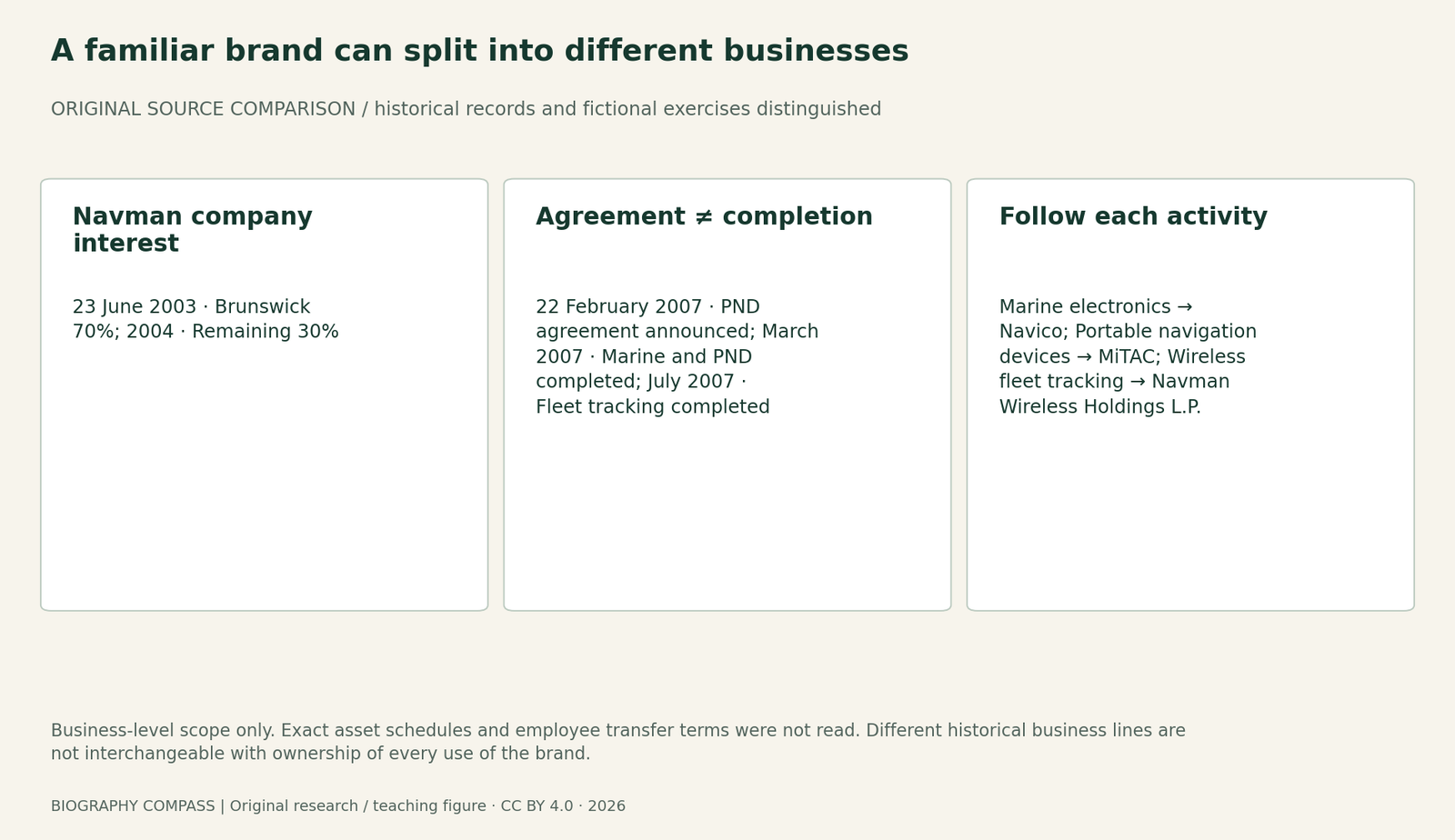
Brunswick’s 2004 annual filing records an initial 70 percent purchase of Navman on 23 June 2003, followed by the remaining 30 percent in 2004. A contemporaneous issuer release describes continued New Zealand management and Maire’s wider Brunswick New Technologies role. These records answer an ownership question and describe operational continuity at the time. They do not prove that every activity would remain together or that the founder alone received the purchase consideration. For this investigation, the useful starting point is a list of business activities, not an assumed single unchanging object called Navman.
An agreement identifies a particular perimeter
Brunswick’s 22 February 2007 announcement concerns the portable navigation device, or PND, operations of the Navman brand. It names MiTAC as the proposed buyer and says completion remains subject to approvals. The same release discusses a separate agreement involving marine-electronics brands, including relevant Navman operations, and says efforts to sell the fleet-management operation continue. This is stronger evidence than a headline saying Navman sold: it identifies an activity, a counterparty and an event stage. It also shows why one brand can appear in more than one transaction without implying that each buyer acquired the same assets.
Sources for this section: [3]
Use the later filing to establish completion
The selected amended 2008 quarterly filing looks back on the disposals. Its Note 16 records that marine electronics and PND businesses were sold in March 2007 to Navico and MiTAC respectively. Wireless fleet tracking followed in July 2007, to Navman Wireless Holdings L.P. The later document therefore changes the status from an announced agreement to a completed disposal and supplies a separate timing for the third activity. It is an amended filing, reproducing later accounting information; it is not silently presented here as an untouched 2007 release. The guide does not need to add transaction proceeds to establish this business map.
Compare a participant’s recollection with the transaction record
In 2013 Ian Daniel described a management and private-equity buyout of the wireless business and its subsequent development. He recalled being hired by Maire in 2002 and described working from the old North Shore site. The shared location is interesting evidence of continuity, but it does not establish that all former products, employees or contracts stayed there. Daniel’s account supplies experience of one business line; the issuer’s documents supply transaction scope and completion records. Read together, they support continuity in particular activities while explaining why the broad brand story can obscure a changing organisation. Neither source supplies a complete transfer agreement or an employment-by-employment schedule.
Original exercise: repair an over-compressed archive caption
A fictional museum caption reads: “On 22 February 2007 MiTAC completed its purchase of every Navman business, including fleet tracking; all the original New Zealand operations therefore continued unchanged.” Use the selected records to mark four separate problems: event stage, business perimeter, other buyers and continuity. Then write a replacement of no more than 75 words. You may name only the buyers and dates actually established by the records. Do not fill the gap with a guessed individual sale receipt, an invented factory closure or a claim that every employee moved. Finally, state one additional document that would be needed to test a claim about a specific employment contract.
Reference answer: preserve the branches and the event stages
One suitable replacement is: “Brunswick announced an agreement to sell Navman’s portable-navigation operations to MiTAC on 22 February 2007. A later filing records completion of the PND and marine-electronics sales to MiTAC and Navico in March 2007, and the wireless-fleet-tracking sale to Navman Wireless Holdings L.P. in July 2007. Those transactions transferred distinct activities; the selected records do not establish unchanged employment or operations.” The original caption incorrectly changes an agreement into completion, expands PND to every business, loses two buyers and turns a contemporary continuity statement into a permanent guarantee. A specific employee claim would require the relevant transfer agreement, employment documentation or a reliable dated announcement addressing that workforce.
Continue the chronology
Related history guides
Equal Prices, Unequal Inputs? Telecom’s Separation Records
Compare Telecom’s 2006 policy change with its 2008 undertakings, then test fictional service arrangements against the actual equivalent-input rules.
Read the timeline1998–2006A Pay-TV Signal Needs More Than Programme Rights
Use Sky’s 1998 broadcasting record and 2006 outage account to distinguish programme permissions, transmission capacity and the equipment needed by viewers.
Read the timelineBiography context
Explore New Zealand through connected lives
Connected biographies
People behind these records
Birth date not established
Peter Maire
Electronics entrepreneur and technology investorPeter Maire developed Navman from a New Zealand electronics venture and later invested in several technology companies.Read biographyQuick answers
Common questions
- Did MiTAC acquire every Navman activity?
- The selected records identify its PND purchase. They separately name Navico for marine electronics and Navman Wireless Holdings L.P. for fleet tracking.
- Why compare an announcement with a later filing?
- They establish different event stages: agreement with conditions and later reported completion.
- Can an old workplace prove business continuity?
- It can show a shared location. Product, employment and legal continuity require more specific evidence.
Primary and institutional sources
How this history was checked
Read the selected historical records with their dates, edition and institutional purpose attached. Fictional exercises are labelled, and each source retains its historical context. This article was reviewed on 27 October 2026.
- Brunswick CorporationBrunswick 2004 Form 10-K: Navman acquisition notes
- Brunswick release reproduced by Boating IndustryBrunswick purchases final 30 percent of Navman,3 June 2004
- Brunswick CorporationAgreement to sell BNT’s portable navigation device unit,22 February 2007
- Brunswick Corporation; US Securities and Exchange CommissionBrunswick amended Q3 2008 Form 10-Q, Note 16
- Andrew Patterson, interest.co.nz; written Ian Daniel interviewLeading the charge, leading global consolidation,16 April 2013