
The short answer
Why can a broadcaster have programmes available and still deliver no picture? Historical Sky records show several dependencies between permission to show material and a viewer actually receiving it. The worked exercise tests those links.
Original source comparison
Different records answer different questions
Keep the document’s purpose and the claim being tested together.
| Record or test | What it establishes | What remains to be checked |
|---|---|---|
| Programme permission | Scope of authorised content use, if the licence is available. | Whether a working distribution and receiving chain exists. |
| Transport record | Capacity, carriage and operational service. | Rights to show every programme on that path. |
| Receiver/access record | Ability and authorisation to receive a service. | A guarantee against upstream outages. |
Chronology
A timeline of the turning points
Scoping review
Redacted study distinguishes transmission, frequency and receiver arrangements.
Signal interruption
Sky reports an approximately 13-hour satellite outage.
Restoration and plans
Records a one-day credit and describes planned broadcast redundancy.
Treat the 1998 study as a dated and redacted source
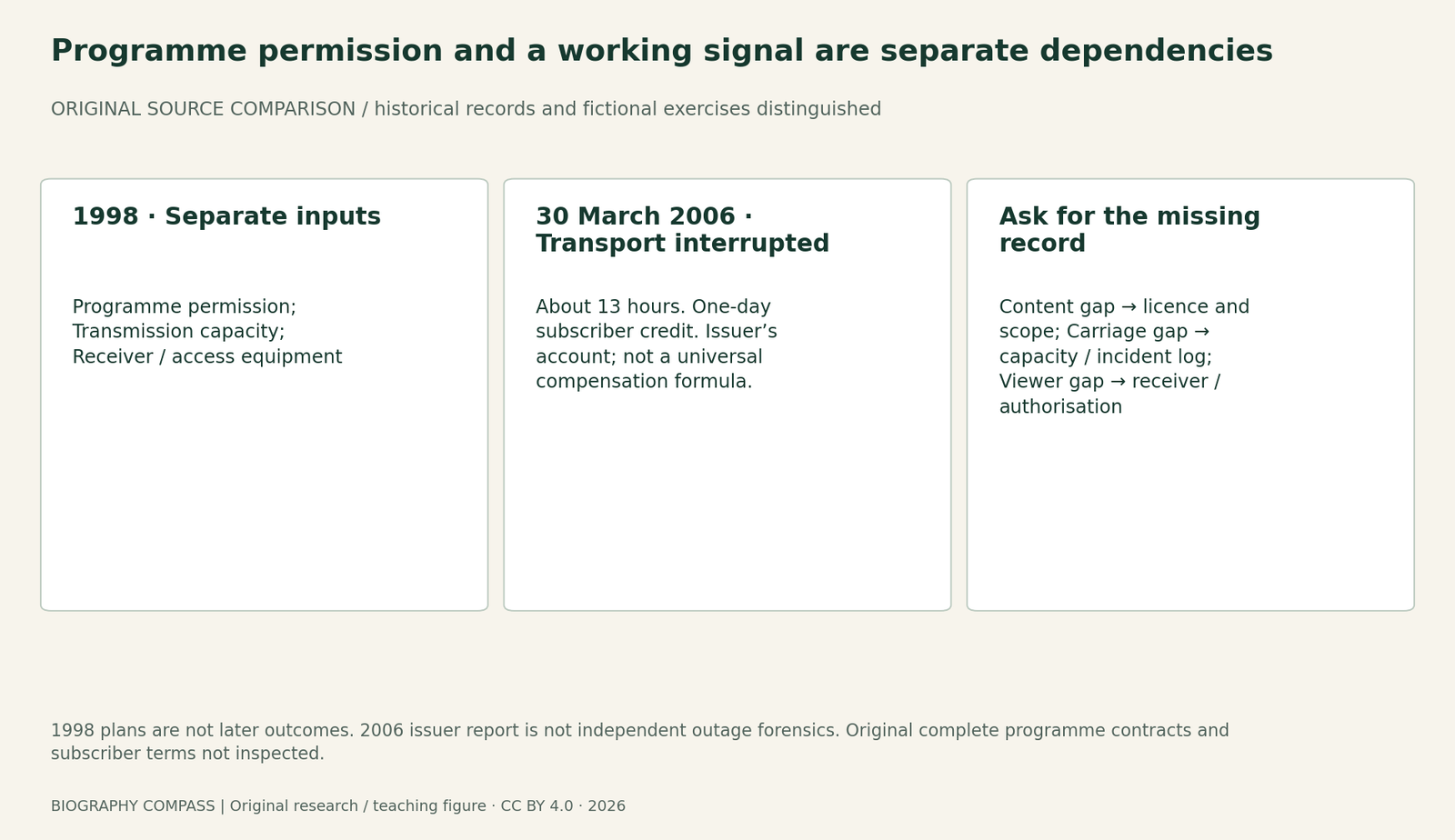
Treasury commissioned the TVNZ scoping review from an Ord Minnett-led consortium. Published in May 1998, it contains deleted and summarised commercial information. Its Sky section records formation in 1987 and transmission beginning in May 1990. For the later operating system, it distinguishes frequency licences, BCL transmission and leased Optus satellite capacity. Those categories describe different inputs. The review was prepared around Crown ownership of TVNZ and informed by management; its expectations are not later measured outcomes. The original unredacted contracts were not available for this guide.
Sources for this section: [1]
Follow the signal through separate dependencies
A programme permission addresses what may be shown within its agreed scope. A transmission arrangement concerns how a signal is carried. The 1998 study also discusses the set-top equipment needed for digital reception. A working transmission path does not itself establish permission to show a programme, and a programme permission does not guarantee that a household’s receiving system works. This is an editorial reading model derived from the separately described inputs. The three boxes are useful because a failure in one box calls for a different remedy from a failure in another. They are not a reconstruction of every term in a particular Sky content contract.
Sources for this section: [1]
The 2006 outage supplies a concrete failure case
Sky’s 2006 annual report states that satellite signal was lost for about 13 hours on 30 March 2006, following routine repositioning of Optus B1. Its chief executive’s review describes cooperation with Optus on restoration and a credit equivalent to one day’s service for subscribers. The same selected review discusses broadcast-centre changes and backup capacity. This is the operator’s account, not an independent engineering investigation. It nevertheless identifies a transport failure rather than reporting that programme permissions disappeared. A channel catalogue could therefore remain commercially relevant while viewers experienced an interruption. That is the practical distinction the exercise explores.
Sources for this section: [2]
Different commitment headings preserve that separation
The report’s Note 27 lists contracts for transmission services separately from contracts for future programmes. It also discusses an Optus D1 transponder agreement and its expected commencement. These are useful document headings, not interchangeable quantities or proof that a forecast launch happened on schedule. A reader investigating a disputed broadcast should ask which commitment is relevant and whether it was effective at the time. The selected pages do not supply complete programme licences, subscriber terms or satellite incident logs. Their absence limits the claims that can be made about legal liability or the exact technical cause of the outage.
Sources for this section: [2]
Original exercise: diagnose four fictional broadcast cards
These cards are invented learning cases, not descriptions of actual Sky contracts. Card A has a valid programme licence for the intended territory, channel and period, but no booked transmission path. Card B has working transport and compatible receivers, but no permission to show the proposed programme. Card C has programme permission and an operational signal, but its supplied receiver cannot decode the service. Card D has all three arrangements in place until the satellite path fails; programme rights and receiver authorisation remain valid. For each card, identify the missing or failed link and the next record you would inspect. Explain why replacing a single rights contract would not solve every card.
Reference answer: match the evidence to the failure
A concerns carriage: inspect a transmission booking, capacity agreement and commissioning record. B concerns programme permission: inspect the applicable licence and its territory, channel, time and permitted-use conditions. C concerns reception: inspect receiver compatibility, configuration and access-authorisation records. D concerns an interrupted transport path: inspect incident logs, restoration work and backup arrangements. Do not infer a rights breach merely from a black screen, or assume compensation without reading the applicable service terms. In the historical example, Sky reported a one-day credit for an interruption of about 13 hours; that report does not establish a universal hour-for-hour compensation formula. The useful output is a specific evidence request, not a guessed legal conclusion about every viewer or programme.
Continue the chronology
Related history guides
Equal Prices, Unequal Inputs? Telecom’s Separation Records
Compare Telecom’s 2006 policy change with its 2008 undertakings, then test fictional service arrangements against the actual equivalent-input rules.
Read the timeline2003–2007When Navman Split: Follow the Product Lines
Trace Navman’s staged Brunswick acquisition and 2007 business-line sales, then reconstruct which buyer and event each original record actually identifies.
Read the timelineBiography context
Explore New Zealand through connected lives
Connected biographies
People behind these records
1956–
Craig Heatley
Entrepreneur, broadcaster and philanthropic supporterCraig Heatley moved from leisure ventures into the financing and development of subscription television in New Zealand.Read biographyQuick answers
Common questions
- Does a working satellite establish programme rights?
- No. Technical carriage and permission to show content are separate questions.
- Were all 1998 plans completed as forecast?
- The selected scoping review is a dated source containing plans and redactions. It does not by itself establish later completion.
- Does the 2006 credit establish a universal compensation rule?
- No. The issuer reported its response to that outage. General liability would require the applicable contract and law.
Primary and institutional sources
How this history was checked
Read the selected historical records with their dates, edition and institutional purpose attached. Fictional exercises are labelled, and each source retains its historical context. This article was reviewed on 27 October 2026.
- Ord Minnett-led consortium, commissioned by Treasury; Beehive publication 13 May 1998TVNZ Scoping Study, May 1998: selected broadcasting sections
- Sky Network Television Limited; original issuer PDF preserved by AnnualReportsSky Network Television Annual Report 2006: selected service and commitments pages