
The short answer
How did a cross-species chromosome experiment test telomere function?
Evidence comparison
Telomere Function Across Two Species
Compare the observations with the narrower conclusions they support.
| Record or observation | What it supports | What remains separate |
|---|---|---|
| Tetrahymena ends maintain linear DNA in yeast | Supports cross-species telomere function | Does not establish identical sequences in all organisms |
| An artificial hairpin fails to stabilise the molecule | Challenges a generic any-cap explanation | Does not identify every molecular contributor to maintenance |
Test function in a second organism
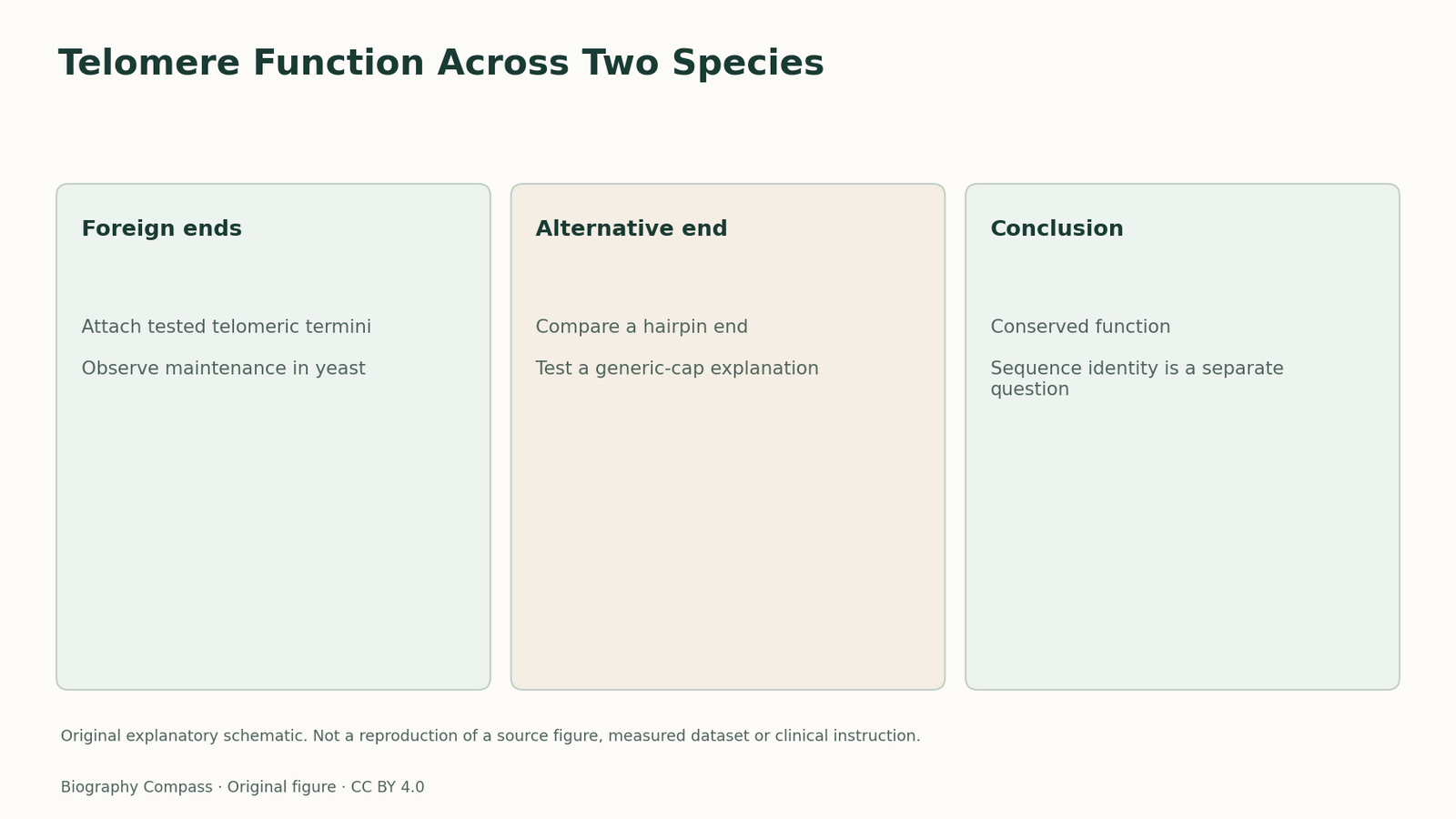
The 1982 Szostak–Blackburn paper examined whether Tetrahymena DNA termini could stabilise a linear plasmid in yeast. This moves beyond comparing two sequences on paper. A recipient organism supplies an experimental context in which the foreign ends either support the tested function or fail to do so. Maintenance of a linear molecule therefore provides a functional readout for the end sequences being investigated.
Use an alternative end as a control
The paper reported that an artificial hairpin end did not stabilise the linear plasmid in the same way. That comparison matters because it tests a broader explanation that any physically closed or specially formed end might suffice. The result supports a more specific property of the tested telomeric termini. It does not identify every molecular interaction responsible for maintenance or establish that a single terminal sequence is universal across species.
Sources for this section: [4]
A conservation exercise
Prepare three invented classroom cards: similar-looking sequences, a foreign end that preserves a linear molecule in a recipient system, and an alternative end that does not. Ask which card is strongest evidence of cross-species function. The answer is the successful functional test, strengthened by the alternative-end comparison. Then ask whether this demonstrates identical sequences in the two organisms. It does not. These cards organise different kinds of evidence and are not numerical observations from the original plasmid experiments.
Sources for this section: [4]
Compare protection with the enzyme question
The linked Greider guide asks how a telomerase RNA supplies sequence information. This guide asks whether particular chromosome ends function in another biological context. End protection and repeat synthesis belong to the same history while remaining experimentally distinct questions.
Continue the chronology
Related history guides
Biography context
Explore United States through connected lives
Connected biographies
Researchers and related questions
1952–
Jack W. Szostak
Molecular biologist and chromosome-end researcherSzostak and Blackburn's 1982 paper tested linear plasmids carrying DNA ends from Tetrahymena in yeast.Read biography1961–
Carol W. Greider
Molecular biologist and telomerase researcherGreider and Blackburn identified telomerase activity in 1984 and published the initial work in 1985.Read biography1918–2007
Arthur Kornberg
Biochemist and DNA-replication researcherKornberg's group isolated DNA polymerase from bacteria in 1956.Read biographyQuick answers
Common questions
- How did a cross-species chromosome experiment test telomere function?
- Supports cross-species telomere function. Does not establish identical sequences in all organisms.
- Are the classroom examples historical measurements?
- No. Invented examples are labelled as classroom models; the source-based discussion identifies the historical evidence separately.
Primary and institutional sources
How this history was checked
Official biographical and award records are read alongside the researcher’s technical account. Source scope and hypothetical examples remain distinct. This article was reviewed on 7 November 2026.