
The short answer
A convincing character can produce the expected action while leaving the mechanism behind that action misunderstood. Separate representation, response and evidence of generalisation.
Compare the records
Attach the claim to the right evidence
The object and scope of a record determine which comparison it supports.
| Record or model | Establishes | Does not establish |
|---|---|---|
| Paper method | Acoustic features and cue–behaviour association. | General language comprehension. |
| Catalogue abstract | A separate personality-survey description. | Inspection of the full thesis or raw survey data. |
| Fictional familiar test | Performance on the specified recordings. | New-speaker performance. |
| Fictional held-out test | A descriptive score on a new set. | A universal capability or a population estimate. |
Chronology
A timeline of the turning points
Co-authored paper
An implementation and preliminary interactions.
Thesis catalogue
A separate record describes two projects.
Held-out recordings
Training is frozen before both tests.
Read what the system represents
In the AAAI 2000 paper, Yoon, Burke, Blumberg and Schneider describe Sydney K9.0. DogEar represents utterances with cepstral features; stored groups are compared using Dynamic Time Warping. The paper expressly distinguishes acoustic patterns from language comprehension. Reward links cues with behaviour.
The method therefore gives a concrete question to ask of an impressive demonstration: what representation and decision procedure could produce the observed response? A label such as “understands” is too broad until the tested capability has been specified. Correct action after a familiar cue does not identify the mechanism by itself.
Sources for this section: [1]
Compare two records without merging their evaluations
The paper reports preliminary interactions and leaves fuller evaluation for later work. MIT’s 2000 thesis catalogue describes two projects, Sydney K9.0 and (void*), and mentions a novice-user survey about personality representation in the latter. The thesis body was not available for this guide.
A catalogue abstract and a research article are different evidence. The survey description cannot be silently transferred to the dog-training demonstration as a controlled test of speech understanding. Conversely, an informal demonstration can show a system operating without establishing every stronger interpretation an audience might attach to it.
Exercise: define the test before seeing the score
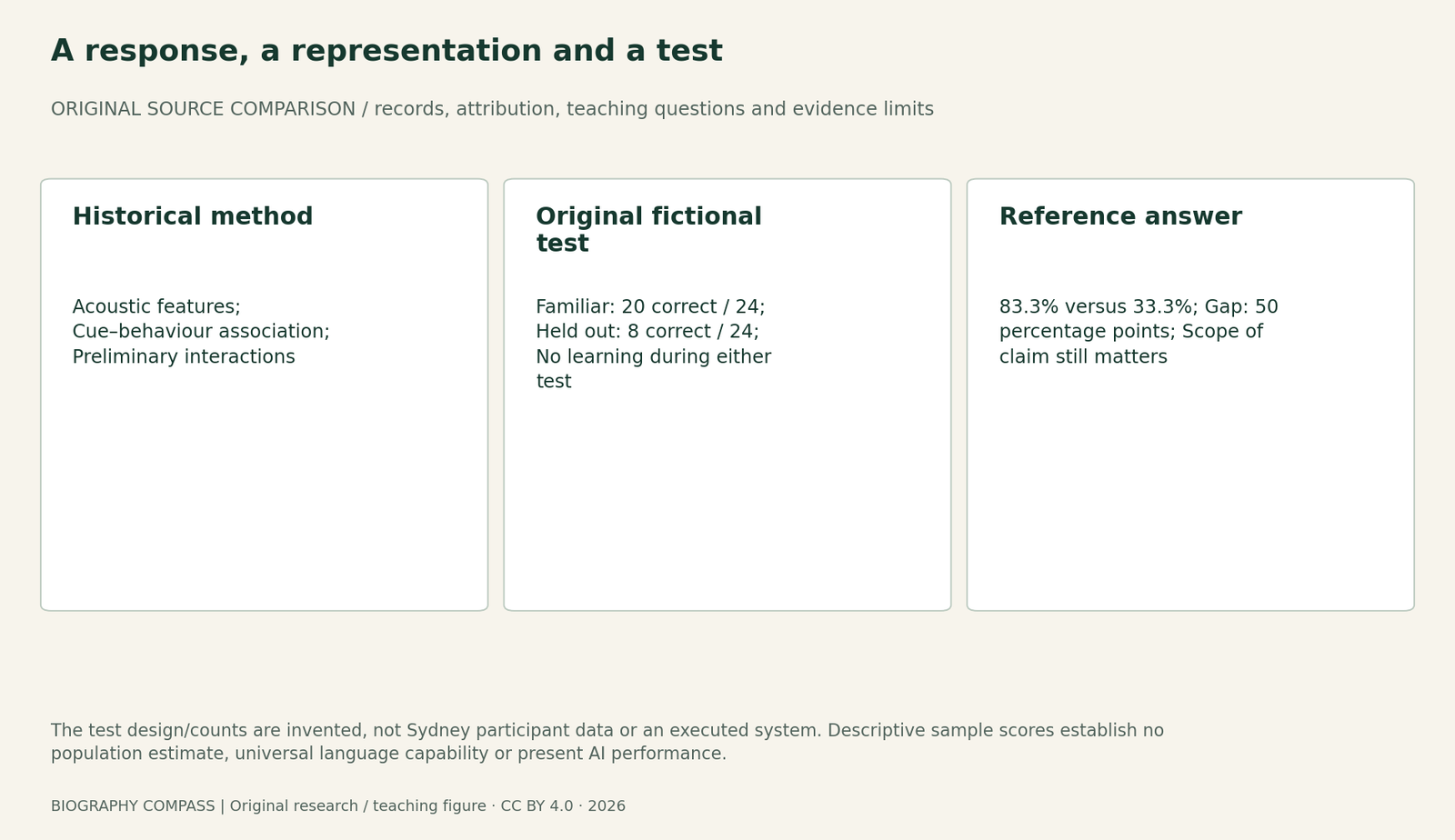
Consider an invented two-action character. A trainer teaches responses using a fixed collection of recorded cues. After training stops, Test F replays 24 familiar recordings and the correct action occurs 20 times. Test H presents 24 new recordings of the same intended commands from previously unused speakers; eight responses are correct. No feedback or further training occurs during either test.
Calculate the two descriptive success rates and their difference in percentage points. Then assess the claim “the character understands the commands regardless of speaker.” State one additional test that would investigate a different capability from matching familiar sounds. These counts are invented, not participant data from Sydney K9.0.
Sources for this section: [1]
Reference answer: a score has a population and a task
The rates are 20 ÷ 24 = 83.3% and 8 ÷ 24 = 33.3%, a 50 percentage-point gap. These finite descriptive results support better performance on the supplied familiar set. They do not establish the proposed speaker-independent capability. Without an experimental design and uncertainty analysis, the figures should not be promoted to population estimates.
One extension would test previously unseen paraphrases while controlling the intended action, speaker and recording conditions. Another would include irrelevant sounds and a defined rejection response. Predefine scoring and keep training examples separate. A successful extension would support the particular generalisation tested; it would still not settle every possible meaning of “understanding.”
Sources for this section: [1]
Keep an engaging interaction distinct from a benchmark
The historical paper’s observation that users found the character lifelike addresses an interaction goal. It need not be treated as a failed claim about a capability the implementation was not designed to possess. A fair reading preserves both the achievement and the stated boundary.
The same discipline helps when evaluating later commercial demonstrations. Ask which inputs were seen during development, what was held out, whether feedback continued, how errors were counted and whether a claim concerns behaviour, internal representation or a user’s impression. Those questions turn an attractive demonstration into an answerable research task.
Sources for this section: [1]
Continue the chronology
Related history guides
What a DRAM capacity label leaves unanswered
Compare how another record separates its stated quantity, method and evidential limit.
Read the timeline2022 product record ·2023 bulletin · original modelWhy daily leverage and a period return differ
Compare how another record separates its stated quantity, method and evidential limit.
Read the timelineBiography context
Explore Worldwide through connected lives
Connected biographies
People connected to these records
1975—
Yoon Song-yee
AI researcher, gaming executive and investorYoon Song-yee’s career connects research on interactive synthetic characters with personalised mobile services, game-company strategy and early-stage entrepreneurship.Read biographyQuick answers
Common questions
- Are the 24-trial counts historical?
- No. They are original invented teaching inputs.
- Was a full doctoral thesis or running system inspected?
- No. The catalogue and the separate paper were inspected; no software, audio session or raw participant data was tested.
Primary and institutional sources
How this history was checked
Selected historical records are linked below. Fictional exercises are labelled, and source scope is kept separate from the strength of a conclusion. This article was reviewed on 29 October 2026.