
The short answer
The time interval in a product objective is part of the objective. A daily multiple cannot be substituted for a multiple of an entire period without checking the arithmetic.
Compare the records
Attach the claim to the right evidence
The object and scope of a record determine which comparison it supports.
| Record or model | Establishes | Does not establish |
|---|---|---|
| Historical prospectus | Named product, manager and daily objective. | Current terms or achieved returns. |
| SEC staff bulletin | A general educational explanation. | Hong Kong product law or an SEC rule. |
| Path A | Index 108; account 112. | A historical observation or forecast. |
| Path B | Index 108; account 116. | A universal doubling rule for period returns. |
Chronology
A timeline of the turning points
Issuer document
Selected Appendix 3 sets the daily objective.
Staff bulletin
Explains daily reset and longer-period divergence.
Compare paths
Equal index endpoints need not imply equal account endpoints.
Keep the date and the product attached
The 29 April 2022 prospectus names Mirae Asset Global Investments (Hong Kong) as manager. Appendix 3 identifies the Global X Hang Seng Index Daily (2x) Leveraged Product, code 07231. Its objective concerns twice the index’s daily performance before fees and expenses, with no assurance of achieving it.
That is a historical issuer document, filed with the exchange. It establishes the stated objective and named entities for that version. It does not supply current 2026 terms, certify realised returns or turn an association with a business group into a personal promise by its founder.
Sources for this section: [1]
Compare a product objective with an educational explanation
The SEC staff’s 29 August 2023 bulletin explains that daily-reset leveraged products can diverge from the stated multiple over longer periods. It also describes costs and the possibility of failing to meet a daily objective. The bulletin expressly has no legal force and creates no additional obligations.
The two records have different jobs. One states terms for a Hong Kong product; the other explains a general mechanism in a US educational context. Their agreement about the daily interval does not make the SEC bulletin the governing document for the Hong Kong product.
Exercise: the same ending index, two different paths
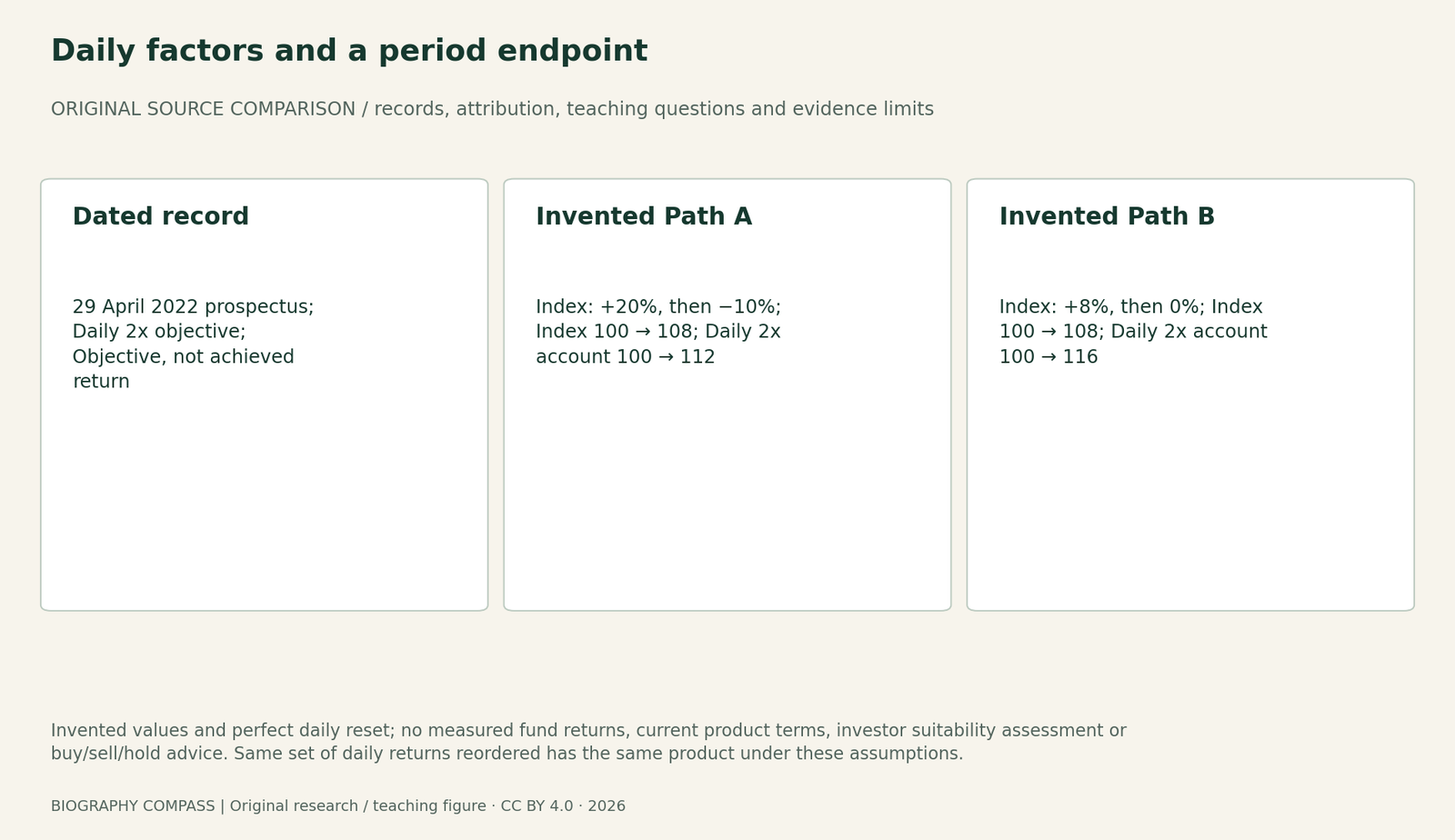
Start a fictional index and a fictional daily 2x account at 100. Path A has index returns of +20% then −10%. Path B has +8% then 0%. Assume the account achieves exactly twice each day’s index return, resets each day and has no fees, financing costs, taxes, distributions, trading frictions or tracking error.
Calculate each index’s ending level and each account’s ending value. Compare both account returns with twice the index’s total two-day return. Can the ending index level alone identify the account result? All paths are invented; they are neither actual Hang Seng observations nor fund performance.
Reference answer: multiply each day’s factor
Both index paths end at 108: 100 × 1.20 × 0.90 = 108 and 100 × 1.08 × 1 = 108. Their period return is 8%. Path A’s account ends at 112: 100 × 1.40 × 0.80. Path B’s account ends at 116: 100 × 1.16 × 1. Their returns are 12% and 16%, although the index has the same period return.
Twice 8% is 16%. It matches Path B here and differs from Path A by four percentage points. The interval-specific factors, rather than the ending index alone, determine this ideal model. Reversing the order of an otherwise identical set of daily returns would not change their product in this frictionless model; these two paths have different daily returns.
Use the calculation for interpretation, not a prediction
The worked example isolates compounding. It deliberately removes mechanisms that a real product document must address. The 2022 objective itself is not a guarantee, and this exercise does not estimate fees, futures effects or a holder’s realised price.
An answerable document-reading task is therefore: identify the reference index, multiplier, reset interval, expense treatment and version date before making a period comparison. The exercise offers no recommendation to buy, sell or hold a product and makes no forecast of future returns.
Continue the chronology
Related history guides
What a DRAM capacity label leaves unanswered
Compare how another record separates its stated quantity, method and evidential limit.
Read the timeline2000 research records · original evaluation exerciseDoes a trained response show language understanding?
Compare how another record separates its stated quantity, method and evidential limit.
Read the timelineBiography context
Explore Hong Kong and United States through connected lives
Connected biographies
People connected to these records
Late 20th–21st century
Park Hyeon-joo
Mirae Asset founder and financial-services entrepreneurPark Hyeon-joo helped establish Mirae Asset with colleagues from the securities industry, then developed a financial group with an international asset-management network.Read biographyQuick answers
Common questions
- Does daily 2x guarantee twice a multi-day return?
- No. The original two-path exercise shows why those are different arithmetic objects.
- Does this exercise model actual fund costs or returns?
- No. It explicitly removes costs and tracking differences to isolate compounding.
Primary and institutional sources
How this history was checked
Selected historical records are linked below. Fictional exercises are labelled, and source scope is kept separate from the strength of a conclusion. This article was reviewed on 29 October 2026.