
The short answer
Why was the complete cell lineage a different kind of reference from the later worm genome sequence?
Read the evidence
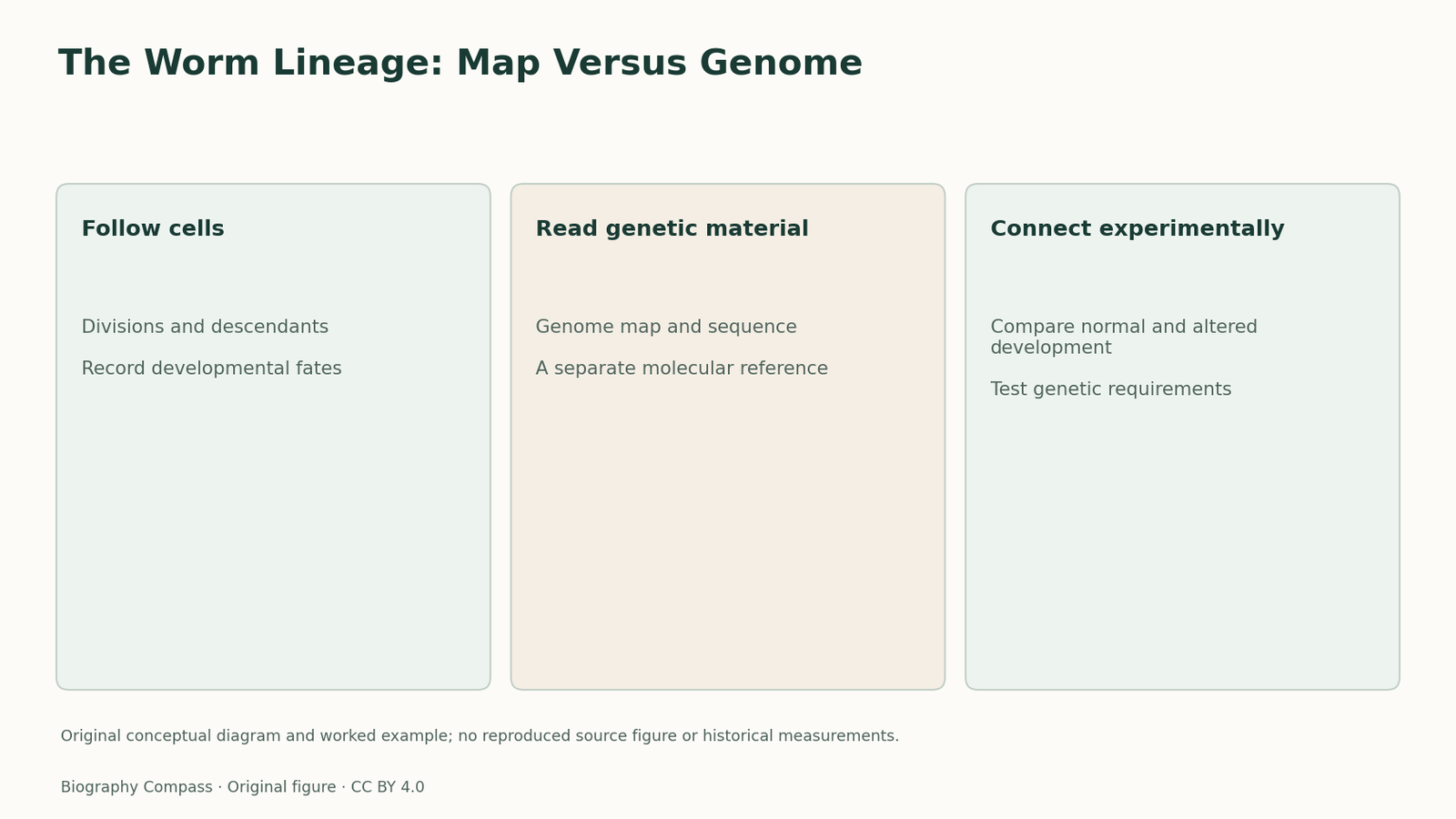
Two reference systems, different questions
Developmental ancestry and DNA sequence can be connected through experiments, but they are not interchangeable maps.
| Record or test | What it establishes | What remains different |
|---|---|---|
| Cell lineage | Records origins, divisions and fates of cells. | Does not itself identify every molecular mechanism. |
| Genome sequence | Records molecular order and supports gene analysis. | Does not directly replay a cell’s developmental history. |
| Mutant comparison | Connects a changed genetic condition with an altered phenotype. | Needs both a reference and appropriate mechanistic tests. |
A lineage is a history of cells
The 1983 embryonic-lineage paper traced C. elegans from a zygote to a newly hatched larva. Its reference record described divisions, descendants and cell fates, including programmed deaths. This is a map of development through time. Its value lies partly in allowing a researcher to ask whether a particular cell appears and follows its expected course. The record is therefore different from a still image showing the final locations of cells in an animal.
Sources for this section: [2]
A genome records a different kind of order
The 1998 consortium paper reported the nematode genome sequence and described features of its genes and chromosomes. It supplied a molecular reference rather than a replay of embryonic divisions. Sulston’s institutional biography connects the project with Bob Waterston’s group and earlier genome mapping. Sequencing made it possible to investigate genetic material on a large scale, but the sequence did not by itself label every cell’s complete developmental history or explain every step linking DNA to a cell fate.
The maps become powerful when connected
The Royal Society account explains how lineage research opened the way to genetic investigation of development and programmed cell death. A detailed cellular reference makes an altered phenotype recognisable; molecular information supports investigation of the genetic changes associated with it. These records are complementary because they describe different levels of the same organism. Neither should be treated as a decorative illustration of the other. Their connection enables experiments that would be harder to interpret using only a sequence or only a developmental tree.
An original reference-map exercise
Imagine two fictional files. File A lists DNA letters in order; File B records that one cell divides into two descendants and that one descendant later dies. Which file directly answers the question of cell ancestry? B does. Which helps locate a sequence change? A does. Now imagine that a mutant retains a cell that normally dies. The lineage supplies the reference phenotype, while genetic analysis can investigate a molecular requirement for that fate. The supported answer is to use both records without pretending that either contains the other in an immediately readable form. This exercise uses no historical cell counts or genomic coordinates. It explains why the 1983 and 1998 landmarks belong to one research history while remaining distinct scientific achievements.
Continue the chronology
Related history guides
Cell Death: Lineage Versus Mechanism
Compare the 1986 ced-3 and ced-4 findings with lineage observations and corpse removal, using a worked exercise on what an absent cell can mean.
Read the timeline1955Benzer’s rII Map: Recombination and Function
Read Benzer’s 1955 rII experiments through two questions: where mutations map and whether their genomes complement, with an original worked example.
Read the timelineBiography context
Explore United Kingdom through connected lives
Connected biographies
Researchers and related approaches
1942–2018
John Sulston
Biologist and genome researcherJohn Sulston moved from chemistry to tracing cell development and then to genome mapping, linking detailed observation with shared biological reference resources.Read biography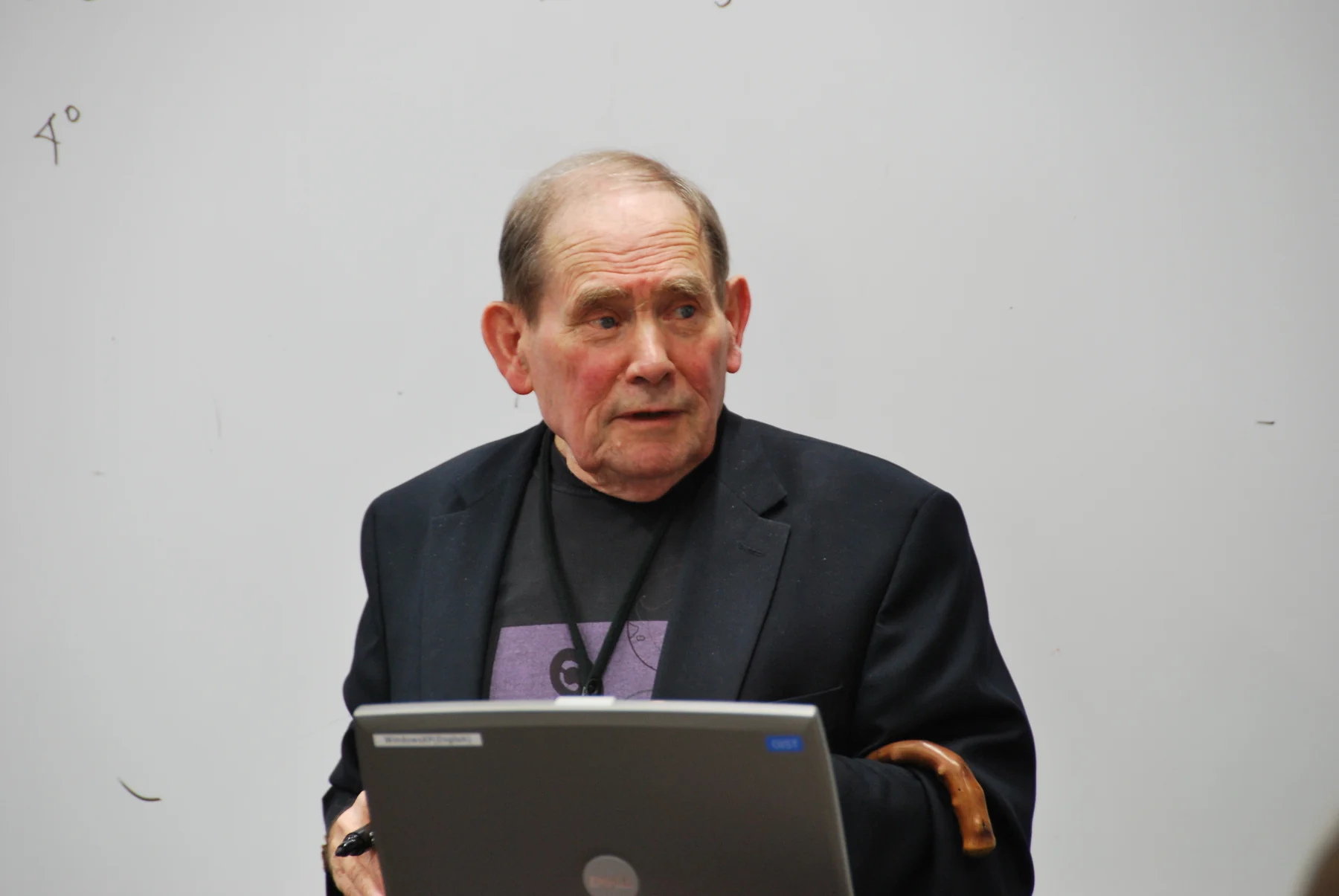
1927–2019
Sydney Brenner
Molecular biologistSydney Brenner helped establish messenger RNA’s role and made a small nematode a tractable model for studying genes, development and the nervous system.Read biographyQuick answers
Common questions
- Why were two major maps needed?
- They recorded different information: the developmental history of cells and the molecular organisation of genetic material.
- Does a complete sequence explain every cell fate automatically?
- No. Connecting DNA information with a developmental event requires further genetic, cellular and molecular experiments.
Primary and institutional sources
How this history was checked
The 1983 and 1998 primary abstracts describe different reference resources. Institutional accounts connect their development without merging their endpoints. This article was reviewed on 7 November 2026.
- Wellcome Sanger InstituteJohn Sulston: founding director biography
- Sulston, Schierenberg, White and Thomson / Developmental BiologyThe embryonic cell lineage of the nematode Caenorhabditis elegans
- C. elegans Sequencing Consortium / ScienceGenome sequence of the nematode C. elegans: a platform for investigating biology
- The Royal SocietySir John Sulston: fellowship biography
- Nobel Prize OutreachJohn Sulston — Facts
- Nobel Prize OutreachJohn Sulston — Biographical