
The short answer
How did survival of normally dying cells distinguish death-execution genes from a cell-lineage description?
Read the evidence
Four observations are not one process
Cell generation, death, survival and clearance occupy different positions in a developmental explanation.
| Record or test | What it establishes | What remains different |
|---|---|---|
| Lineage observation | Identifies a cell’s origin and usual fate. | Does not alone identify the death machinery. |
| Survival in a mutant | Tests a genetic requirement for the normal fate. | Needs cell identification rather than a corpse count alone. |
| Persistent or absent corpses | Reveals a visible outcome worth investigating. | May reflect death initiation, clearance or observation timing. |
A lineage tells a developmental history
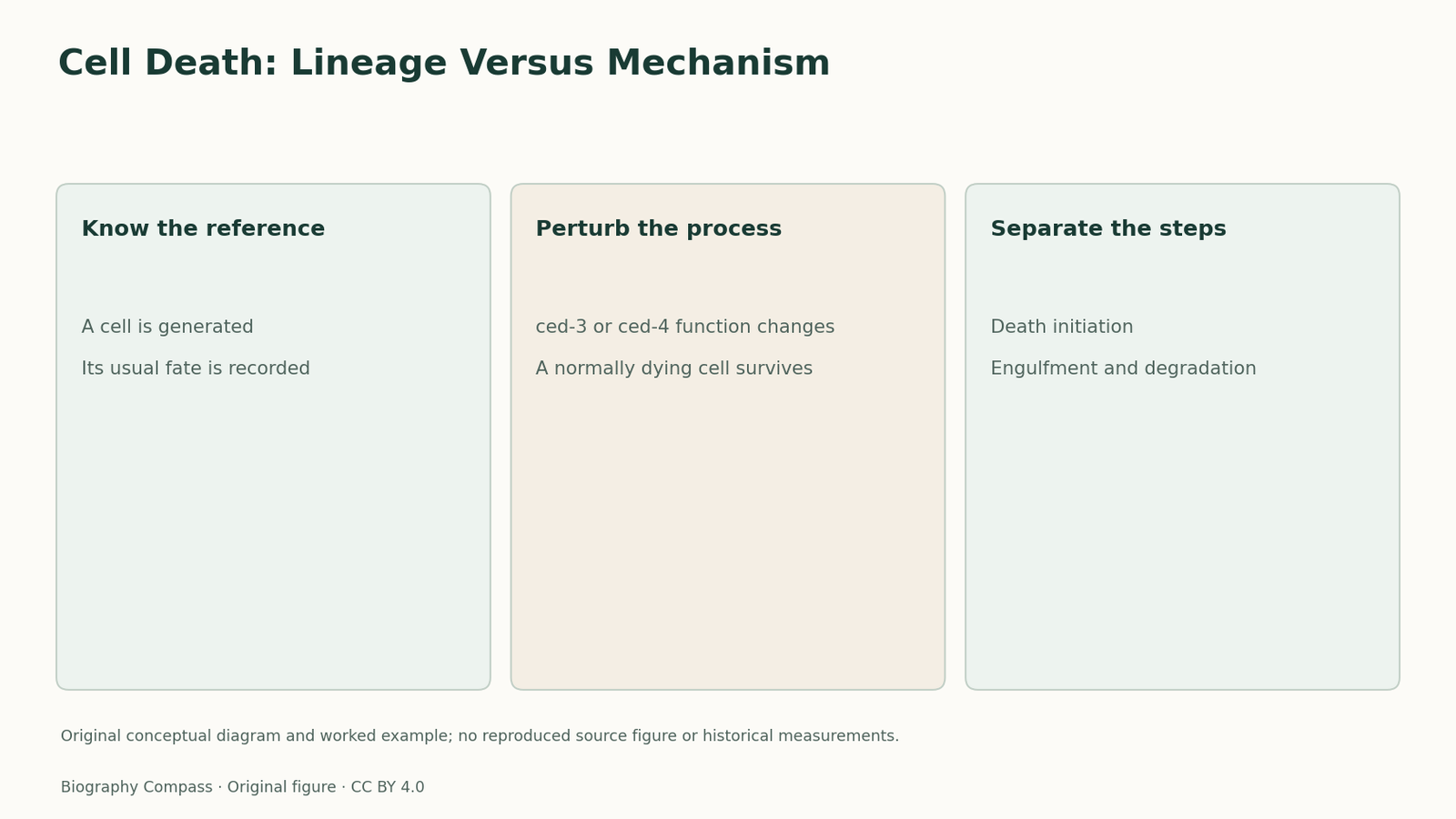
A cell-lineage map records how cells arise and what normally happens to them. That reference was essential to the C. elegans programme because researchers could identify cells expected to die at particular stages. It did not by itself establish the molecular machinery of death. Horvitz’s lecture describes the transition from observing the normal pattern to seeking mutations that changed it. The genetic question was whether particular functions were required for the death event to occur.
Sources for this section: [4]
The 1986 result changed the expected fate
Ellis and Horvitz reported that reduced or lost ced-3 or ced-4 function allowed normally dying cells to survive and differentiate. This was evidence that the death process required gene activity. It also showed why the identity of the surviving cell mattered: an extra cell in a mutant could be related to a known event in the normal lineage. The result was not merely that a microscope revealed fewer corpses. The developmental outcome had changed.
Sources for this section: [2]
Death and corpse removal are separate steps
The lecture distinguishes initiating death from engulfing a corpse and degrading its contents. This matters because a snapshot can be misleading: a missing corpse might reflect absent death or faster removal, while a persistent corpse might indicate a clearance defect. Horvitz’s 1999 review places the genetic findings within an active pathway. The mechanistic advance was to identify processes within that pathway rather than treating every change in visible dead cells as the same biological event. Normal-looking overall morphology also does not mean that every developmental process is unchanged.
An original three-record exercise
Imagine a fictional animal in which a particular cell is usually absent by the time of observation. Three explanations are proposed: the cell was never generated, it died after being generated, or it remains alive but was not recognised. What records would help? A lineage observation addresses its origin; tracking the cell over time addresses its fate; an identity marker helps distinguish survival from misidentification. Now imagine that a mutation restores a living, differentiated cell at the expected position. This supports a changed fate more strongly than an isolated reduction in corpse counts. The exercise uses no invented nematode measurements. Its answer explains why lineage, survival and clearance evidence must be connected before assigning a gene to a death mechanism.
Continue the chronology
Related history guides
The Worm Lineage: Map Versus Genome
Compare the 1983 C. elegans lineage map with the 1998 genome sequence, using a worked exercise on cell ancestry, DNA information and experiments.
Read the timeline1955Benzer’s rII Map: Recombination and Function
Read Benzer’s 1955 rII experiments through two questions: where mutations map and whether their genomes complement, with an original worked example.
Read the timelineBiography context
Explore United States through connected lives
Connected biographies
Researchers and related approaches
1947–
Robert Horvitz
Geneticist and developmental biologistRobert Horvitz used the nematode C. elegans to investigate how genes control development, cell survival and behaviour.Read biography
1927–2019
Sydney Brenner
Molecular biologistSydney Brenner helped establish messenger RNA’s role and made a small nematode a tractable model for studying genes, development and the nervous system.Read biographyQuick answers
Common questions
- Why is an absent corpse ambiguous?
- It may reflect no death, rapid clearance or the timing of observation; additional evidence must distinguish those possibilities.
- Does a grossly normal mutant prove cell death has no role?
- No. Overall appearance is a limited endpoint and should not be turned into a claim that all functions or conditions are unaffected.
Primary and institutional sources
How this history was checked
The 1986 abstract supports the survival result. Horvitz’s lecture explains the mutant-search logic and the distinction between death and corpse processing. This article was reviewed on 7 November 2026.
- MIT Department of BiologyH. Robert Horvitz: education and research
- Ellis and Horvitz / CellGenetic control of programmed cell death in the nematode C. elegans
- Horvitz / Cancer Research,1999Genetic control of programmed cell death in the nematode Caenorhabditis elegans
- Robert Horvitz / Nobel Prize OutreachWorms, Life and Death: Nobel Lecture
- Nobel Prize OutreachRobert Horvitz — Facts
- Nobel Prize OutreachRobert Horvitz — Biographical