
The short answer
How did the evidence change between the 1996 selective-inhibition experiments and the 2001 early clinical trial?
Read the evidence
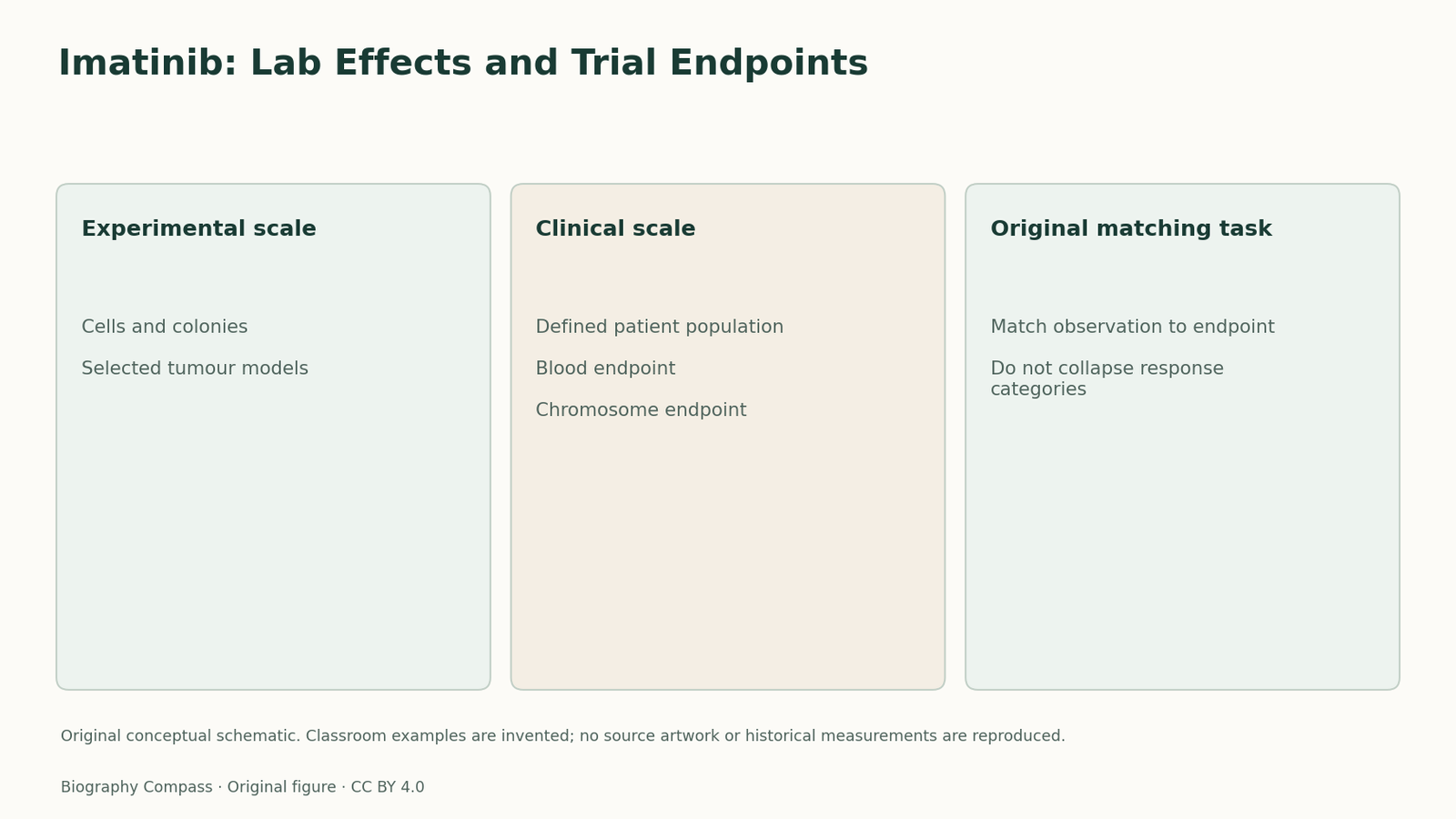
Imatinib: Lab Effects and Trial Endpoints
Compare biological setting and endpoint before comparing the strength of a result.
| Record or comparison | What the record supports | What remains separate |
|---|---|---|
| 1996 laboratory study | Selected Bcr-Abl experimental systems supported a rationale for clinical investigation | Cell effects do not establish every clinical outcome |
| 2001 phase 1 study | Specified patients had separately reported haematologic and cytogenetic responses | This was not a universal randomised survival comparison |
The laboratory established a rationale
Druker and colleagues’1996 paper examined a compound directed at Abl tyrosine kinase in systems containing Bcr-Abl. Its opening describes effects in experimental cells, tumour models and colony-forming comparisons using patient material. These are several kinds of preclinical evidence, but patient-derived cells remain different from administering a compound to a patient. Laboratory selectivity can support a biological rationale. By itself it cannot establish the full pattern of benefits, adverse effects or duration of response in people.
Sources for this section: [3]
The trial had a defined population
The 2001 report describes a phase 1 dose-escalating study in 83 patients with chronic-phase CML whose interferon treatment had failed. It reports tolerability and distinguishes complete haematologic responses from cytogenetic responses. Those endpoints concern different observations: improvement in blood-related findings is not identical to a reduction in the proportion of examined Philadelphia-positive cells; complete cytogenetic remission is a separate subset of response. The abstract does not make this selected early-phase study a randomised comparison against every alternative treatment, nor a statement about every phase of the disease.
Sources for this section: [4]
An original endpoint-matching activity
Create three invented cards: colonies formed from a cell sample decrease; blood findings meet a defined response category; and chromosome examination meets a different response category. Ask students to place each card under laboratory, haematologic or cytogenetic evidence. Then ask whether the first card proves the second and third must occur in every patient. It does not: the biological setting and observation differ. Next imagine a patient card satisfying the blood endpoint but not the chromosome endpoint. Ask whether the records necessarily contradict each other. They do not, because the endpoints are distinct. Finally, ask what would be needed to claim that one treatment gives longer survival than another. A study designed to compare that outcome would be needed; these cards provide no such comparison. The cards are invented and contain no historical patient measurements.
Follow the collaboration as well as the result
The Lasker account describes a development chain involving chemistry, laboratory biology and clinical investigation. That chain explains why evidence accumulates through different questions rather than one decisive experiment answering everything at once. The guide’s comparison preserves that sequence: a selected cellular effect supported further study, and an early clinical report added patient responses within stated limits. It does not turn a historical research milestone into a universal description of current care or infer unreported long-term outcomes from the short abstract reviewed here.
Continue the chronology
Related history guides
What did the recurring Philadelphia chromosome marker establish before its mechanism was understood?
Connect the later research with the earlier chromosome marker.
Read the timeline1996–2001How should an early abnormal-chromosome observation be compared with later identification of a translocation?
Read the collaborative observation underlying the Philadelphia chromosome history.
Read the timeline1996–2001Why was HER2 amplification as a prognostic association different from evidence that an antibody treatment worked?
Compare another programme that moved from a molecular association to a clinical question.
Read the timelineBiography context
Explore United States through connected lives
Connected biographies
Researchers and related questions

1955–
Brian Druker
Physician-scientist and leukaemia researcherBrian Druker connected clinical questions with a collaborative programme testing whether a molecular abnormality could guide the development of a cancer medicine.Read biography1928–2016
Peter Nowell
Pathologist and cancer researcherPeter Nowell combined pathology and chromosome research, collaborating on a recurring cancer-associated abnormality and later developing an evolutionary model of tumours.Read biography1927–1993
David Hungerford
Cytogeneticist and cancer researcherDavid Hungerford supplied chromosome-analysis expertise to a collaboration that identified a recurring abnormality in a particular form of leukaemia.Read biography1948–
Dennis Slamon
Oncologist and cancer researcherDennis Slamon connected molecular investigation with oncology through collaborative studies of HER2 and subsequent clinical research.Read biographyQuick answers
Common questions
- Were patient-derived colonies the same evidence as treated patients?
- No. Laboratory observations using patient material and clinical observations in patients are different research stages.
- Was the 2001 report a randomised comparison with all other therapies?
- No. It was a phase 1 dose-escalating study in a specified chronic-phase population after interferon failure.
Primary and institutional sources
How this history was checked
The original 1996 opening and a complete 2001 primary abstract are compared with dated institutional and award histories. No unreviewed long-term trial data are inferred. This article was reviewed on 7 November 2026.
- Oregon Health & Science UniversityMeet Dr. Brian Druker
- Lasker FoundationMolecularly targeted treatments for chronic myeloid leukemia
- Nature MedicineEffects of a selective inhibitor of the Abl tyrosine kinase on the growth of Bcr–Abl positive cells
- NEJM / OHSU research repositoryEfficacy and safety of a specific inhibitor of the BCR-ABL tyrosine kinase in chronic myeloid leukemia
- Tang Prize FoundationBrian J. Druker — Tang Prize laureate