
The short answer
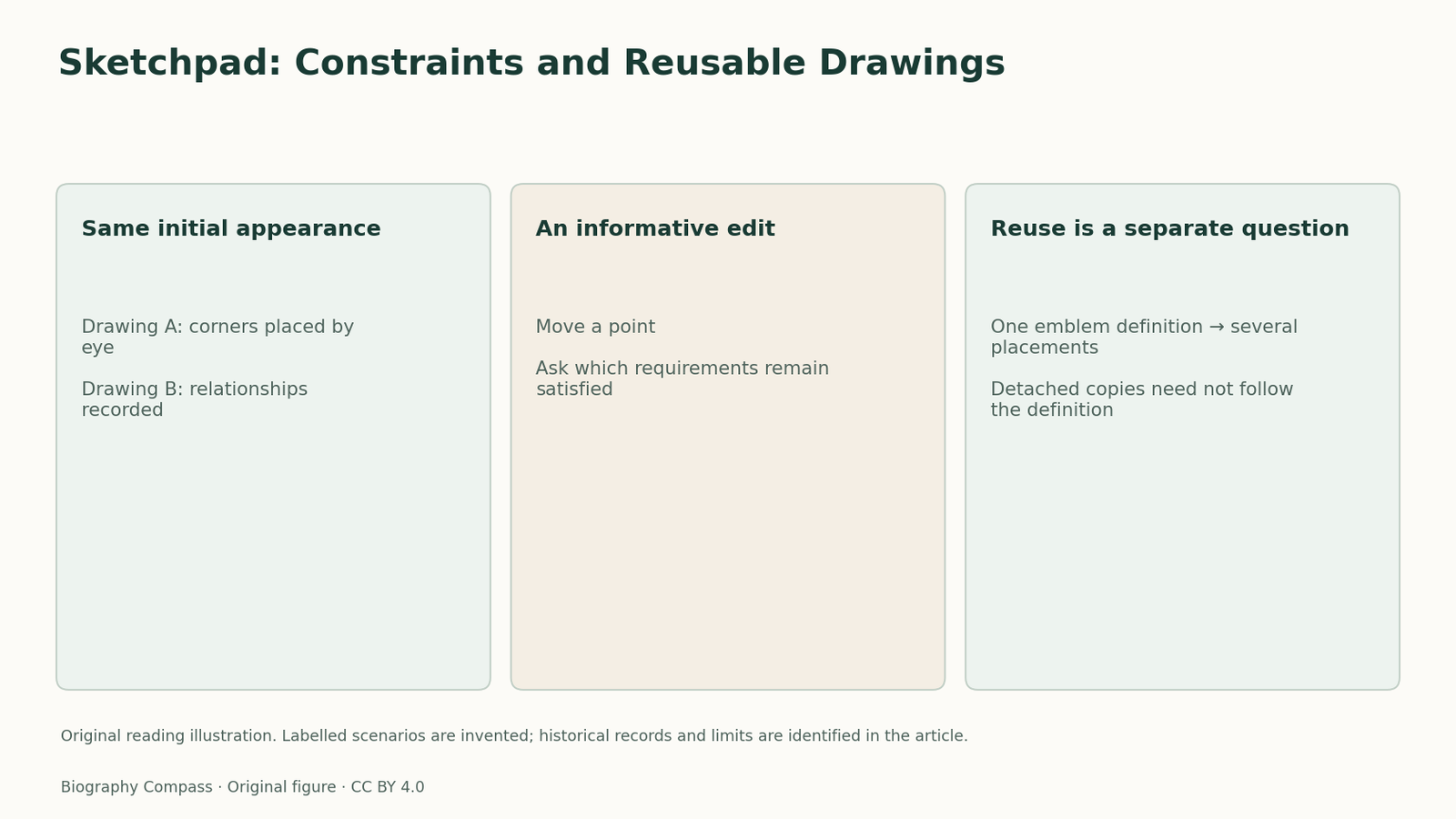
Two drawings can look identical until someone moves a point. Their different responses reveal whether a relationship was recorded or merely happened to be visible.
Compare the representations
What changes when a drawing stores a relationship instead of only a position?
Keep the stated evidence separate from the conclusions it permits.
| Distinction | Representation or action | What follows — and what does not |
|---|---|---|
| Placed by eye | A shape initially looks rectangular. | Its appearance alone records no requirement to stay rectangular. |
| Constrained | Selected relationships must remain satisfied. | Unspecified dimensions may still vary. |
| Instance | A placed figure retains a relationship to a reusable definition. | A visually identical detached copy need not behave the same way. |
Chronology
A timeline of the turning points
Selected historical record
The cited record supplies the historical starting point; the labelled examples below are original.
The thesis’s distinctive ingredients
Sutherland’s Sketchpad thesis describes light-pen interaction, geometric constraints and reusable subpictures. In its introductory explanation, constraints include relationships such as horizontal, perpendicular and point-on-line; subpictures allow a defined figure to be used repeatedly.
Sources for this section: [1]
An original drawing review
Invent two drawings of a rectangular sign. Both initially look square to the page. In Drawing A, the corners were placed by eye. In Drawing B, the horizontal and perpendicular relationships are recorded as requirements. Move the upper-right corner. Drawing A may become skewed without violating anything its representation says. Drawing B has relationships the system must attempt to preserve.
The useful test is not which screenshot looked neater before the move. It is which intended properties were represented and what happens when the user changes something. This example does not assert that every constraint system resolves every edit successfully. Conflicting requirements can make the desired edit impossible.
Underconstrained, constrained and contradictory
Suppose the sign is required to have horizontal top and bottom edges, but no width has been specified. Several widths may satisfy those rules. Calling the result wrong because it is not one particular width adds a requirement that was never entered. Now stipulate both “width is 100” and “width is 120” in the same units. No single width can satisfy both. The contradiction is in the requirements, not necessarily in the solver.
These invented cases help a reader ask what a historical demonstration actually showed: drawing, satisfying a set of relationships, or diagnosing a conflicting set. One successful example is not evidence for all three.
A reusable definition is not just a duplicate
Sketchpad also distinguishes reusable subpictures from independent marks. Its introductory example uses repeated figures and attachment relationships to build larger patterns.
For an original design review, imagine several signs using the same emblem definition. An instance may have its own position while retaining a relationship to that definition. A detached copy only happens to resemble the emblem now. Before changing the master, ask which placements should follow the change and which have deliberately become independent. This is a representation question, not a claim that the thesis implements every behaviour of a modern CAD package.
Sources for this section: [1]
Continue the chronology
Related history guides
Biography context
Explore United States through connected lives
Connected biographies
A working life behind the record

Quick answers
Common questions
- Does an unchanged screenshot prove that a drawing has constraints?
- No. The representation or a controlled edit must provide evidence. Appearance at one instant does not show how future edits are handled.
Primary and institutional sources
How this history was checked
The account identifies the selected portions actually consulted. Original scenarios and reference answers explain the distinction without reproducing the source’s diagrams or implying that historical software was run. This article was reviewed on 5 November 2026.