
The short answer
A portable screen can display a lesson without letting a learner investigate anything. The more demanding question is what the learner can change, predict and check.
Compare the representations
What would make a personal computer a learning medium rather than a delivery screen?
Keep the stated evidence separate from the conclusions it permits.
| Distinction | Representation or action | What follows — and what does not |
|---|---|---|
| Delivery | The learner watches a finished animation. | An explanation is presented, but the governing rule may remain hidden. |
| Investigation | The learner changes an inspectable rule and predicts its effect. | The activity creates evidence about a model the learner is using. |
| Evaluation | A new case and explanation are examined. | A successful display alone does not establish learning. |
Chronology
A timeline of the turning points
Selected historical record
The cited record supplies the historical starting point; the labelled examples below are original.
A speculative paper with an educational argument
Kay’s 1972 paper explicitly introduces speculation about portable personal information devices. Its opening questions technological cures for education and treats children as active constructors of models. The fictional scenarios illustrate an intention; they are not reports of a completed classroom trial.
Sources for this section: [1]
An original classroom activity
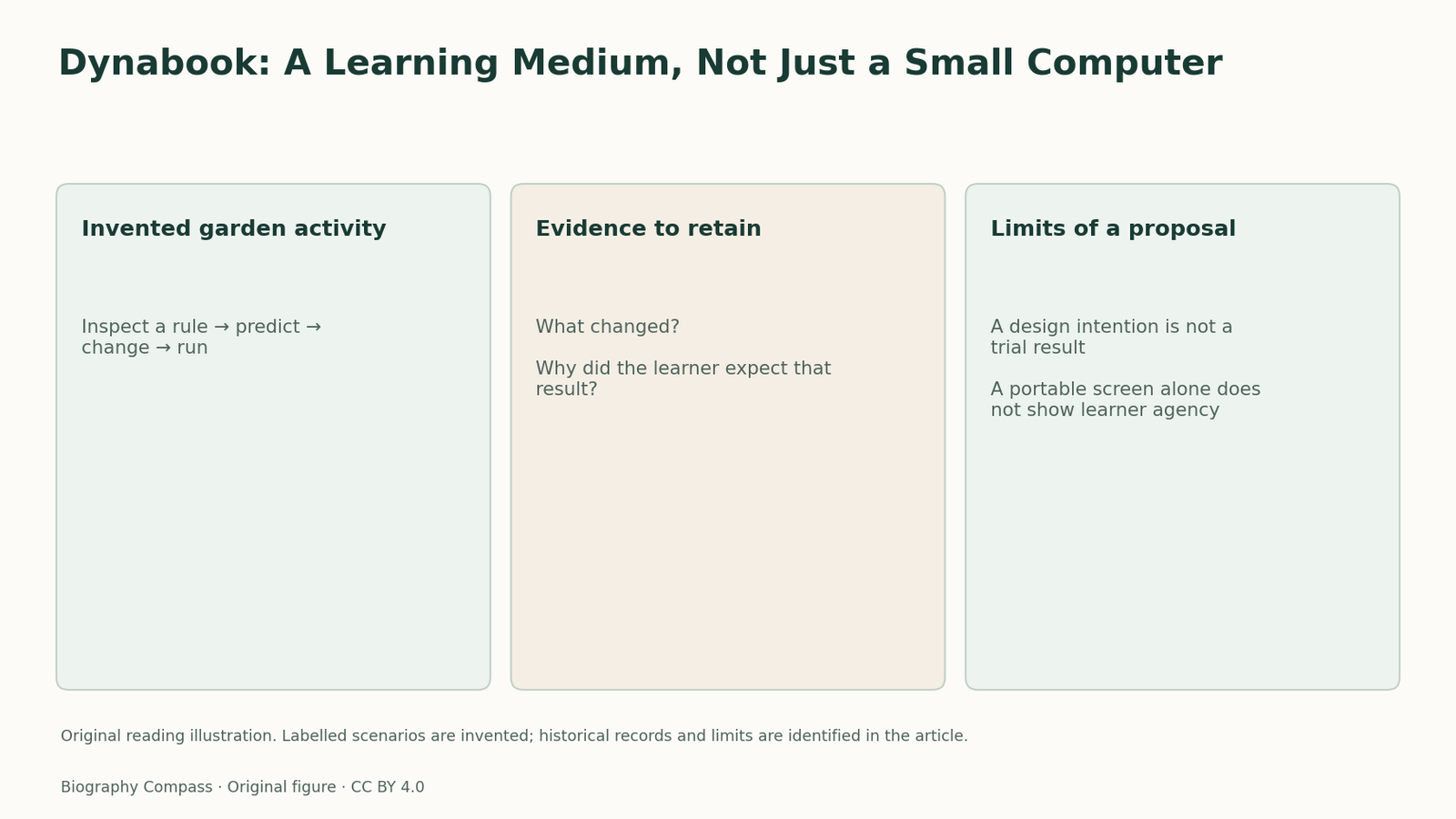
Ask learners to design a tiny animated garden. Each plant has a visible state and a rule that changes it when water or light is added. Provide a simple initial rule, then let learners alter it. Before each run they write down a prediction; afterward they compare what happened with what they expected. The garden, rules and lesson sequence are newly invented here.
A learner who only watches a prewritten animation receives an explanation. A learner who can inspect the rule, change it and test a prediction has a different kind of access. Neither activity is automatically good teaching, but they give an observer different evidence about what the learner understands.
What an evaluator should record
Record the learner’s initial explanation, the specific change made and the reason given for it. If the learner changes several rules randomly until the desired animation appears, success on screen may not show understanding. A brief explanation or a new case can reveal whether the learner can use the model beyond one successful run.
Also record what the system permits the learner to inspect. A hidden rule cannot be meaningfully revised. An interface may offer attractive controls while keeping the governing relationship inaccessible. For this activity, the important affordance is not the device’s resemblance to a notebook but the learner’s ability to work on an explanation.
A proposal is not evidence of an outcome
The selected opening of Kay’s paper does not claim that a technological medium alone guarantees educational improvement. It explicitly resists that simple cure narrative.
To turn the garden activity into an educational claim would require a stated learning objective, suitable observation and a comparison that addresses the question being asked. A compelling design rationale is not yet such a study. The proposal remains useful because it helps formulate a testable design question: what intellectual work can the learner do that would otherwise be difficult? That question applies to a classroom computer without depending on a prediction about any later commercial tablet.
Sources for this section: [1]
Continue the chronology
Related history guides
Biography context
Explore United States through connected lives
Connected biographies
A working life behind the record
Quick answers
Common questions
- Does this article reproduce a lesson tested by Kay in 1972?
- No. The garden activity is an original illustration of a design question. It is not a recovered experiment or evidence of measured learning gains.
Primary and institutional sources
How this history was checked
The account identifies the selected portions actually consulted. Original scenarios and reference answers explain the distinction without reproducing the source’s diagrams or implying that historical software was run. This article was reviewed on 5 November 2026.