
The short answer
Two rod-shaped isolates can look similar while behaving differently in a comparison. Shiga’s records show why those observations belong in separate columns.
Evidence at a glance
Why did agglutination add a different kind of evidence?
Read each observation alongside the particular inference it supports.
| Record or example | Observation | Interpretation |
|---|---|---|
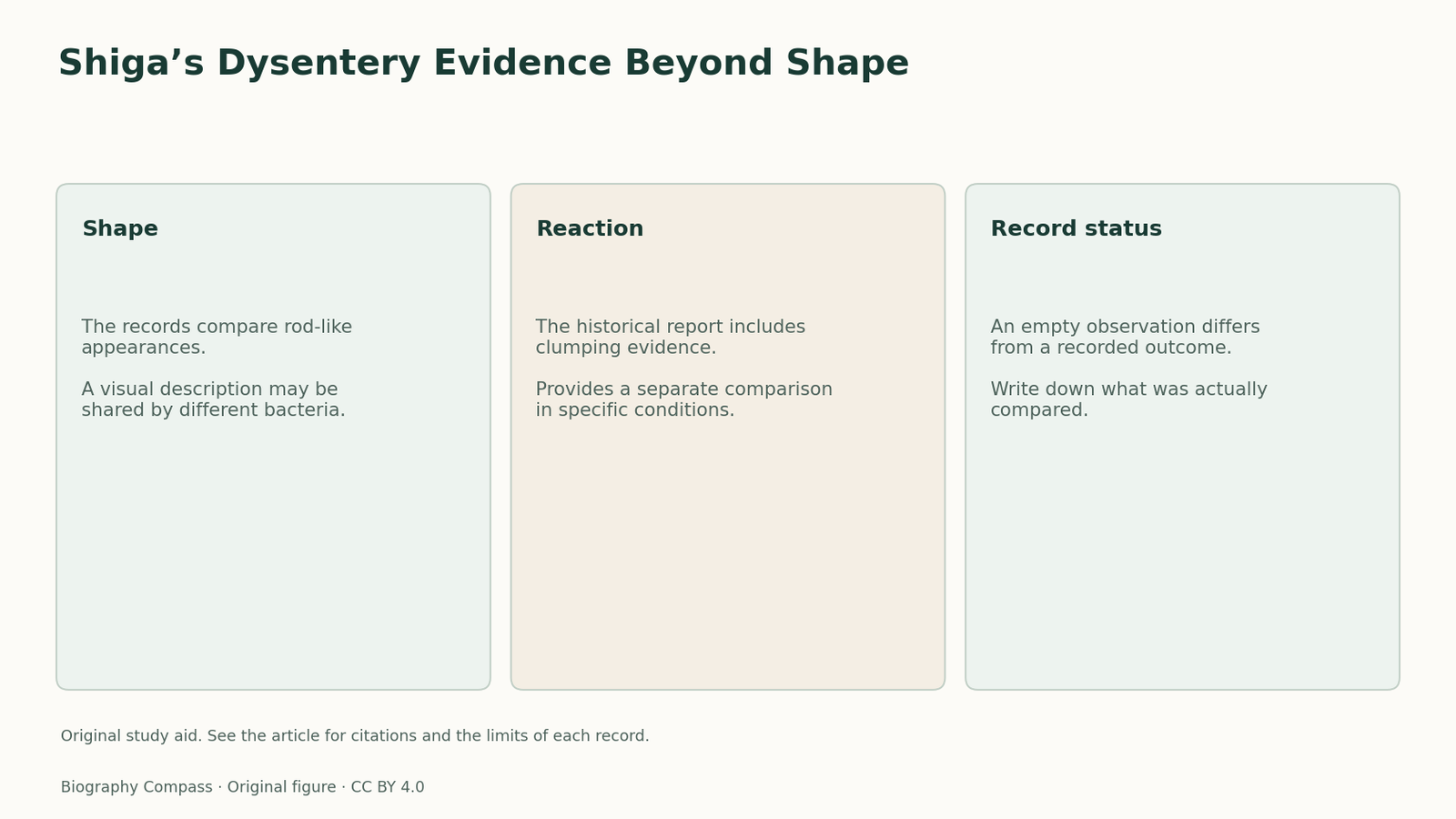
| Shape | The records compare rod-like appearances. | A visual description may be shared by different bacteria. |
| Reaction | The historical report includes clumping evidence. | Provides a separate comparison in specific conditions. |
| Record status | An empty observation differs from a recorded outcome. | Write down what was actually compared. |
Read the description and the reaction separately
The 1900 U.S. notice compares the appearance of Shiga’s bacillus with that of familiar bacteria. The later taxonomic paper, based on the 1897 report, describes a positive agglutination reaction against serum from recovering patients. Shape compares what the isolates look like. Agglutination compares a visible reaction when the isolate and selected serum are brought together under recorded conditions.
An original comparison of records
Imagine descriptions of two isolates, A and B. Both are short rods in a drawing. A is reported to clump in a comparison with a given serum; B is reported not to clump in the same comparison. A label based on the drawings alone misses this difference. The reaction result separates two descriptions under the modeled conditions, without proving how the organisms behave in every setting.
Ask what evidence is still missing
If an archive card mentions clumping for A but contains no observation for B, leave the B entry blank. A missing record and a recorded lack of reaction are different. Compare both isolates in the same recorded conditions before interpreting a difference. A second question is how the patients, isolates and recovery specimens were selected. The hypothetical cards train a reader to notice those limits without giving laboratory instructions.
Date each conclusion by the record it uses
The initial Japanese publication dates from 1897, while the subsequent reports and later accounts have their own dates. Sorting the shape observation, the reaction and the historical descriptions by record makes it possible to say which source supports each point. It also keeps the name used in a modern catalogue from being inserted unchanged into a nineteenth-century publication.
Continue the chronology
Related history guides
Biography context
Explore Japan through connected lives
Connected biographies
The researcher behind the records
1871–1957
Kiyoshi Shiga
BacteriologistShiga linked a distinctive isolate to epidemic dysentery in Japan.Read biographyQuick answers
Common questions
- Did a similar shape make two isolates equivalent?
- The reaction provided a separate observation that could distinguish isolates with similar appearances.
Primary and institutional sources
How this history was checked
The notes distinguish period evidence, later interpretation, and original exercises. This article was reviewed on 5 November 2026.