
The short answer
How does RNA splicing separate a transcript from the mature message?
Evidence comparison
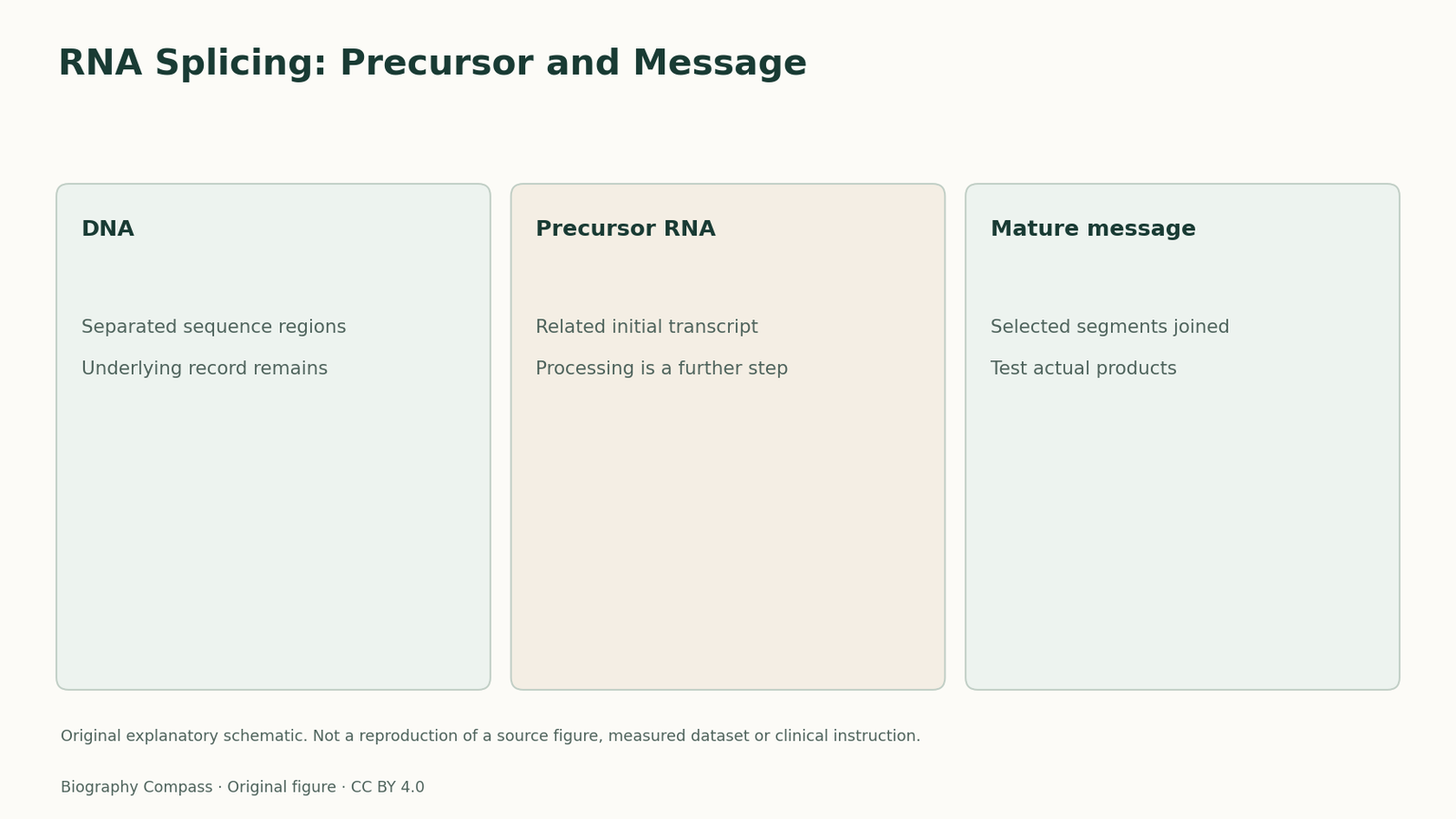
RNA Splicing: Precursor and Message
Compare the observations with the narrower conclusions they support.
| Record or observation | What it supports | What remains separate |
|---|---|---|
| DNA–RNA hybrid comparison | Relates mature-message segments to genomic positions | Does not imply routine deletion of the underlying DNA |
| Precursor-to-message processing model | Explains joining of RNA segments | Does not establish every possible alternative product |
A mature message can connect separated DNA regions
Berget, Moore and Sharp's 1977 adenovirus study compared messenger RNA with viral DNA through hybrids visualised in the electron microscope. Portions of the mature message corresponded to separated genomic regions. The paper proposed assembly through multiple splicing during maturation of a larger precursor RNA. The important observation concerns the relationship between two molecular records: the DNA arrangement and the sequence present in the mature RNA.
Deletion from RNA is not deletion from the chromosome
In the splicing model, processing changes the RNA product. It does not require the chromosome to discard the intervening DNA whenever a message is made. This distinction prevents a common misreading of a simple diagram with a segment removed. A line labelled DNA and a line labelled precursor RNA represent different molecules, even if related sequence blocks appear in both. The final message is another stage in that information pathway.
Sources for this section: [3]
Keep a copy of the original
Write the invented DNA arrangement A–x–B–y–C on one sheet. Copy it onto a second sheet labelled precursor RNA, then join A, B and C on a third labelled mature message. Ask which sheet should retain x and y. The answer is the DNA record; the model also leaves them in the initial transcript before processing. This is a conceptual exercise with fictional blocks, not a reconstruction of the adenovirus segments or a claim about the exact chemistry of the spliceosome.
Sources for this section: [3]
Do not infer every alternative message
The discovery of interrupted genes made processing an experimentally necessary question. It does not mean that every imaginable combination of blocks is produced in a cell. To establish an alternative RNA product, a reader needs evidence that the particular product exists, not merely a diagram that permits it.
Continue the chronology
Related history guides
Biography context
Explore United States through connected lives
Connected biographies
Researchers and related questions
1944–
Phillip A. Sharp
Molecular biologist and RNA-splicing researcherA 1977 paper by Susan Berget, Claire Moore and Sharp investigated adenovirus late messenger RNA.Read biography
1943–
Richard J. Roberts
Biochemist and molecular-biology researcherRoberts shared the 1993 medicine prize with Phillip Sharp for the discovery of split genes.Read biography
1947–
Thomas R. Cech
Biochemist and RNA-catalysis researcherCech's group found that an intervening RNA sequence could be removed and the remaining RNA joined without an added protein catalyst.Read biographyQuick answers
Common questions
- How does RNA splicing separate a transcript from the mature message?
- Relates mature-message segments to genomic positions. Does not imply routine deletion of the underlying DNA.
- Are the classroom examples historical measurements?
- No. Invented examples are labelled as classroom models; the source-based discussion identifies the historical evidence separately.
Primary and institutional sources
How this history was checked
Official biographical and award records are read alongside the researcher’s technical account. Source scope and hypothetical examples remain distinct. This article was reviewed on 7 November 2026.