
The short answer
How can the growing surface of a Type II supernova supply a physical ruler?
Read the evidence
What is measured and what is inferred
A distance needs physical size and apparent size for the same emitting region.
| Quantity | Evidence | Sensitivity |
|---|---|---|
| Physical radius | Velocity and elapsed time | Depends on explosion time and line interpretation |
| Angular radius | Received flux, colour and modelled surface brightness | Depends on extinction and dilution |
| Distance | Physical radius divided by angular radius | Changes when either inferred size changes |
Two sizes for the same photosphere
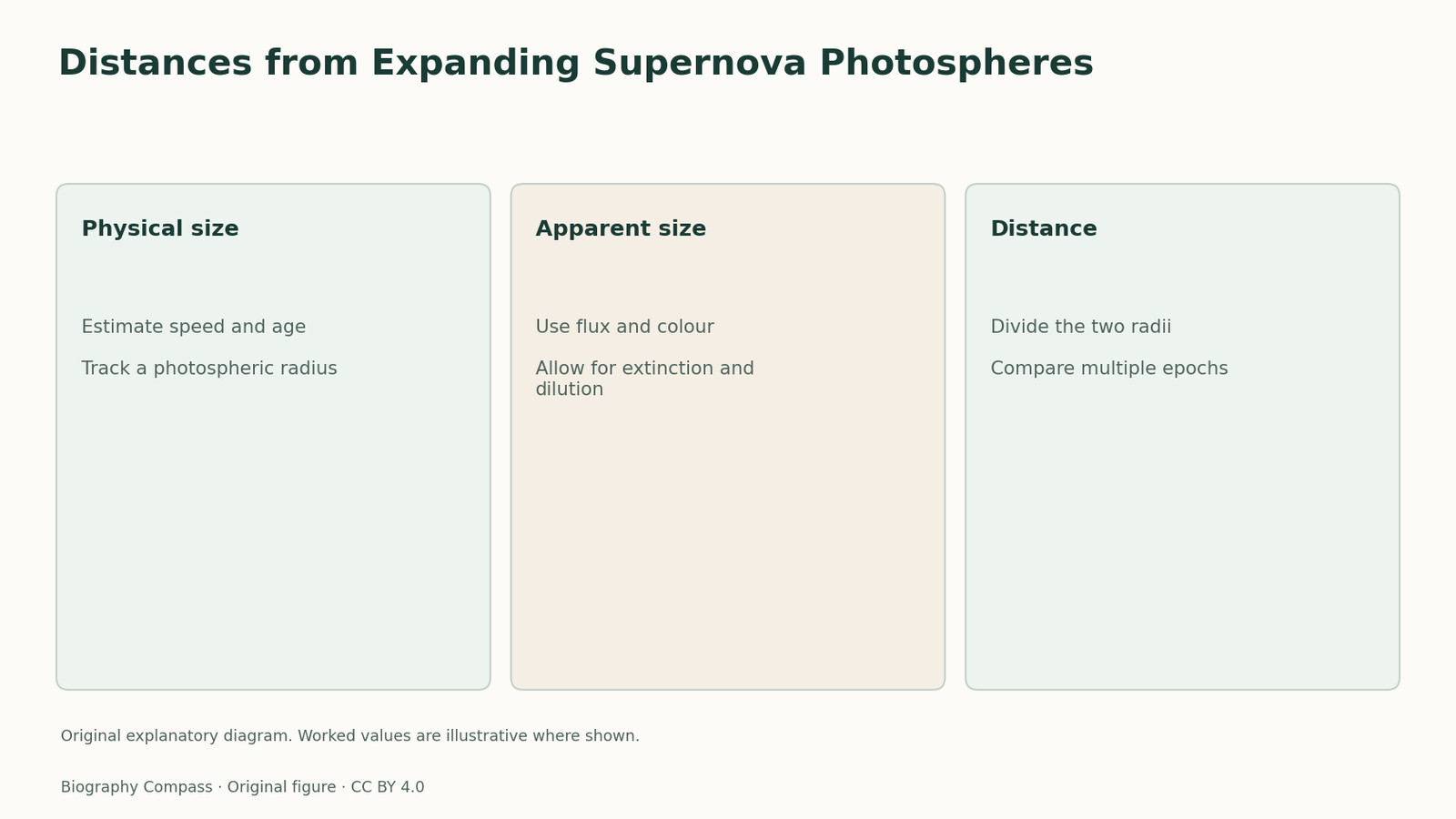
The photosphere of a supernova is the effective region from which much of the light escapes. The expanding photosphere method compares a modelled physical radius with an inferred angular radius. If the physical radius is R and the small angular radius is θ in radians, the distance is approximately R divided by θ. The photosphere is usually too small in apparent size to measure directly from a resolved image. Instead, brightness and colour constrain its angular size. Measurements of the spectrum help estimate the expansion speed associated with the effective emitting layer.
A clock as well as a speed
A velocity by itself does not supply a radius. In the simplest illustration the radius is approximately the speed multiplied by the time since explosion, with the progenitor’s initial radius neglected. The observation date is known, but the explosion date may fall between observations. The inferred radius changes if the estimated time changes. Multiple epochs can help separate the date and distance because each epoch supplies a new relation between the expanding radius and inferred angular size. This is also why it is useful to distinguish an estimate of photospheric velocity from a measurement of the boundary of all the ejecta.
An invented scale calculation
Consider an illustrative radius of two trillion metres and an angular radius of one billionth of a radian. The ratio is two sextillion metres. If the angular radius is revised upwards by a factor of two with the physical radius fixed, the inferred distance falls by a factor of two. If only the radius is doubled, the inferred distance doubles. The numbers are deliberately artificial. They let a reader see how errors in two separate inputs can change the result in opposite directions. Both radii have to refer to the same effective layer for the reasoning to be meaningful.
Sources for this section: [1]
Why flux dilution belongs in the calculation
The 1992 paper addresses how the measured flux differs from the flux expected for a simple thermal surface. If the source is fainter per unit apparent area than the idealisation assumes, a given measured flux can imply a larger angular size than the ideal model would suggest. Extinction by intervening material also changes the received flux. These are different effects, even though both bear on brightness. The study explored extinction, asymmetries and dilution while applying the method to ten Type II supernovae. The publication’s model dependence should stay attached to any claimed distance.
Separate this method from Type Ia comparisons
An expanding photosphere distance relies on the relationship between physical expansion and inferred apparent size. The later Type Ia work related a standardised luminosity to received brightness. Both estimate distance from light, and both depend on models and calibrated measurements, but their error budgets are not identical. If the shape of an expanding atmosphere is uncertain, the size inference can shift. If the intrinsic Type Ia luminosity is not appropriately standardised, the brightness comparison can shift. The 1992 collaboration is valuable because it exposes those distinct assumptions before the two methods are combined in a broad history of supernova cosmology.
Continue the chronology
Related history guides
Finding Supernovae in Batches
Follow the Supernova Cosmology Project’s search sequence from reference images to spectra, and work through a scheduling example for a short-lived target.
Read the timeline1998Dust and the 1998 Supernova Evidence
Explore how the High-z team estimated dust effects from colour and light curves, and why its 1998 paper still treated extinction as a systematic uncertainty.
Read the timeline1990s–2001The Hubble Key Project’s Distance Ladder
Trace how the Hubble Key Project calibrated Cepheids, checked five secondary indicators and combined measurements of the expansion rate in 2001.
Read the timelineBiography context
Explore United States through connected lives
Connected biographies
Researchers and collaborators
1967–
Brian Schmidt
Astronomer and research leaderTrace Brian Schmidt from Arizona and Harvard to Mount Stromlo, covering his Type II distance method and leadership of the High-z supernova team.Read biography1969–
Adam Riess
Observational cosmologistFollow Adam Riess from MIT and Harvard to the High-z Supernova Search Team, including his work on supernova colours, distance and cosmic expansion.Read biography1959–
Saul Perlmutter
Experimental cosmologistExplore Saul Perlmutter’s career, the role of Carl Pennypacker and the Berkeley collaboration, and how scheduled searches made distant supernovae useful.Read biographyQuick answers
Common questions
- Why is the explosion date important?
- It helps turn an expansion speed into an estimated physical size.
- What does flux dilution affect?
- It changes the angular size inferred from measured flux and colour.
Primary and institutional sources
How this history was checked
Dates, legal milestones and historical claims are checked against the official and institutional records below. This article was reviewed on 13 November 2026.