
The short answer
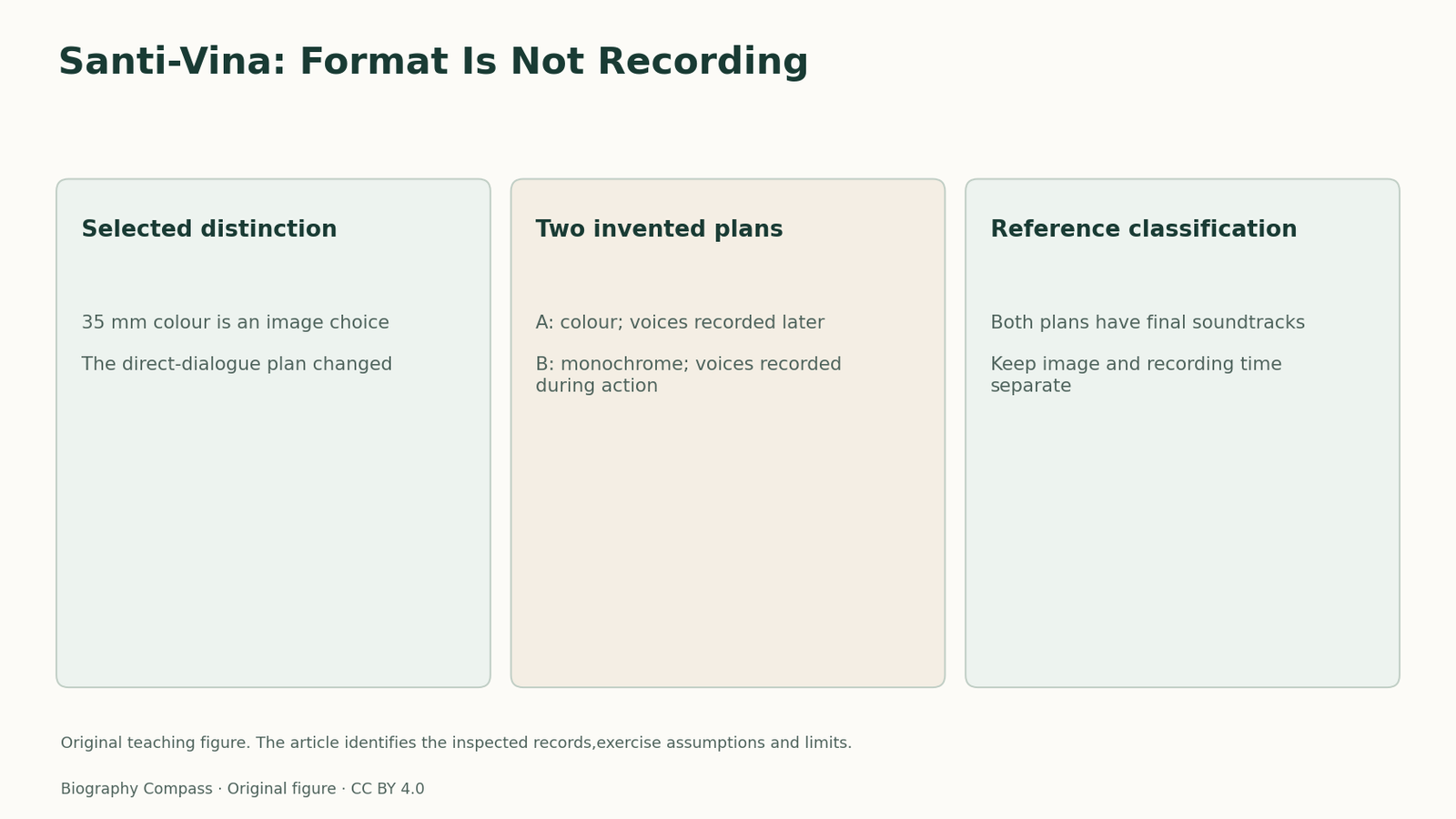
A film’s gauge and colour describe some production choices, but they do not specify every sound decision. This distinction matters when a concise festival description is compared with a practitioner’s technical account.
Decisions and their practical consequences
Compare the working choices
The left column identifies the consulted account; the right proposes a new task.
| Decision | Selected account | Original proposal |
|---|---|---|
| Image | 35 mm colour | Identify image treatment separately. |
| Dialogue | Direct plan changed to dubbing | Do not infer recording time from a soundtrack. |
Chronology
A timeline of the turning points
Original production
Santi-Vina.
Renewed presentation
Cannes Classics.
An ambition and a changed method
Sanchai Chotirosseranee reports that Santi-Vina was planned for 35 mm colour and directly recorded sound. Technical limitations defeated the latter plan, so dialogue was dubbed. Processing also depended on a laboratory in Japan.
Cannes describes the film’s 35 mm colour and quality sound. That broad description does not say dialogue was recorded during the photographed performance. The two accounts therefore address different levels of the production, rather than necessarily contradicting each other.
Image and sound are separate decisions
The preservation account later distinguishes camera negatives, sound negatives and release prints used as references. Their separate survival helped a transnational restoration. The existence of a sound negative does not reverse the account of dubbing.
A process sheet should give separate entries for image capture, voice capture, timing and the joining of those materials. A single adjective such as “sound” cannot carry all four. Nor does a format label establish a budget, technical quality or the location of every stage.
Sources for this section: [1]
Original production worksheet
Consider two invented plans. A uses colour images and voices recorded later; B uses monochrome images and voices recorded during the performance. Both have a final soundtrack. Classify each under image treatment, voice-recording time and final presentation. Then repair this claim: “Because A has a soundtrack, its voices must have been recorded on the set.” No equipment capability is assumed beyond these stipulated inputs.
Sources for this section: [1]
Reference answer
A is colour with later voice recording; B is monochrome with contemporaneous voice recording. Both can be described as having a soundtrack under the scenario. The repaired claim should simply state that A combines colour images with later-recorded voices. Whether they align convincingly is another question and cannot be answered from the plan alone.
For a real film, investigate the account of production and the particular version being described. A festival’s concise format line can be accurate without explaining all technical stages. This worksheet establishes a distinction between categories; it is not a reconstruction of a studio, a film viewing or a practical recording manual.
Sources for this section: [1]
Continue the chronology
Related history guides
Biography context
Explore Thailand and United Kingdom through connected lives
Connected biographies
Follow the working life
Quick answers
Common questions
- Does a soundtrack prove on-set voice recording?
- No. The voices could be recorded later.
Primary and institutional sources
How this history was checked
The archivist explains a changed production plan; the festival article gives a concise format and presentation description. This article was reviewed on 31 October 2026.