
The short answer
A multilingual rehearsal can distribute expertise without distributing the scene into unrelated pieces. Merican’s account offers a practical example: responsibility for the whole drama can coexist with reliance on other people’s linguistic knowledge.
Decisions and their practical consequences
Compare the working choices
The left column identifies the consulted account; the right proposes a new task.
| Decision | Selected account | Original proposal |
|---|---|---|
| Language | Actor-supported expertise | Name the question needing a fluent reader. |
| Direction | Story and dramatic nuance | Write the intended relationship change. |
Chronology
A timeline of the turning points
English staging
Thunderstorm.
Another language setting
Hokkien and Cantonese.
A concrete rehearsal problem
Merican had acted in Thunderstorm before directing its English version in 2017. For the 2019 Hokkien-and-Cantonese production, she stressed story and nuance while depending on actors’ language knowledge. She described understanding more Hokkien than she could confidently speak.
Her later account with Hasham presents teaching and nurturing practitioners as continuing theatre work. Expertise can be developed within the company rather than presumed to reside entirely in the director.
Three questions for a rehearsal note
Pronunciation asks how an utterance is formed. Intention asks what the speaker is trying to do. Relationship asks why the same words might work differently when addressed to a parent, employer or stranger. Agreement on the first question does not settle the other two.
A useful rehearsal note identifies the uncertainty and the person best placed to test it. “Make this more natural” is less useful than asking whether an address sounds respectful, whether the speaker is concealing resentment, and whether the listener recognises that concealment. Those questions invite different kinds of expertise without turning language into a decorative surface.
Sources for this section: [1]
Original two-reading task
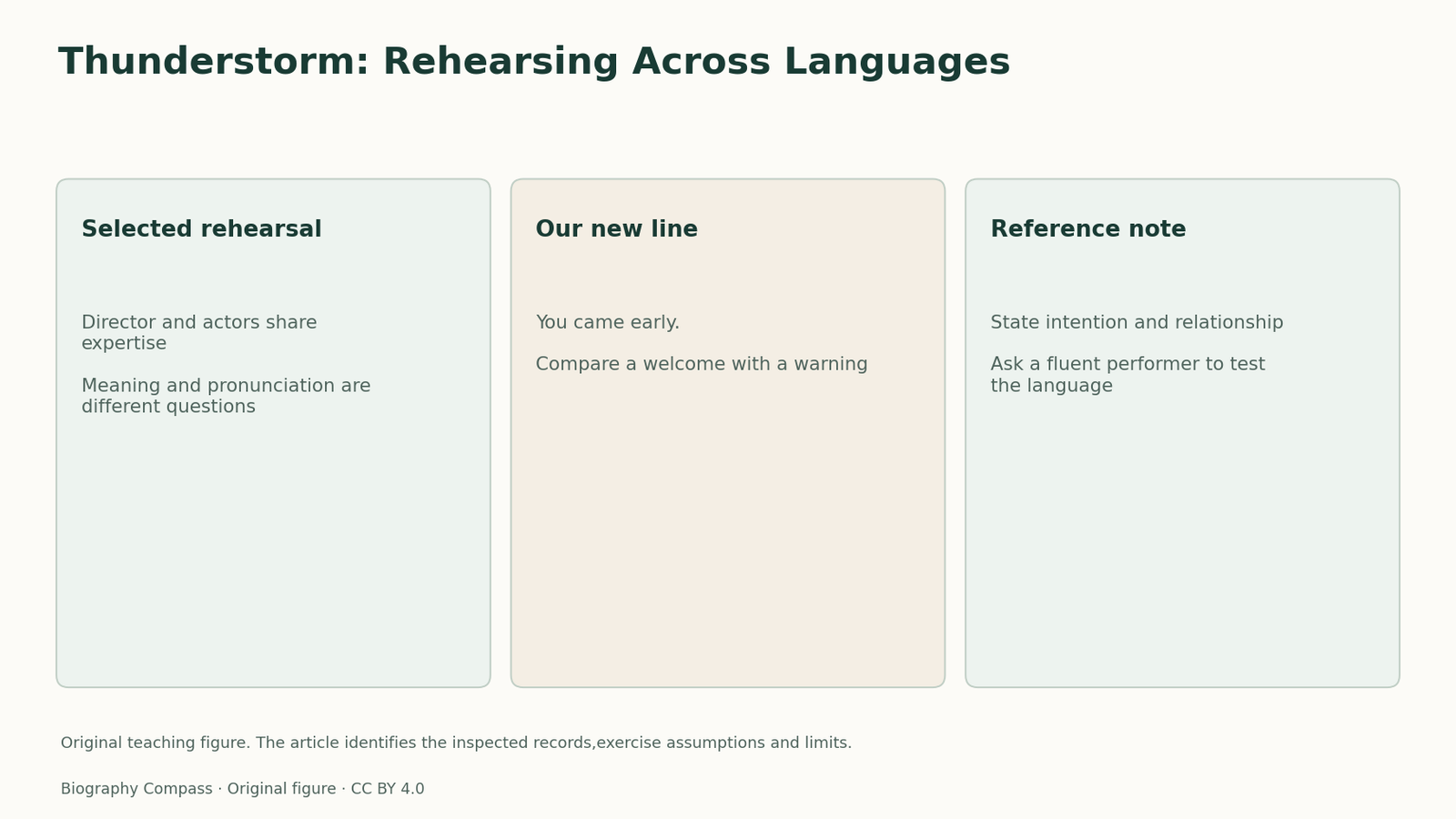
Use our invented English line, “You came early.” In reading A, a host welcomes a friend who can help prepare a room. In reading B, a worker warns a visitor who has arrived before a difficult meeting. Do not translate the line or borrow dialogue from the play. Write one note about intention, one about relationship and one question you would ask a fluent performer before adapting it into another language.
Sources for this section: [1]
Reference answer and test
For A, the intention may be to enlist help through warmth; the relationship permits an informal invitation. For B, the intention may be to delay entry without alarming the visitor; a professional relationship limits how direct the warning can be. A fluent performer should test forms of address, idiom and whether the proposed tone is plausible, not merely pronounce the existing words.
The director can compare both readings by asking a listener what changed and why. If the listener only reports “louder” or “faster,” the note may not yet communicate the intended relationship. This is a new rehearsal experiment, with no claim that either reading occurred in the historical production.
Sources for this section: [1]
Continue the chronology
Related history guides
Biography context
Explore Kuala Lumpur, Malaysia through connected lives
Connected biographies
Follow the working life
Quick answers
Common questions
- Must I supply a translation?
- No. The exercise asks which decisions need linguistic advice.
Primary and institutional sources
How this history was checked
The 2019 interview identifies the linguistic problem; the later company conversation supplies a contrasting account of mentoring. This article was reviewed on 31 October 2026.