
The short answer
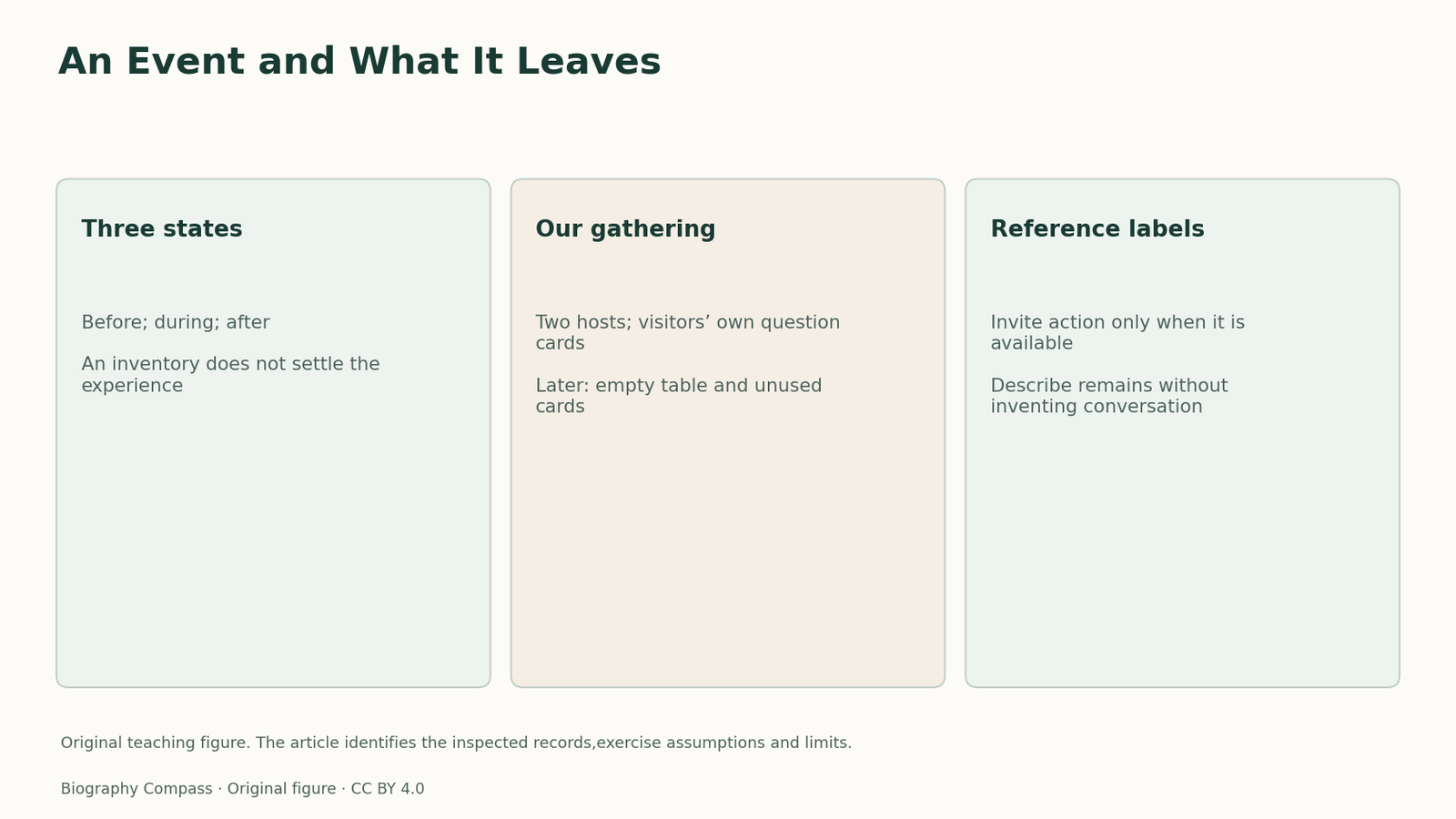
A room may hold the tools of an activity before, during or after it happens. Those states create different encounters, even when the inventory stays similar. The selected accounts make that temporal difference concrete.
Decisions and their practical consequences
Compare the working choices
The left column identifies the consulted account; the right proposes a new task.
| Decision | Selected account | Original proposal |
|---|---|---|
| Encounter | Visitors help and later see traces | Write time-specific labels. |
| Recreation | Different staff and institution | Specify new practical responsibilities. |
Chronology
A timeline of the turning points
Activity and traces
An early cooking project.
Museum realisation
A later presentation of Free.
Use, remains and another realisation
Tiravanija described visitors helping with food in 1990 and objects left behind as evidence of activity. He wanted later visitors to imagine what had happened, rather than treating the display as an unchanged substitute for the event.
MoMA’s 2012 account says its recreation of the 1992 Free installation used the museum restaurant’s staff and a daily serving period. The work involved both a spatial arrangement and practical labour under different institutional conditions.
Ask what a visitor is being invited to do
An inventory answers “what is here?” An invitation answers “what can I do now?” A remnant display may ask a third question: “what happened before I arrived?” Clear interpretation should identify which state a visitor encounters instead of promising participation whenever an object associated with an activity is present.
Participation also has conditions. An organiser can ask who knows the invitation, who can enter, whether the timing excludes some people and whether the expected action is clear. These are original planning questions, not findings that a named historical exhibition achieved equality or failed a particular visitor.
Sources for this section: [1]
Original gathering and remnant task
Plan an invented table where two hosts invite visitors to exchange blank cards carrying their own questions. Later, the room will display unused cards and an empty table. Write two different labels: an invitation while hosts are present and an account after the gathering. Do not copy a real artwork’s instructions, recipe or layout. State one thing the later display cannot establish about the conversation.
Sources for this section: [1]
Reference answer
The live label can identify what visitors may do, the hosts’ role and the current time window. The later label should describe the earlier gathering and identify the objects as remains or unused materials. It should not say that conversation is currently happening if nobody is hosting it. An empty table cannot establish how welcoming participants found the event or what every person said.
A later presentation could be planned as a new realisation, but that requires a new invitation, people and responsibilities. Calling it the same experience would conceal the change. The exercise therefore distinguishes continuity of a project from identity of every encounter, without deciding the copyright or authenticity of a real installation.
Sources for this section: [1]
Continue the chronology
Related history guides
Biography context
Explore New York City, United States through connected lives
Connected biographies
Follow the working life
Quick answers
Common questions
- Does the inventory establish the experience?
- No. It does not record every person’s encounter.
Primary and institutional sources
How this history was checked
The artist’s retrospective account and MoMA’s practical recreation description distinguish several forms of encounter. This article was reviewed on 31 October 2026.