
The short answer
A coral section records anatomy. A list of fossils from a bed can help compare that bed with another, provided the identifications can be checked.
Evidence at a glance
How does a coral description become evidence for correlation?
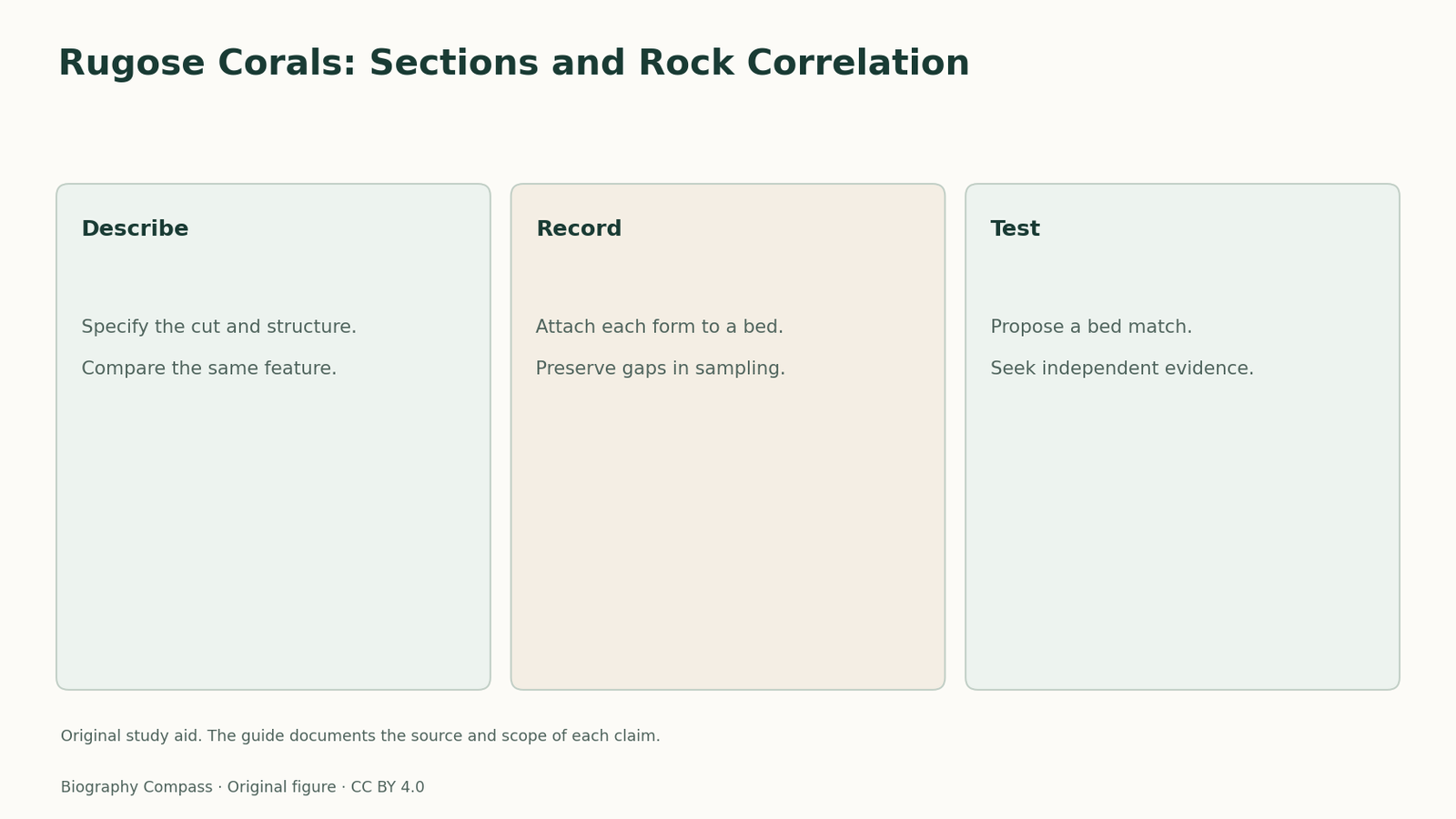
Match each piece of evidence to a specific inference.
| Evidence | What it supplies | How to read it |
|---|---|---|
| Section | A view reveals specific internal structures. | Check position and terminology. |
| Occurrence | A fossil is recorded from a particular bed. | Keep the locality and position attached. |
| Correlation | Shared forms suggest a possible match. | Use additional evidence to test it. |
Chronology
A timeline of the turning points
Terminology
Hill publishes a study of rugose coral terminology.
Regional synthesis
The Australian Palaeozoic paper applies coral evidence to rock sequences.
Begin with a repeatable anatomical description
The Academy memoir traces Hill’s attention to rugose coral terminology to difficulties in comparing descriptions made by different workers. Internal structures can be viewed in a cut through the skeleton, but the orientation and position of the cut matter. A useful description identifies the feature and the view from which it was observed. Two illustrations can look different because they show different parts of one structure.
Move from a feature to a fossil assemblage
Hill’s Australian synthesis concerned a different scale of evidence. After specimens had been identified, records of several localities could be compared for similarities and differences in their coral assemblages. The 1943 paper records that application of coral study. A description tied to an individual section is one input to the comparison. A record of the fossil’s position in a succession is another.
Work through two invented sections
At classroom site A, write that a lower bed contains forms R and S and an upper bed contains T. At site B, place S in a lower bed and T with U in an upper bed. The two occurrences of T give a reason to compare the upper beds. Before asserting equivalence, ask how confidently T was identified, whether one site was sampled less thoroughly, and whether the fossil could have lived across a longer interval.
State what would strengthen the comparison
A second fossil group or an independently dated horizon could help test the proposed match. An unfamiliar structure in one illustration can also prompt a check of how that specimen was cut. The exercise puts the proposed bed match and the quality of the identifications into separate lines. It explains the logic of correlation without assigning a date to any actual locality in Hill’s publications.
Continue the chronology
Related history guides
Biography context
Explore Australia through connected lives
Connected biographies
The researcher behind the records
1907–1997
Dorothy Hill
Geologist and palaeontologistHill studied the skeletons of extinct corals and used their distributions to compare rock sequences.Read biographyQuick answers
Common questions
- Does one shared coral prove two beds are the same age?
- A shared form can support comparison, but its range, identification and other evidence affect the strength of the correlation.
Primary and institutional sources
How this history was checked
Publication dates and specimen records describe different events. Invented exercises are labelled. This article was reviewed on 5 November 2026.