In this biography
Quick facts
- Born
- 1907
- Died
- 1997
- Birthplace
- Brisbane, Queensland, Australia
- Country
- Australia
- Nationality
- Not independently established
- Known for
- Fossil coral classification and Australian stratigraphy
Why this life matters
Her career joined precise descriptive language to geological comparisons across regions.
Timeline
Key moments
Terminology paper
Hill examines terms for describing rugose corals.
Return to Queensland
Hill resumes research in Brisbane.
Palaeozoic synthesis
The paper compares Australian evidence from rugose corals.
Queensland field material and Cambridge methods
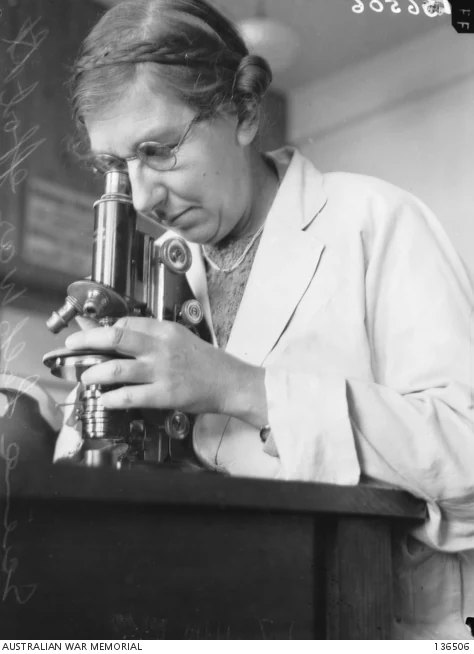
Hill studied science at the University of Queensland and pursued research in Cambridge. The coral material behind her doctoral work included fossils from the Burnett River Valley of southeast Queensland. At Cambridge, she had access to other collections and a community of specialists. That made it possible to compare structures encountered in different regions without assuming that each author had described them in precisely the same way.
Sources for this section: [1]
Giving structures comparable names
One of Hill’s projects examined how workers described the internal structures of rugose corals, an extinct group. A shared vocabulary mattered because a section through a fossil shows a particular view rather than the whole skeleton. A description needed to make the observed feature and the way it was seen clear to another reader. Her 1935 terminology work and the later paper on Silurian corals show that description was an active research problem.
Comparing faunas across Australia
Hill returned to Brisbane in 1937 and organized descriptions of coral faunas from different Australian localities. Geologists could use these distributions to investigate which rock intervals might be comparable. The 1943 synthesis applied the results to a reinterpretation of the Australian Palaeozoic record. It drew its value from the descriptions and locality evidence behind it rather than from any one unusually complete coral.
Building a community for continued work
Her career also included teaching and support for research at the University of Queensland. The work of describing and comparing specimens required stable collections and readers trained to examine their evidence. The Academy’s memoir describes her role in international fossil coral research. The combination of descriptions, institutions and collaboration helps explain why her influence extended well beyond individual species names.
Quick answers
Frequently asked questions about Dorothy Hill
- What kind of fossils did Dorothy Hill study?
- She specialized in fossil corals, including rugose corals whose internal skeletal structures can be examined in section.
Keep exploring
Lives connected to this story
- Isabel Cookson
Compare another Australian palaeontologist who made small structures useful for geological interpretation.
- Birbal Sahni
Compare how fossil plant anatomy and living forms could inform a different kind of palaeontological comparison.
Sources and further reading
Explore the evidence
These references support the biography and offer further reading. Official records, first-person accounts and independent reporting provide different perspectives; image records document attribution and licensing.
- 1. Australian Academy of Science biographical memoirDorothy Hill 1907–1997
The memoir distinguishes Hill’s terminology, local descriptions and regional synthesis.
- 2. Royal Society archiveHenry Woods’s report on Hill’s rugose coral paper
- 3. Dorothy Hill, Proceedings of the Royal Society of Queensland, 1943A Re-Interpretation of the Australian Palaeozoic Record
- 4. Australian MuseumProfessor Dorothy Hill