
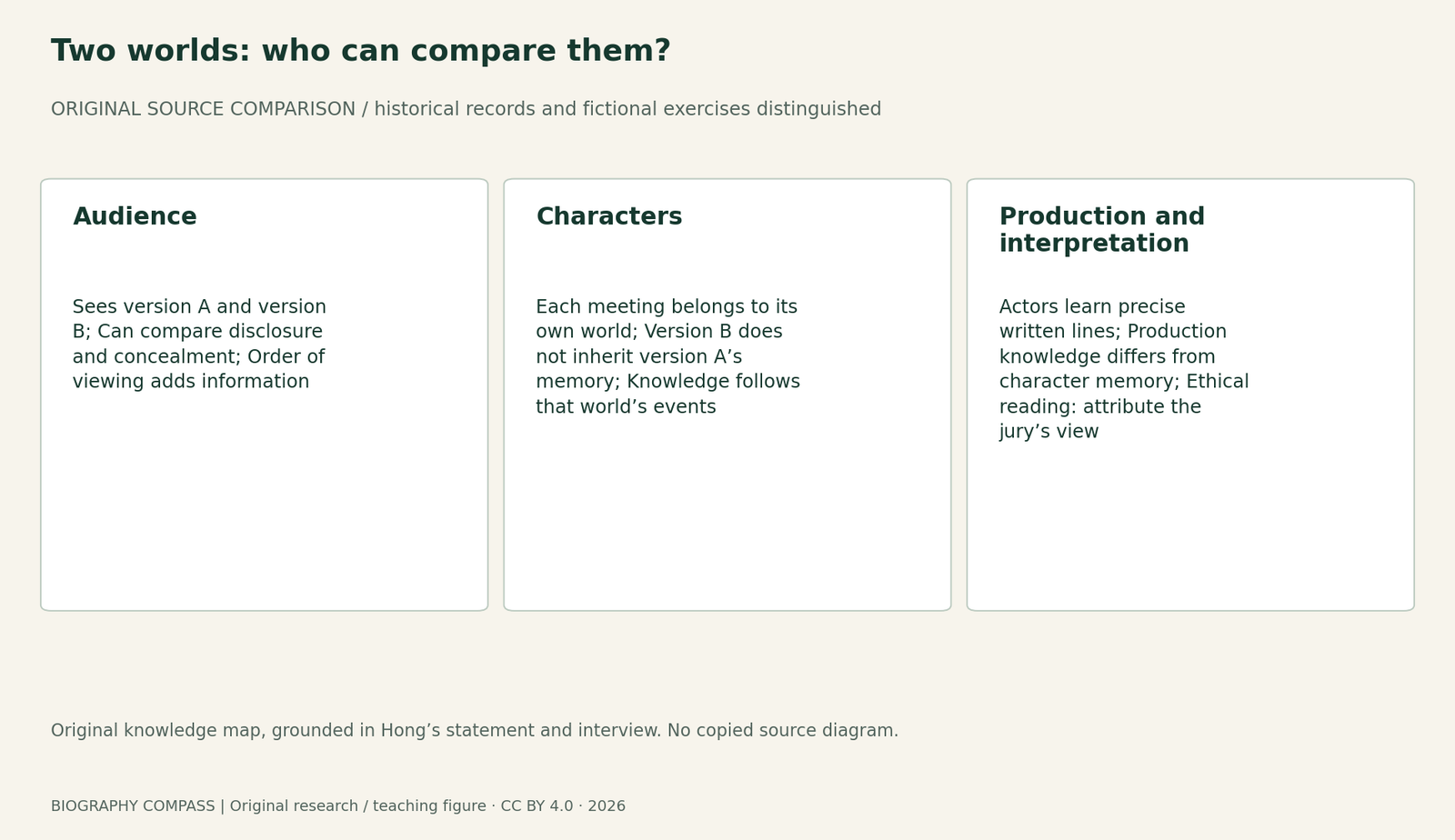
The short answer
A repeated encounter can tempt a viewer to call the second version a correction of the first. Hong Sang-soo’s own statement offers a different starting point: two independent and equally legitimate worlds. Separating the viewer’s accumulated knowledge from each character’s knowledge changes how the comparison works.
Original source comparison
Construction, synopsis and reception offer distinct evidence
Read the role and purpose of each record before combining its claims.
| Record | What it establishes | How to use it |
|---|---|---|
| Director statement and interview | Independent worlds; audiences have seen what second-world characters have not. | Build a knowledge map without inventing memory transfer. |
| NYFF programme | A repeated meeting with changed emotional dynamics. | Identify the situation the programme introduces. |
| Ecumenical Jury record | An explicitly ethical account supporting a commendation. | Attribute the interpretation to that jury rather than making it the only authorial message. |
Chronology
A timeline of the turning points
Locarno recognition
The film received the Golden Leopard and a separate Ecumenical Jury commendation.
New York programme
NYFF introduced the repeated encounter and changed dynamics.
US distributor press kit
The release materials preserved Hong’s statement and a selected interview.
Start with the director’s explicit structural claim
The distributor’s press kit includes Hong’s statement that the film presents two different worlds. He rejects the idea that one is inherently more legitimate, more important or nearer in time than the other. That statement gives a firm boundary for analysis: a second presentation does not by itself establish a character’s memory of the first. The viewer can compare both worlds, while the film’s people need not be understood as travelling between them. This is a more specific proposition than the general observation that the film repeats an encounter.
Sources for this section: [1]
The programme explains the encounter, while the interview explains knowledge
The New York Film Festival programme introduces a director’s meeting with a painter and a restart with changed emotional dynamics. Hong’s press-kit interview makes a further distinction: the people in the second version do not know each other, whereas viewers have already encountered them through the first. A programme synopsis and a participant’s explanation thus supply complementary information. The synopsis identifies the repeated situation; the interview identifies a difference between the information held by the audience and that available within each situation.
Do not transfer the actor’s preparation into the character’s memory
The press-kit conversation discusses the production process as well as the finished structure. Hong describes working from actors and locations, writing material during production and having performers learn precise lines. Actors participate in making the film and therefore operate with practical knowledge outside a character’s fictional situation. The interviewers also discuss the relationship between the two versions during shooting. Such production discussion should not be turned into evidence that a character remembers another world. Performer preparation, fictional knowledge and audience comparison are different levels of the work.
Sources for this section: [1]
A jury’s ethical reading is a further interpretive layer
The Ecumenical Jury’s record gives Right Now, Wrong Then a commendation and explains its decision through honesty, integrity and the encounters between people. That is a named jury’s interpretation. It can be compared with Hong’s refusal, in the press-kit interview, to reduce the structure to one clear moral message. A reader can find ethical questions productive without converting the jury’s wording into the director’s sole intention. The comparison preserves two useful voices: an explanation of construction and an account of why a particular jury valued the result.
Exercise: build a knowledge map for two independent meetings
Invent two versions of a meeting between a visiting botanist and a café owner. In version A, the botanist conceals having visited the town before. In version B, a separately situated botanist volunteers an earlier visit. Treat the versions as independent worlds. Make three rows: audience, botanist and café owner. For each row, state what can be known from that version and what is available only by comparing both. Finally decide whether the owner in B can know about the concealment in A, and give a reason.
Worked answer: comparison belongs first to the audience
After seeing both versions, the audience can compare concealment in A with disclosure in B. The botanist in A knows about that world’s earlier visit and decision to conceal it; the owner in A has only the information disclosed or observed there. In B, the owner can know about the earlier visit because it has been mentioned, but cannot thereby know that another version concealed it. Nothing in the invented premise transfers that information across worlds. The exercise permits a viewer to prefer one encounter while keeping a preference separate from a claim about remembered events.
Sources for this section: [1]
Turn the map into a precise critical question
A productive discussion can now ask how a viewer’s extra information changes attention to a gesture or disclosure. It need not ask which version cancels the other. Hong’s account of precise dialogue and responsive daily writing also supplies a production question: how were small differences made performable? The Locarno record adds a final distinction, separating the festival’s Golden Leopard from the Ecumenical Jury’s commendation. Structure, method and reception can all inform the discussion while keeping the original film, interview and award record in their appropriate roles.
Continue the chronology
Related history guides
How can pansori be a film’s script when a screenwriter is credited?
Compare Chunhyang’s Busan programme, Cannes credits and archive account to distinguish a performance’s narrative function from credited screenwriting work.
Read the timeline1934–2020What can Yi Sang’s newspaper page tell us before interpretation?
Compare the original 1934 Ogamdo newspaper page with a later cultural-centre account, then separate visible form, publication history and attributed interpretation.
Read the timelineBiography context
Explore South Korea through connected lives
Hong Sang-soo biography
Read the broader life and career behind this focused question.
Explore the biographiesRelated learning guideHow can pansori be a film’s script when a screenwriter is credited?
Compare Chunhyang’s Busan programme, Cannes credits and archive account to distinguish a performance’s narrative function from credited screenwriting work.
Explore the biographiesRelated learning guideWhat can Yi Sang’s newspaper page tell us before interpretation?
Compare the original 1934 Ogamdo newspaper page with a later cultural-centre account, then separate visible form, publication history and attributed interpretation.
Explore the biographiesConnected biographies
People connected with this question
1960—
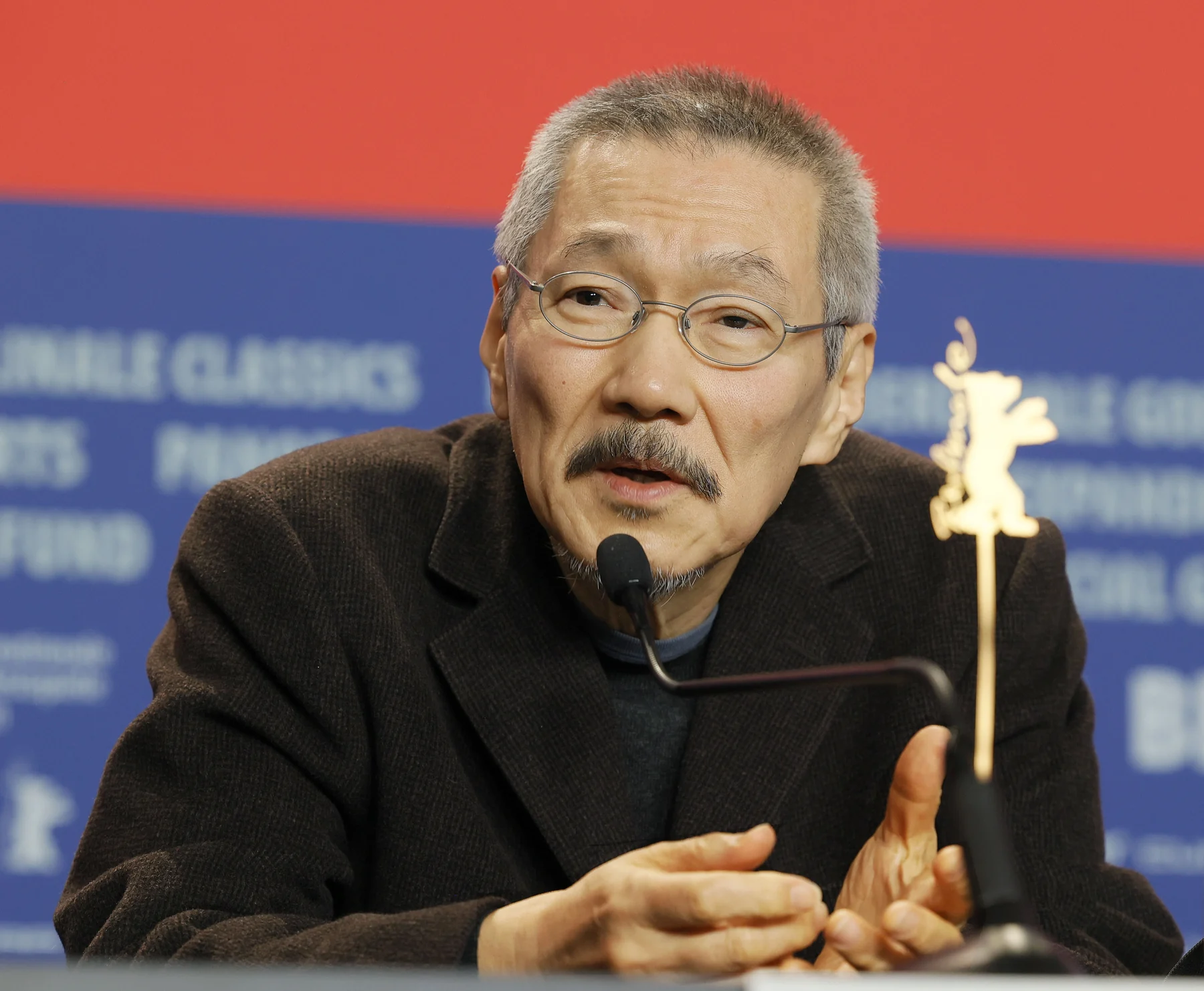
Hong Sang-soo
Film director and screenwriterHong Sang-soo is a South Korean filmmaker whose films often return to meetings, conversation and changes of perspective. After studying in Korea and the United States, he made his feature debut in 1996 and developed a distinctive practice of writing closely around actors and locations.Read biographyQuick answers
Common questions
- Does repetition prove that a character has learned from the first version?
- No. Hong describes independent worlds; audience comparison does not establish a character’s cross-world memory.
- Can a viewer still make an ethical comparison?
- Yes. The distinction asks the viewer to identify whose interpretation it is and what information supports it.
Primary and institutional sources
How this history was checked
Compare the original records and the named interpretations, keeping production credits, archival observations and later explanations distinct. This article was reviewed on 27 October 2026.