
The short answer
A programme writer calls pansori the script of Im Kwon-taek’s Chunhyang. The credits name a screenwriter. These statements can coexist because they answer different questions: one describes the film’s organising form, while the other identifies a production role. Reading the records together makes the relationship more precise.
Original source comparison
Narrative function and production credit answer different questions
Read the role and purpose of each record before combining its claims.
| Record | What it establishes | How to use it |
|---|---|---|
| Busan programme note | Pansori is described as script, narration and music. | Attribute the formulation to Han Sang-jun and explain its formal meaning. |
| Cannes credits | Kim Myoung-gon is credited for screenplay. | Retain the named production role alongside the performance source. |
| Archive account | Sung verses, dialogue and dramatic scenes are related. | Describe the interaction of channels rather than assigning all work to one role. |
Chronology
A timeline of the turning points
Busan programme
Han Sang-jun described pansori’s narrative and musical functions; credits named a screenwriter.
Cannes competition
Chunhyang appeared in the official competition.
A different film’s prize
Im shared the directing award for Chihwaseon.
Archive presentation
KOFA’s programme explained the relationship between sung verses and filmed scenes.
Begin with the wording and its speaker
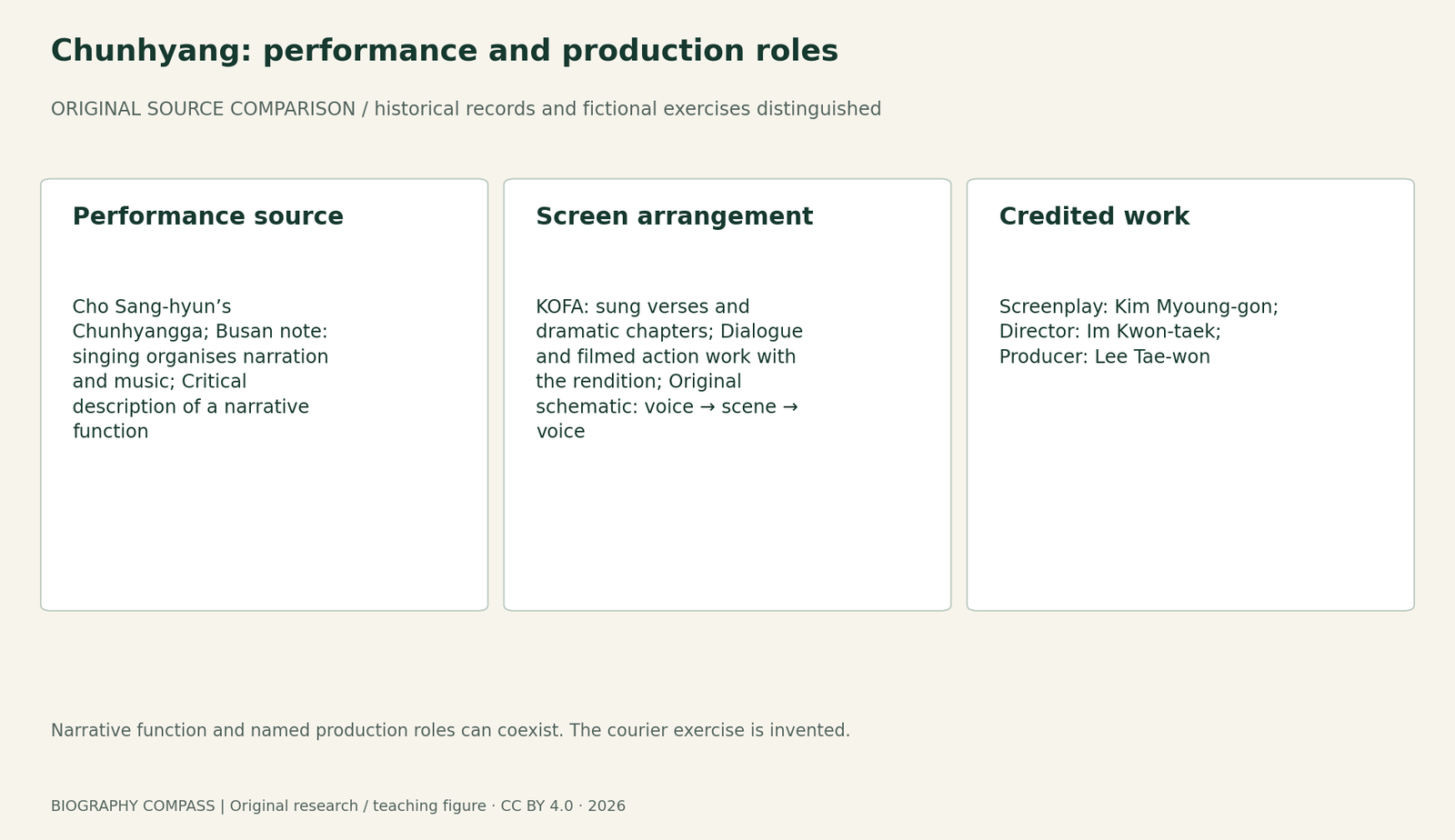
The 2000 Busan programme note by Han Sang-jun reports that Im was deeply moved by Cho Sang-hyun’s performance of Chunhyangga. It describes the singing as the film’s script, narration and background music. This is a critic’s compact account of how a performance works within the film. It is not presented as a complete production-credit list or a statement that no screenwriter participated. The attribution matters: Han is explaining a relationship between an existing performance and a new screen work, using “script” to describe a narrative function.
Sources for this section: [1]
Read the actual credits beside that description
The same Busan entry separately names Kim Myung-kon for screenplay and Lee Tae-won as producer. Cannes’s official 2000 entry credits Myoung-Gon Kim as screenwriter and Kwon-Taek Im as director. The spellings differ between the English records, but the role distinction is clear. Production credits identify responsibility within the filmmaking process; a critical account can then explain the formal importance of the singing. Neither source requires us to erase the credited writer in order to recognise pansori’s organising force.
Ask what a performance can organise
The Korean Film Archive’s later programme account describes Cho Sang-hyun’s sung rendition, dramatic chapters aligned with its verses and spoken dialogue woven into the film. This supplies a more concrete account of the relationship Han described. Singing can establish the movement of a narrative while filmed scenes provide bodies, settings and actions. Dialogue and images can extend a performance without simply replacing it. The useful question becomes how these channels are arranged, rather than which single person or medium owns every element of the story.
Keep adaptation, performance and credit as separate questions
A source model for this case has three parts. First comes the performed narrative identified by the programme. Second comes the arrangement of singing, dialogue and dramatic scenes described by the archive. Third comes the production’s named division of work. Those parts overlap without being identical. A singer’s narrative importance does not automatically confer the screenplay credit, just as a screenplay credit does not demonstrate that every narrative element originated with its holder. This is an analysis of the cited records, offering a practical way to describe the collaboration.
Design an original adaptation plan
Try a small exercise using an invented oral story about a courier who loses a village’s only bridge key. A narrator has already recorded the story with a drummer. Plan three screen moments: arrival, discovery of the loss and a decision about crossing the river. For each moment, choose whether the audience receives information from the narrator, spoken dialogue or visible action. Then draft separate credits for the narrator-performer, screenwriter and director. Explain one place where the existing performance controls the sequence and one where the screenwriter must make an additional choice.
Worked answer: organise the channels before assigning a label
One possible plan opens with the narrator announcing the courier’s arrival while an image establishes the bridge. In the second moment, silence in the narration allows a close view of an empty key pouch, followed by dialogue confirming the loss. In the third, the narrator resumes as the courier proposes a ferry. The performance supplies the sequence of arrival, loss and response; the screenwriter chooses the silent discovery and dialogue. Credits can therefore name a narrator-performer, screenwriter and director separately. This invented plan demonstrates the distinction without borrowing a scene, song or line from Chunhyang.
Use festival records for the milestone they actually document
Cannes identifies Chunhyang as a 2000 competition selection. That record should remain separate from Im’s shared directing prize for Chihwaseon in 2002. Likewise, the later archive programme documents a later presentation and interpretation of Chunhyang rather than a new original production date. The comparison yields a usable account of adaptation: name the performed source, explain the work it does in the screen narrative and retain the credited roles. The records support that account without requiring a claim that the complete film or source recital was viewed or heard here.
Continue the chronology
Related history guides
Who knows what in Right Now, Wrong Then’s two worlds?
Read Hong Sang-soo’s statement and interview beside programme and jury records, then map what audiences and characters know across two independent versions.
Read the timeline1934–2020What can Yi Sang’s newspaper page tell us before interpretation?
Compare the original 1934 Ogamdo newspaper page with a later cultural-centre account, then separate visible form, publication history and attributed interpretation.
Read the timelineBiography context
Explore South Korea through connected lives
Im Kwon-taek biography
Read the broader life and career behind this focused question.
Explore the biographiesRelated learning guideWho knows what in Right Now, Wrong Then’s two worlds?
Read Hong Sang-soo’s statement and interview beside programme and jury records, then map what audiences and characters know across two independent versions.
Explore the biographiesRelated learning guideWhat can Yi Sang’s newspaper page tell us before interpretation?
Compare the original 1934 Ogamdo newspaper page with a later cultural-centre account, then separate visible form, publication history and attributed interpretation.
Explore the biographiesConnected biographies
People connected with this question
Born in the 1930s
Im Kwon-taek
Film directorIm Kwon-taek is a South Korean filmmaker whose career began in the commercial film industry of the early 1960s. He later became internationally associated with films exploring Korean history, religion, music and artistic practice.Read biographyQuick answers
Common questions
- Does “pansori is the script” mean there was no screenwriter?
- No. It describes a narrative function in a programme note; the same record and Cannes separately credit a screenwriter.
- Is the courier exercise part of Chunhyang?
- No. It is an original invented planning exercise demonstrating the distinction between narrative channels and production roles.
Primary and institutional sources
How this history was checked
Compare the original records and the named interpretations, keeping production credits, archival observations and later explanations distinct. This article was reviewed on 27 October 2026.