
The short answer
A finished painting shows one arrangement. A filmed sequence can preserve earlier arrangements that the completed surface covers up. This changes what it means to animate a line or shape.
Compare production decisions
Separate the stages of the work
Use the distinctions to plan an action or explain an editorial choice.
| Stage | Decision to identify | A mistake to avoid |
|---|---|---|
| Accumulation | Which earlier marks persist? | Calling every new state a new moving object. |
| Support | Can the surface change while the sequence continues? | Assuming a cumulative image requires one untouched sheet. |
| Hold | How long does a state remain? | Mistaking a repeated exposure for an added mark. |
Chronology
A timeline of the turning points
Completed work
Motion Painting No. 1.
The process is the changing subject
Susan Ehrlich’s account of Motion Painting No. 1 describes photographing each application of paint separately. Successive marks build and transform the image; a brush need not be visible for the viewer to encounter a process.
MoMA identifies the 1947 work as oil painting on Plexiglas with Bach’s Brandenburg Concerto No. 3.
The practical contrast is between displacement and accumulation. In one design, the same disc moves from left to right. In another, a trail grows by adding a new segment while the earlier segments stay. Both can create movement, but they organise the persistence of the image differently.
Material limits enter the form
Moritz’s account says that thickening paint began to catch reflections, prompting Fischinger to continue on fresh Plexiglas placed over the work. That is a material intervention within a cumulative process.
It prevents a misleading equation of continuous visual growth with a single untouched physical surface. A production can preserve the appearance of development while changing its support. The record is useful for identifying a constraint; it does not give an exposure log from which every second can be reconstructed.
Sources for this section: [1]
Original exercise: retain, replace or hold
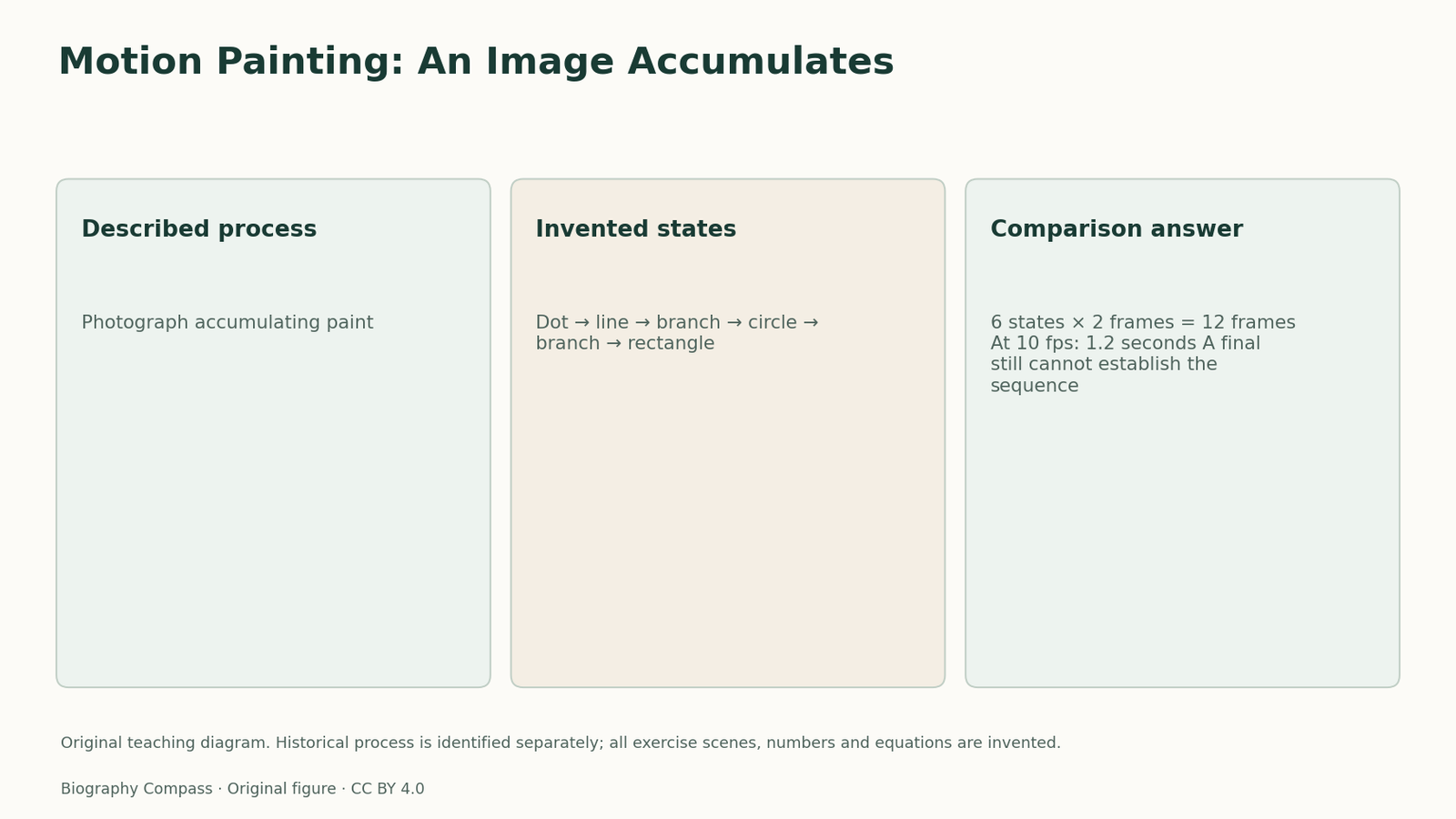
Make an invented six-image plan. State 1 contains a dot. State 2 adds a line, State 3 a branch, State 4 a circle, State 5 a second branch and State 6 a surrounding rectangle. Each state retains the preceding marks. Hold each for 2 frames at a stipulated 10 fps. Now make Version B by moving only the dot through six locations and erasing its old position each time. Describe one difference a viewer could recognise.
Calculate the duration of each plan, then say whether a still image of State 6 would prove that all earlier marks were photographed. No actual painted frame or musical phrase from the film is supplied.
Reference answer: persistence changes the action
Each version has 12 frames and lasts 1.2 seconds under the stipulated rate. Version A leaves a visible history of added marks; Version B presents a relocating dot without that trail. The durations match, but the screen events differ. Holding State 6 longer changes emphasis and duration without adding another mark.
The still cannot establish the sequence: an artist could have painted the final arrangement before the camera started. To substantiate the plan you need the ordered images or a production log, not merely a complex final picture. You may revise the marks for a different visual rhythm, but avoid calling a frame-for-frame change a musical synchronisation unless you have specified a separate temporal relationship.
Continue the chronology
Related history guides
Biography context
Explore United States through connected lives
Connected biographies
The maker’s wider career
1900–1967
Oskar Fischinger
Abstract filmmaker and painterPainting became a changing screen event.Read biographyQuick answers
Common questions
- Does the final still prove the order of the marks?
- No. The ordered images or a production record are needed to support a sequence.
Primary and institutional sources
How this history was checked
Named museum and archive accounts describe the material process. The visual sequences and timings here are invented; no film frames are reproduced. This article was reviewed on 31 October 2026.