
The short answer
How does oxygen-dependent destruction regulate a cellular response?
Evidence comparison
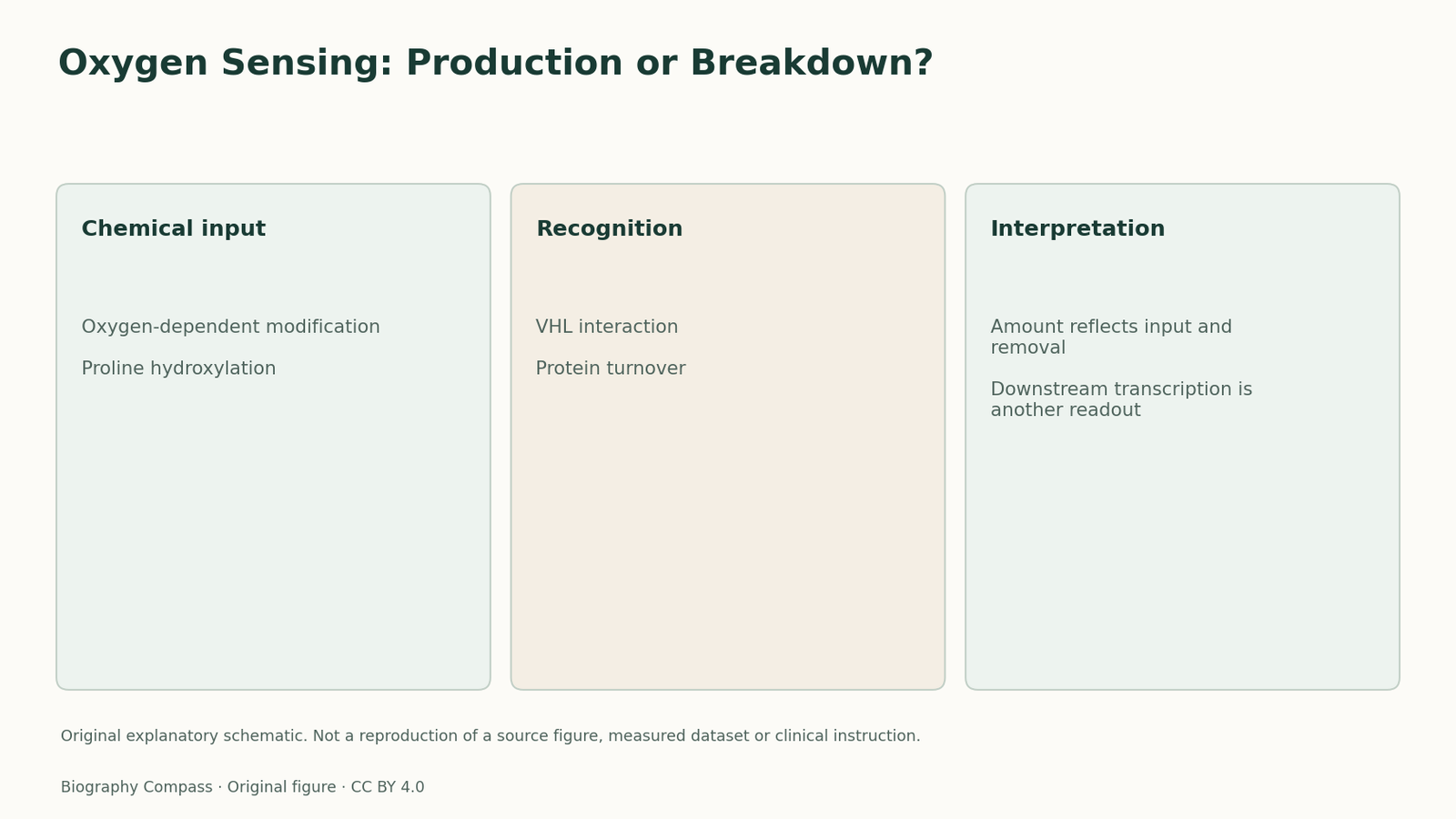
Oxygen Sensing: Production or Breakdown?
Compare the observations with the narrower conclusions they support.
| Record or observation | What it supports | What remains separate |
|---|---|---|
| Reduced protein destruction | Can allow HIF to accumulate | Does not require an increased production rate |
| Oxygen-dependent proline modification | Links oxygen availability with VHL recognition | Does not alone measure every downstream gene response |
A protein level can change without a new production rate
Ratcliffe's oxygen-sensing work concerns the control of HIF protein stability as well as its consequences for transcription. A useful starting distinction is between producing a molecule and removing it. A larger amount of protein does not, by itself, show that its gene was transcribed faster. In the HIF system, regulated destruction provides a major link between oxygen availability and the amount of active regulatory protein.
Connect oxygen to recognition
Jaakkola and colleagues' 2001 paper linked HIF-alpha recognition by the von Hippel–Lindau protein with hydroxylation of a proline residue. The modifying reaction uses oxygen and involves iron. This connects an environmental input with a chemical mark and a protein-destruction pathway. The sequence of claims matters: oxygen availability affects modification; modification affects recognition; recognition participates in turnover. It is more informative than a diagram in which oxygen simply points to a gene labelled on or off.
Sources for this section: [4]
A stock-and-clearance exercise
Imagine a classroom container receiving ten counters per minute. In one condition ten are removed each minute; in another only two are removed. Even with identical input, the second container gains counters. The answer is that a change in clearance can increase the stock without an increase in production. These invented counts are not HIF measurements and do not model its actual kinetics. They isolate one logical possibility that should be checked before interpreting an observed protein level.
Sources for this section: [4]
Keep downstream responses separate
Accumulation of a transcriptional regulator and the resulting expression of particular genes are different observations. The comparison helps readers recognise which part of oxygen sensing a paper measures and which part remains an additional experimental question.
Continue the chronology
Related history guides
Biography context
Explore United Kingdom through connected lives
Connected biographies
Researchers and related questions
1954–
Peter J. Ratcliffe
Physician-scientist and cellular oxygen-sensing researcherA 2001 paper by Panu Jaakkola and colleagues, including Ratcliffe, examined how the von Hippel–Lindau protein recognises HIF-alpha.Read biography1948–
James P. Allison
Immunologist and cancer-immunotherapy researcherDana Leach, Matthew Krummel and Allison reported a CTLA-4-blockade study in 1996.Read biography
1940–
Joseph L. Goldstein
Physician and molecular-genetics researcherThe Brown–Goldstein programme connected LDL recognition at the cell surface with uptake and intracellular regulation.Read biographyQuick answers
Common questions
- How does oxygen-dependent destruction regulate a cellular response?
- Can allow HIF to accumulate. Does not require an increased production rate.
- Are the classroom examples historical measurements?
- No. Invented examples are labelled as classroom models; the source-based discussion identifies the historical evidence separately.
Primary and institutional sources
How this history was checked
Official biographical and award records are read alongside the researcher’s technical account. Source scope and hypothetical examples remain distinct. This article was reviewed on 7 November 2026.