
The short answer
A measured transition in an applied field is not automatically the zero-field separation sought by an analysis. Keep the experimental observable and the inferred quantity distinct, including the atom or isotope to which a reported value belongs.
Original record and worked interpretation
Track which quantity is reported
Every numerical row below belongs to the invented model.
| Scaled field B | Observed pair | Pair average |
|---|---|---|
| 2 | 126, 114 | 120 |
| 5 | 135, 105 | 120 |
| With common qB² term | Each branch gains B² | Averages 124 and 145 |
Chronology
A timeline of the turning points
Lecture
Field dependence and zero-field inference.
Original model
Two idealised symmetric branches.
Read the system and field condition
Lamb describes radio-induced transitions that reduce a metastable beam signal. The transition frequencies depend on magnetic field; analysis yields zero-field separations. The next page’s 1059.0 and 9912.6 Mc/s values refer to deuterium.
Mc/s means millions of cycles per second. Do not relabel those figures as two measurements of the same gap in ordinary hydrogen, or read a value at an arbitrary field as already field-free.
Sources for this section: [1]
A deliberately simpler branch model
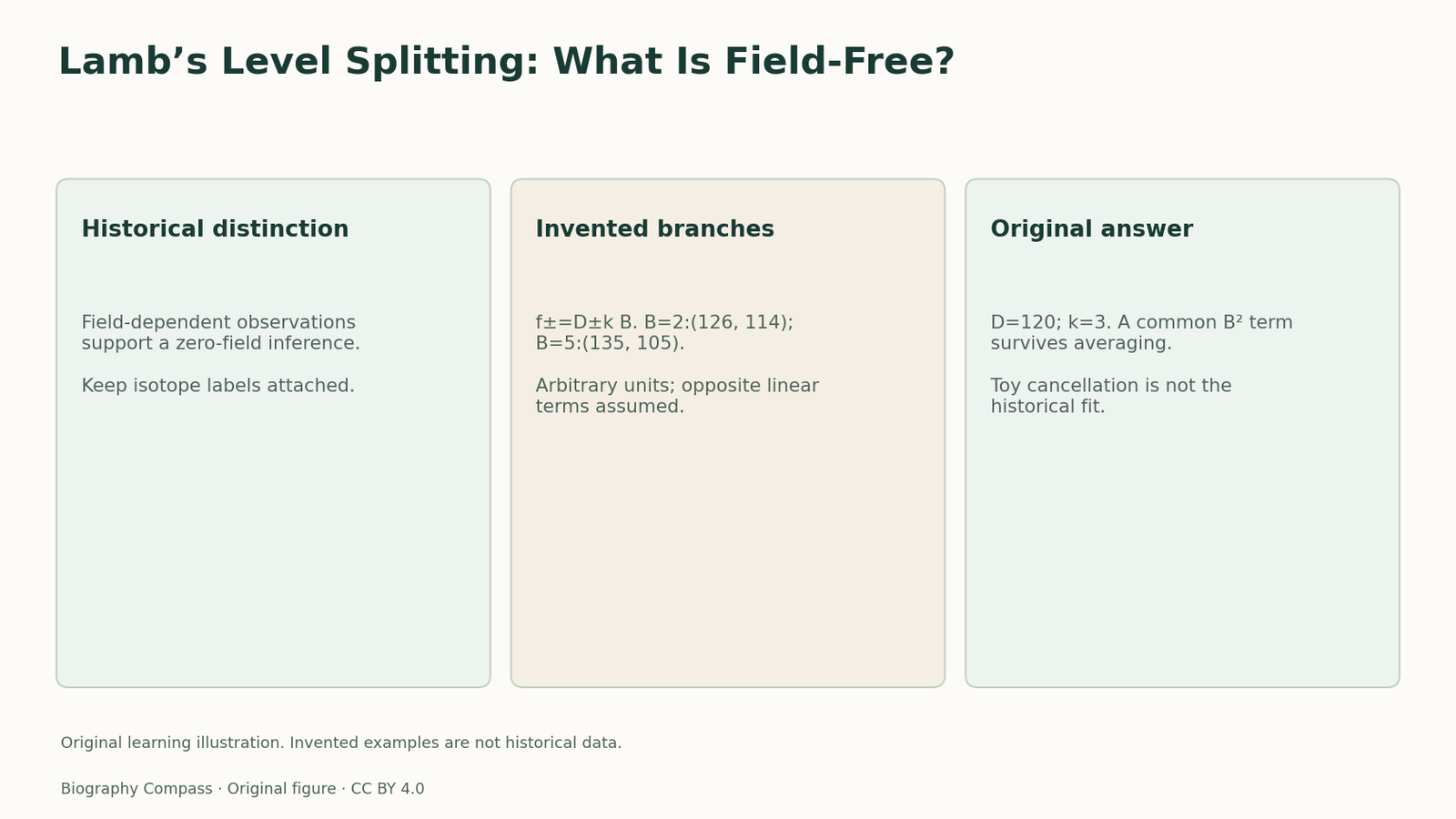
For an invented model, let two transition frequencies be f+(B)=D+kB and f−(B)=D−k B. B uses arbitrary scaled field units; frequencies use arbitrary frequency units, so k has frequency units per field unit. D and k are constant, and the branches have exactly opposite linear field terms.
At B=2 the frequencies are 126 and 114; at B=5 they are 135 and 105. Recover D and k, and check whether treating any single one of these readings as the zero-field term is justified. This is not the real experiment’s level structure or fitting procedure.
Sources for this section: [1]
Reference answer and a model check
At each B, the average of the two branches is 120, so D=120. The difference f+(B)−f−(B)=2kB gives k=12/4=3 for the first pair and 30/10=3 for the second. All four readings exceed or fall below the common zero-field term.
Now add an unmodelled common term qB² with q=1 in frequency units per squared field unit to both branches. The averages become 124 at B=2 and 145 at B=5. Pair averaging cancels the opposite linear terms but does not cancel a common nonlinear shift. Agreement at more than one field is therefore a useful check of this stipulated simplification.
Sources for this section: [1]
What the original model teaches
The algebra exposes a distinction between cancellation under a model and measurement independent of a model. It neither derives the real atomic level curves nor replaces the spectroscopy and theory needed in the historical analysis. The isotope label, the field condition and the assumptions must travel with any quoted number.
Sources for this section: [1]
Continue the chronology
Related history guides
Biography context
Explore United States through connected lives
Connected biographies
The researcher behind the record
1913–2008
Willis Lamb
Atomic and optical physicistSpectroscopy and measurement researcher.Read biographyQuick answers
Common questions
- Does pair averaging cancel every field effect?
- No. The invented common nonlinear term survives the average.
- Are these invented frequencies the historical spectral values?
- No. The real lecture’s isotope-specific values are identified separately.
Primary and institutional sources
How this history was checked
Historical claims use the selected records below. Invented inputs and worked interpretations are labelled; they are not reconstructed experiments. This article was reviewed on 31 October 2026.