
The short answer
A one-for-one exchange preserved a share count while changing the company in which investors held it. Read Pruksa’s 2016 documents to follow the ownership chain, the continuing work and the plans for future businesses.
Original structure comparison
What changed and what continued?
Separate the investor’s security from the subsidiary’s operating work.
| Country | Before exchange | After accepted exchange |
|---|---|---|
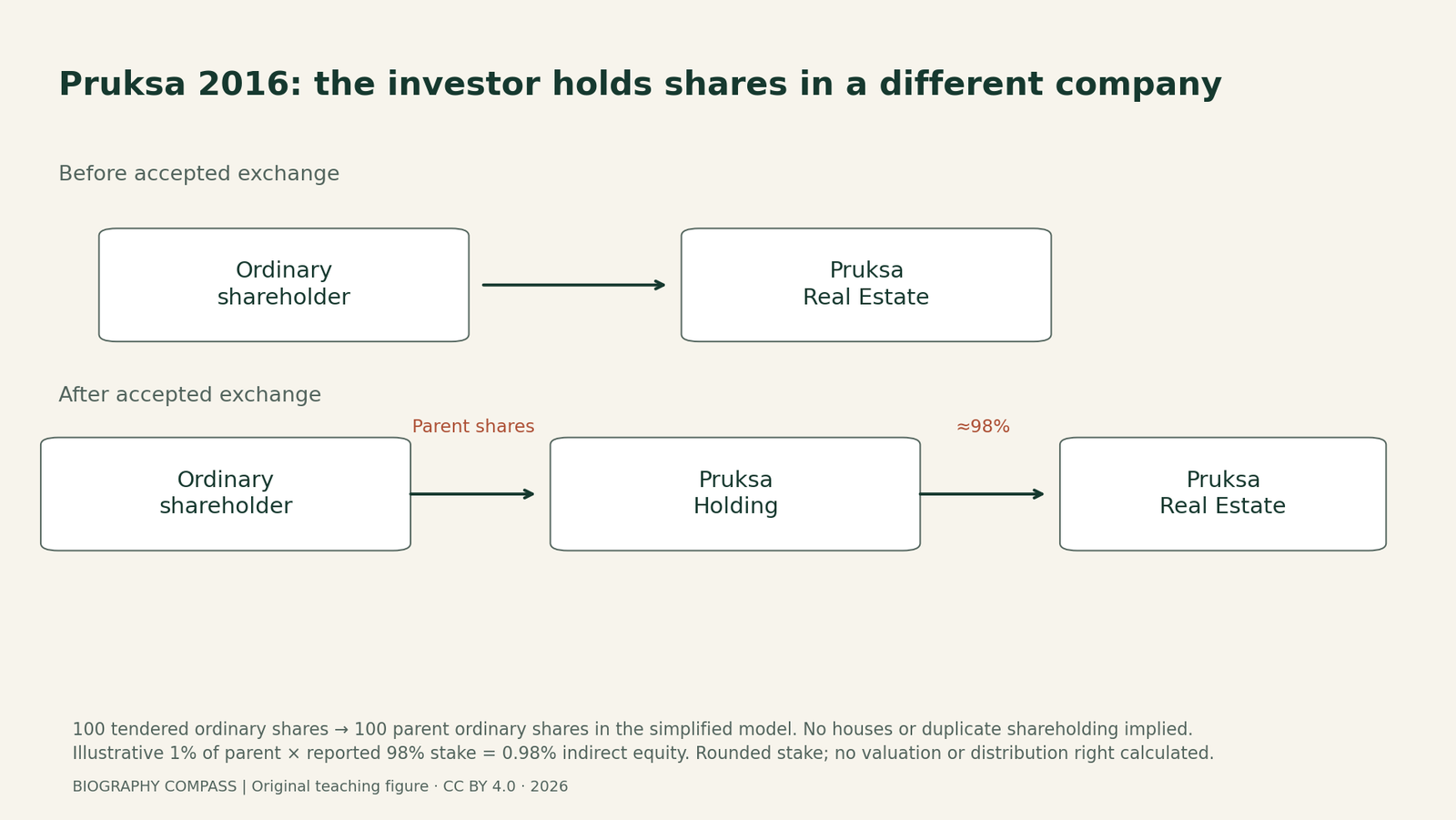
| Common shareholder | Directly holds Pruksa Real Estate ordinary shares. | Holds Pruksa Holding ordinary shares at the stated one-for-one ratio. |
| Listed security | Pruksa Real Estate is the listed issuer. | Pruksa Holding replaces its listing on 1 December 2016. |
| Property activity | Design, construction, sales and handovers within the operating business. | Continues in Pruksa Real Estate beneath the parent. |
| Future investments | Expansion within the existing organisation. | Parent structure can hold additional businesses; results require later evidence. |
Chronology
A timeline of the turning points
Parent established
Pruksa Holding begins with initial registered capital of Bt10,000.
Shareholder approval
Pruksa Real Estate’s annual general meeting approves the restructuring plan.
Exchange offer
The SEC-filed report gives this period for the offer of newly issued same-class securities.
Listing changes
Pruksa Holding is listed in place of Pruksa Real Estate.
Reported structure
The annual report shows the parent holding approximately 98 percent of the operating company.
Approval, the offer and listing were separate steps
The third-quarter management discussion filed with the Thai SEC identifies approval at the annual general meeting on 28 April 2016. It gives the tender period as 19 October to 23 November and explains that the parent’s shares would replace the operating company’s listing, with delisting on the same day. The later corporate chronology dates the new listing to 1 December. These steps had different effects: establishing a legal company did not complete the exchange; approving a plan did not mean every shareholder had accepted it; the offer period allowed participation; and listing made the new parent the publicly traded security. The chronology matters when describing what investors held on any particular date.
One for one was an exchange rule, not a valuation
The one-for-one ratio says how many securities of a given class were offered for those tendered. It does not state that a share’s market price, underlying assets or future dividends were guaranteed to remain identical. The annual report also discusses warrants and capital authorisations, so a classroom common-share example should state what it leaves out. Consider an investor tendering 100 ordinary shares and accepting the stated exchange. The basic model gives 100 ordinary shares in the parent. It does not give 100 shares in both companies, cash equal to the old market value, or ownership of a particular house. Valuation requires additional prices, rights and financial information.
The subsidiary percentage answers another question
Pruksa’s annual report says the parent acquired approximately 98 percent of Pruksa Real Estate through the tender process. That number concerns the parent’s stake in its subsidiary, not the exchange ratio received by each participating investor. Nor does it mean every investor acquired 98 percent of the parent. For an illustrative investor owning one percent of the parent after the restructuring, multiplying 1 percent by the reported 98 percent gives a 0.98 percent indirect economic interest in the property company. This is a deliberately simplified ownership calculation. It assumes one ordinary equity class and ignores other assets, liabilities, warrants, treasury holdings and contractual rights; it is not a direct entitlement to subsidiary cash or land.
Sources for this section: [2]
An organisational chart did not move every job immediately
The annual report explicitly describes an initial period in which Pruksa Holding depended on the existing property company’s business groups and support functions. Finance and accounting, risk management, human resources, legal services, information systems, marketing and procurement remained available through the operating business. The parent would oversee overall policies and future investments. This is a substantive distinction between legal ownership and operational work. A parent can set strategy and allocate capital while specialists in a subsidiary continue providing services. The filing therefore does not support a picture in which a new box on the chart instantly duplicated every department or removed construction responsibility from the housing organisation.
Sources for this section: [2]
The stated reason was room for different businesses
The 2016 report lists goals including expanding core housing segments, entering related businesses, developing recurring income and building a professional organisation. A parent could hold investments alongside the main property company rather than forcing every activity into the same operating entity. These were strategic intentions at the time. They should be tested against subsequent launches and financial reports if the question is whether diversification succeeded. The year-end revenue table still shows property sales dominating the group. It is therefore inaccurate to read the ambition for recurring income as evidence that new recurring businesses had already replaced development sales in 2016. A structure creates an option; reported operations show how far it has been used.
The housing operation still had its own production problem
Thongma Vijitpongpun’s earlier construction choices help explain what remained beneath the corporate chart. In his later interview, he described using tunnel-form and then precast systems to address the time and cash required to deliver houses. Suppliers trained staff, and factory production required investment and management. Those tasks did not disappear when shareholders exchanged securities. A holding-company guide therefore needs both the legal and operational levels: investors received shares in a different entity, while teams continued designing, manufacturing, selling and handing over homes. The founder’s executive role sat alongside an independent chairman and other managers named in the 2016 report.
Exercise: inspect a proposed explanation
A draft caption says: “In 2016 every Pruksa investor swapped 100 shares for 100 houses, the new parent bought all of the operating company, and all employees moved to the parent so recurring income replaced property sales.” Identify four unsupported claims. Then use the simplified example of a one-percent holding in the parent and its reported 98-percent subsidiary stake to calculate an indirect percentage. State one reason that this percentage is not a valuation. Finally identify which record is better suited to showing whether new recurring businesses later generated income: a restructuring diagram or a subsequent financial report with segment revenue.
Reference answer: describe the actual change
An accepting ordinary shareholder received parent-company ordinary shares at one for one, not houses. The reported subsidiary stake was approximately 98 percent, rather than 100 percent. The annual report describes reliance on support functions remaining in the operating company. Its 2016 revenue table still shows the central role of property sales. In the simplified ownership model, 0.01 multiplied by 0.98 equals 0.0098, or 0.98 percent. That product gives a proportion of an equity chain, without asset values, debts, share prices or distribution rights. A subsequent segment financial report is the stronger test of realised recurring income. These distinctions let the reorganisation explain a genuine corporate change without attributing results to it before they occurred.
Continue the chronology
Related history guides
Connected biographies
People and organisations
Born c. 1957
Thongma Vijitpongpun
Civil engineer and Pruksa founderThongma Vijitpongpun applied civil engineering and construction experience to mass-market housing. Pruksa’s growth involved production systems, customer finance and professional management, followed by a holding-company structure in 2016.Read biographyQuick answers
Common questions
- Did one-for-one mean the two securities had identical value?
- It specified the exchange quantity for the same class of security. It did not guarantee identical market prices or future distributions.
- Did the holding company own all of Pruksa Real Estate?
- The 2016 annual report describes approximately 98 percent ownership after the tender process. The guide preserves that reported rounded figure.
Primary and institutional sources
How this history was checked
Original filings and institutional accounts supply the dated evidence. The comparisons, calculation and exercise are original teaching aids; retrospective and participant accounts are identified where used. This article was reviewed on 27 October 2026.
- Pruksa Real Estate; Thai Securities and Exchange Commission filingManagement discussion and analysis, third quarter 2016, page 7
- Pruksa Holding Public Company LimitedAnnual Report 2016, corporate structure, operations and director profiles
- Pruksa HoldingCorporate information: Pruksa history and milestones
- A. Stotz Investment Research / Become a Better InvestorBusiness DNA: Thongma Vijitpongpun, interview with Andrew Stotz, 2019