
The short answer
The headline was a hotel acquisition, but the purchased object was shares in a listed company. Compare the bidder’s presentation, NH’s board report and the annual report to see the transaction in stages.
Original record comparison
Three records answer different questions
A complete account needs the buyer, the target and the operating definitions.
| Country | What it establishes | What remains separate |
|---|---|---|
| NH board report | Bidder, staged holdings, dividend adjustment and board/adviser perspective. | A legal equitable-price test is not a guarantee of financial fairness. |
| Minor presentation | Reported completion, total investment and pro-forma comparison under stated assumptions. | A modelled 2017 start is not the actual acquisition date or organic growth. |
| Annual report | Year-end group structure and different hotel operating models. | A corporate shareholding is not freehold title to each property. |
Chronology
A timeline of the turning points
Offer announced and filed
The initial €6.40 offer accompanies purchases that establish a substantial stake.
Dividend adjustment
A €0.10 gross dividend reduces the bid price to €6.30.
Mandatory bid
NH’s board report says a further purchase takes the bidder to 35.55 percent and makes the offer mandatory.
NH board report
The board publishes a non-binding assessment and distinguishes legal price requirements from financial fairness.
Tender completed
Minor reports a final 94.1 percent holding and approximately €2.327 billion investment.
Identify the bidder and the purchased security
The bidder was MHG Continental Holding (Singapore) Pte. Ltd., indirectly wholly owned by Thailand-listed Minor International. The target securities were shares in Spain’s NH Hotel Group. William Heinecke led Minor, but the buyer was a corporate subsidiary rather than the founder personally. The distinction matters because the shares brought exposure to a company with its own assets, debts, employees, brands and contracts. It was not a purchase order for a collection of hotel buildings detached from their business. NH’s board report and Minor’s year-end subsidiary table show the ownership chain. They provide a sound starting point before discussing portfolio size or proposed benefits.
A stake accumulated before the public offer finished
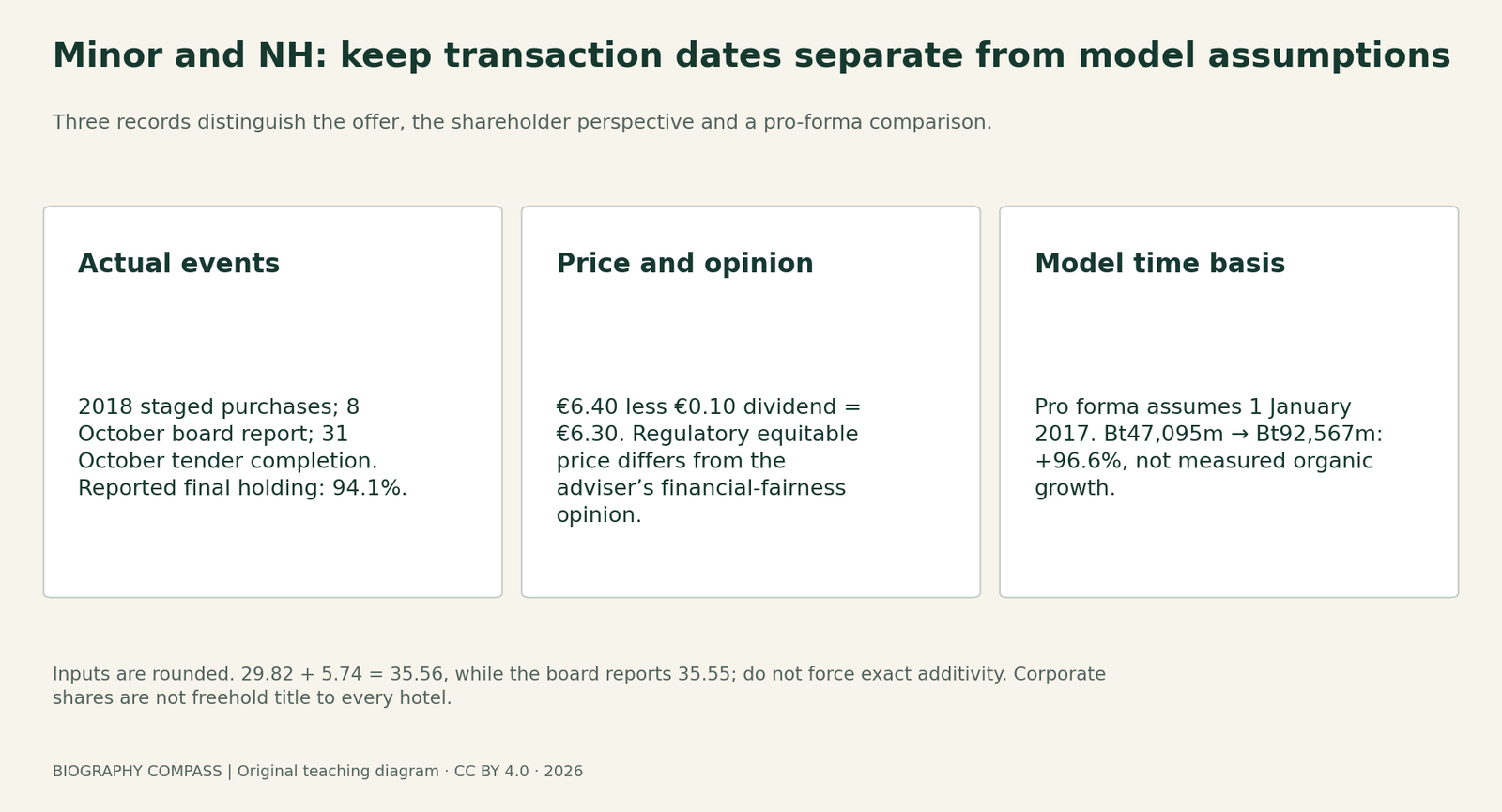
Minor did not acquire its entire final holding in a single transaction. NH’s board report says the bidder already held 29.82 percent before a further 5.74 percent purchase took it to 35.55 percent on 9 August. The offer, initially voluntary, then became mandatory under the rules described in that 2018 filing. Additional purchases followed. Minor’s November presentation summarises the accumulation across quarters and reports 94.1 percent after completion. Rounded stake percentages should not be added as though they were an exact share register. The useful conclusion is the sequence: an initial strategic holding, further block and market purchases, then the tender result.
The price change followed a stated dividend rule
The initially announced consideration was €6.40 per share. The offer terms said it would be reduced by any gross dividend distributed before settlement. NH paid a €0.10 gross dividend on 27 July 2018, so the offer price became €6.30. The arithmetic is simply €6.40 minus €0.10. It should not be described as an unexplained late price cut or as proof that every investor received exactly the same net proceeds. Dividend eligibility depended on the record date, while taxes and personal transaction costs are outside this guide’s model. A price history becomes understandable when the distribution rule and timing accompany the two figures.
Sources for this section: [1]
A legal price test differed from financial fairness
NH’s October board report describes the bid price as equitable for the purposes of the applicable takeover rule, linked to the highest price paid or agreed in relevant prior acquisitions. It then separately discusses enterprise valuation, potential synergies and a control premium. Its financial adviser’s opinion concluded that €6.30 was not fair from a strictly financial perspective to shareholders other than the bidder and its affiliates, subject to the opinion’s assumptions and limitations. These statements are compatible because the tests answer different questions. Regulatory treatment did not certify a universal investment value. The board report was compulsory but non-binding; each shareholder still had to decide whether to accept.
Sources for this section: [1]
The board record also shows how conflicts were handled
The filing says Heinecke, Dillip Rajakarier and Stephen Chojnacki did not attend or send representatives to the NH board meeting approving the report because of their conflicts as the bidder’s proprietary directors. This is a concrete governance fact, more useful than assuming a founder personally directed both sides’ conclusions. The report’s opinions also came from a particular board at a particular moment. Minor’s presentation emphasised the platform and financial attractions for the buyer, whereas NH’s report considered the position of the target’s shareholders. Comparing the documents exposes those perspectives without treating either as a neutral valuation of all future outcomes.
A hotel portfolio did not mean freehold ownership everywhere
Minor’s annual report distinguishes owned and joint-venture hotel operations, leased hotels and hotels managed for third-party owners. Its broad “company-owned” operating category even includes leased properties, so that heading cannot be read as a land registry. A hotel management contract can generate fees and place a brand on a property without conveying its freehold. Buying NH shares therefore changed corporate control over a portfolio of different rights and obligations. Comparing these operating models explains how the transaction expanded brand reach while also changing financing and lease exposure. Individual buildings would require their own property and contract records if the question were who owned the underlying real estate.
Sources for this section: [3]
Pro-forma figures were a model, not the event date
Minor’s third-quarter presentation compares revenue of Bt47,095 million with pro-forma combined revenue of Bt92,567 million, labelled as a 97 percent increase. It explicitly assumes the 94.1 percent acquisition had occurred on 1 January 2017, although the actual completion was in October 2018. Other assumptions include no fair-value adjustment and specified funding treatment. The table illustrates a combined historical scale under assumptions. It is not evidence that Minor actually bought NH in 2017 or that all the difference was organic sales growth. A comparison should therefore keep the model’s time basis and financing assumptions beside its larger number.
Sources for this section: [2]
Exercise: repair a transaction headline
A proposed headline reads: “Heinecke bought every NH hotel for €6.40 each in 2017; Spanish approval proved the price financially fair.” Identify four changes required. Then calculate the adjusted cash bid from €6.40 and the €0.10 dividend. Finally use the presentation’s two revenue numbers to calculate the increase as a percentage of the smaller number. State whether that percentage is an observed organic growth rate or a pro-forma scale comparison. Use the dated reports rather than a current share price, and do not infer a present holding from the 2018 snapshot.
Reference answer: connect equity, price and model
A Minor subsidiary bought NH shares through staged transactions, reaching a reported 94.1 percent by completion, rather than Heinecke personally buying every building. The cash bid was €6.30 per share after the dividend adjustment. Actual tender completion was 31 October 2018; 1 January 2017 was a modelling assumption. The regulatory equitable-price treatment was separate from the adviser’s adverse financial-fairness opinion. The revenue difference is Bt45,472 million. Dividing by Bt47,095 million and multiplying by 100 gives approximately 96.6 percent, rounded to 97 percent in the presentation. This is the model’s comparison of scale, not an organic growth measurement. Precise nouns, dates and denominators turn a large acquisition headline into an explanation a reader can test.
Continue the chronology
Related history guides
Connected biographies
People and organisations

Born 1949
William Heinecke
Minor founder and hotel and restaurant business leaderAmerican-born William Heinecke built businesses in Thailand before expanding into restaurants and hotels. His career combines franchises, home-grown brands, management contracts and acquisitions through Minor International.Read biographyQuick answers
Common questions
- Did Minor buy all of NH in October 2018?
- Minor reported 94.1 percent ownership after completion, rather than 100 percent. This guide uses that historical snapshot.
- Why do the offer records contain both €6.40 and €6.30?
- The initially announced €6.40 price was reduced by NH’s €0.10 gross dividend under the stated offer terms, producing €6.30.
Primary and institutional sources
How this history was checked
Original filings and institutional accounts supply the dated evidence. The comparisons, calculation and exercise are original teaching aids; retrospective and participant accounts are identified where used. This article was reviewed on 27 October 2026.
- NH Hotel Group; Spanish National Securities Market Commission (CNMV)Report of NH Hotel Group’s Board of Directors on the takeover bid, 8 October 2018, English translation
- Minor InternationalCompany presentation, third quarter 2018, pages 7–9
- Minor International Public Company LimitedAnnual Report 2018, operating models, acquisition and director credentials