
The short answer
A renewable electricity supply can matter greatly to an aluminium smelter without describing its entire footprint. Press Metal’s 2024 report places hydroelectric supply beside operational improvements and upstream raw-material emissions. Its product description and corporate targets also use different boundaries. This guide follows those distinctions, using the GHG Protocol’s definitions and a fictional improvement plan. It does not independently verify Press Metal’s inventory or reproduce its proprietary product assessment.
Compare the records
A record, its scope and the inference
Use the detail that answers the question, then preserve the condition attached to it.
| Record or example | Evidence supplied | Supported inference |
|---|---|---|
| Electricity statement | Predominantly hydroelectric supply to Sarawak smelters. | An energy-input statement, not proof of a zero complete footprint. |
| Product description | A stated Scopes 1-and-2 threshold and separate life-cycle discussion. | Retain the boundary attached to the threshold. |
| Corporate target note | Selected upstream categories and dated intensity targets. | Distinguish category coverage and ambition from achieved results. |
Chronology
A timeline of the turning points
Reported baseline
The issuer uses a 2020 intensity baseline for its stated climate targets.
Boundary expanded
The report describes adding upstream Scope 3 to its targets.
Target horizons
15% and 30% intensity reductions are targets in this historical report.
Net-zero ambition
A target horizon, not evidence that net zero has been achieved.
Identify the sources before comparing the claim
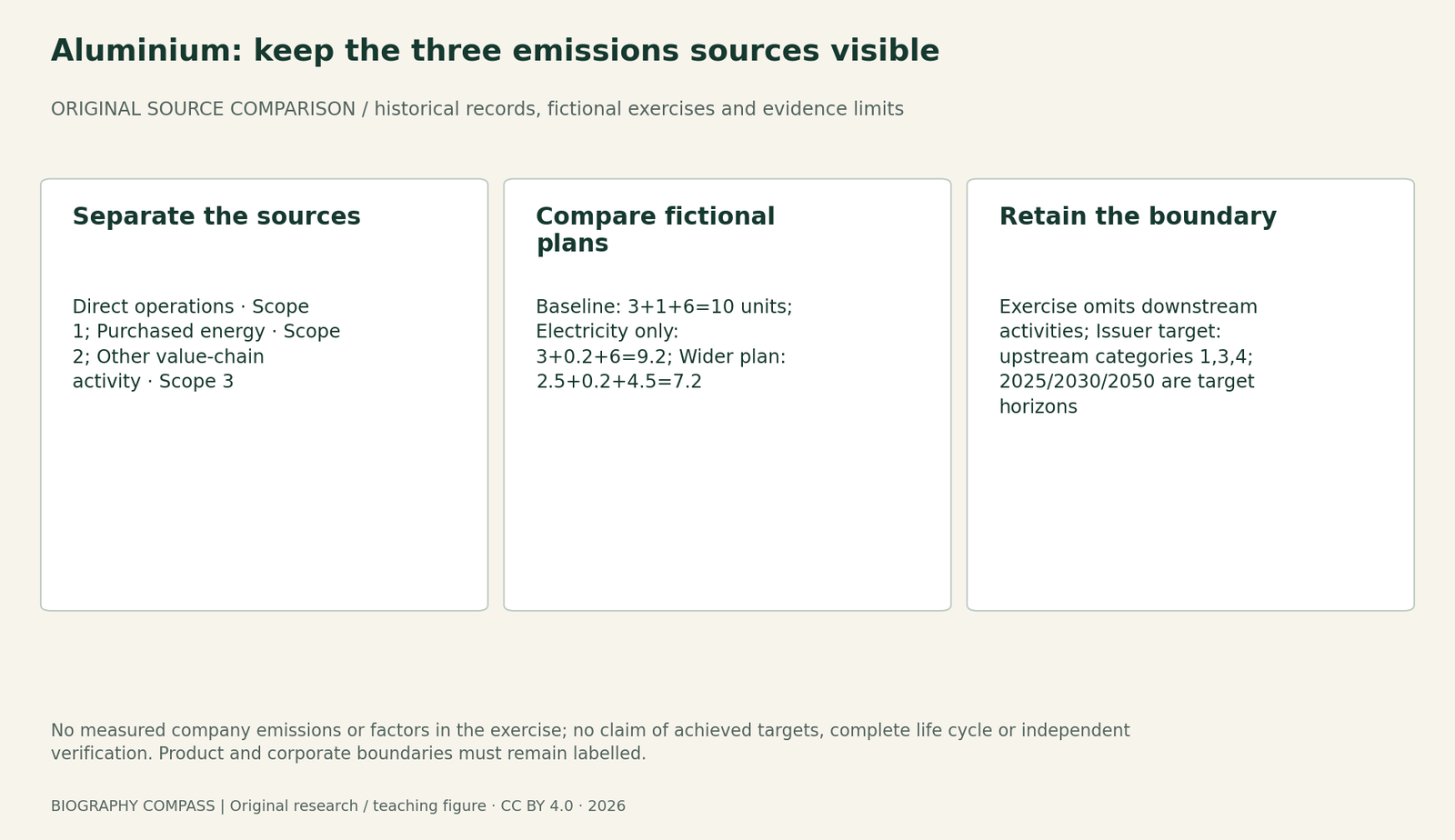
The GHG Protocol distinguishes direct emissions from owned or controlled operations, emissions associated with purchased energy, and other indirect emissions in the value chain. These are Scopes 1, 2 and 3. Press Metal’s report says its Sarawak smelters obtain electricity predominantly from renewable hydroelectric sources. That statement addresses an important input. It does not say that every direct industrial emission or every supplier’s production activity disappears when the electricity mix changes.
The issuer describes several levers, not one cure
The report describes pot-control and operational improvements, including measures addressing anode effects, alongside its electricity arrangements. It separately identifies alumina supply as a significant upstream emissions hotspot and discusses supplier engagement. These are different interventions because they concern different parts of the production system. Their presence in the same report makes an electricity-only reading incomplete. The source records what the company says it is doing; this guide has not inspected the equipment or independently measured the resulting reductions.
Sources for this section: [1]
A product threshold is not the whole corporate target
The GEM product description gives a footprint below four tonnes of CO₂-equivalent per tonne of aluminium for Scopes 1 and 2. The report also discusses product life-cycle assessments, available on request, and a broader corporate climate target. Its target note includes upstream Scope 3 categories 1, 3 and 4. A reader should therefore identify the exact boundary attached to each number. A Scopes 1-and-2 threshold cannot silently become a claim about every upstream and downstream activity.
The report’s 15% reduction by 2025 and 30% by 2030 refer to intensity against a 2020 baseline. They are historical targets, not findings that those reductions occurred. Nor does a lower intensity automatically establish a lower absolute total when output changes. This distinction keeps a programme of work separate from proof of its eventual result.
Sources for this section: [1]
Original exercise: compare two improvement plans
Consider a fictional producer with a deliberately simplified, non-overlapping inventory per tonne of output: direct operations 3 units, purchased electricity 1 unit, and selected upstream activities 6 units. No downstream activities are included. Plan E reduces only electricity to 0.2 units. Plan S also reduces direct operations to 2.5 and selected upstream activities to 4.5. Calculate the totals under both plans. Then assess the proposed label: electricity improved, therefore our entire aluminium life cycle has zero emissions. Name two additional pieces of evidence needed for a real product claim. These inputs are invented teaching quantities, not Press Metal measurements or emission factors.
Worked answer: the unchanged sources remain
The starting total is 3 + 1 + 6 = 10 units. Plan E gives 3 + 0.2 + 6 = 9.2. Plan S gives 2.5 + 0.2 + 4.5 = 7.2. Neither is zero, and neither includes downstream activities. The proposed label is unsupported even if the electricity improvement is valid. A real claim would need an explicitly defined product-system boundary and a documented inventory, including appropriate supplier evidence and verification. The arithmetic illustrates the need to include the remaining sources; it is not an estimate of the company’s footprint.
Sources for this section: [2]
Compare like boundaries and preserve the date
Before comparing two products, ask whether the figures cover the same processes, gases, time period and unit of output. Also ask whether a number describes a product, the company’s operations or a future target. Press Metal’s report is useful because these different kinds of statement appear together and can be separated. A low-carbon electricity advantage is meaningful within that account, while the direct-process and supply-chain records show why it cannot answer every environmental question by itself.
Continue the chronology
Related history guides
Is Westports’ 2082 concession date unconditional?
Compare Westports’ brief concession announcement with its detailed 2023 filing, then test how a land-transfer condition changes three fictional project records.
Read the timeline2016 decision · status reported at 2023When can an online gateway restrict insurance choice?
Study MyCC’s 2016 gateway decision and its dated procedural update, then test three fictional insurance-validation paths for equivalent treatment.
Read the timelineBiography context
Explore Malaysia through connected lives
Koon Poh Keong biography
Read the wider career behind this specific record and learning question.
Explore the biographiesRelated learning guideIs Westports’ 2082 concession date unconditional?
Compare Westports’ brief concession announcement with its detailed 2023 filing, then test how a land-transfer condition changes three fictional project records.
Explore the biographiesRelated learning guideWhen can an online gateway restrict insurance choice?
Study MyCC’s 2016 gateway decision and its dated procedural update, then test three fictional insurance-validation paths for equivalent treatment.
Explore the biographiesConnected biographies
People behind the records
20th century—
Koon Poh Keong
Press Metal co-founder and aluminium-industry executiveKoon Poh Keong and four brothers built Press Metal from an extrusion business into an enterprise with smelting operations in Sarawak.Read biographyQuick answers
Common questions
- Were the underlying product LCAs independently read?
- No. The report says they are available on request; this guide reads its public disclosure only.
- Are the exercise quantities actual company emissions?
- No. They are explicitly fictional units in a simplified inventory.
Primary and institutional sources
How this history was checked
Read the dated original records alongside the labelled fictional exercise. Announced plans, conditions and reported results have different meanings. This article was reviewed on 28 October 2026.