
The short answer
Why can the same novel appear with different approaches to explaining Māori? Read the surviving kinds of evidence before deciding what a glossary does: an excerpt, an author’s account, a publisher’s record and a translation event.
Original evidence comparison
What each record can establish
Keep the object, speaker and date attached to each claim.
| Country | Evidence supplied | Useful claim | Claim requiring more evidence |
|---|---|---|---|
| Authorised prologue | A literary excerpt and accompanying author note. | Visible movement between craft, maker and community. | The full novel’s structure or every narrator. |
| Publication records | Bibliography, publisher listing and library description. | Edition dates, publisher and identifiers. | That a catalogue date is the date of composition. |
| Author interview | A participant’s retrospective explanation. | Her stated reasons for glossary and typography choices. | Every reader’s response or a complete publishing archive. |
| Translation report | A dated institutional event report. | Author and translator explain an Italian glossary. | A direct comparison of glossary entries not inspected. |
Chronology
A timeline of the turning points
First publication
Penguin publishes Potiki in New Zealand.
A further English edition
The Academy bibliography records the Women’s Press edition in Britain.
Hawai‘i publication
The University of Hawai‘i Press issues its Talanoa edition.
Author interview
Grace discusses drafting, Māori language and her original glossary decision.
Italian edition
Grace and Antonella Sarti-Evans explain a glossary for a different audience.
Begin with the object you actually have
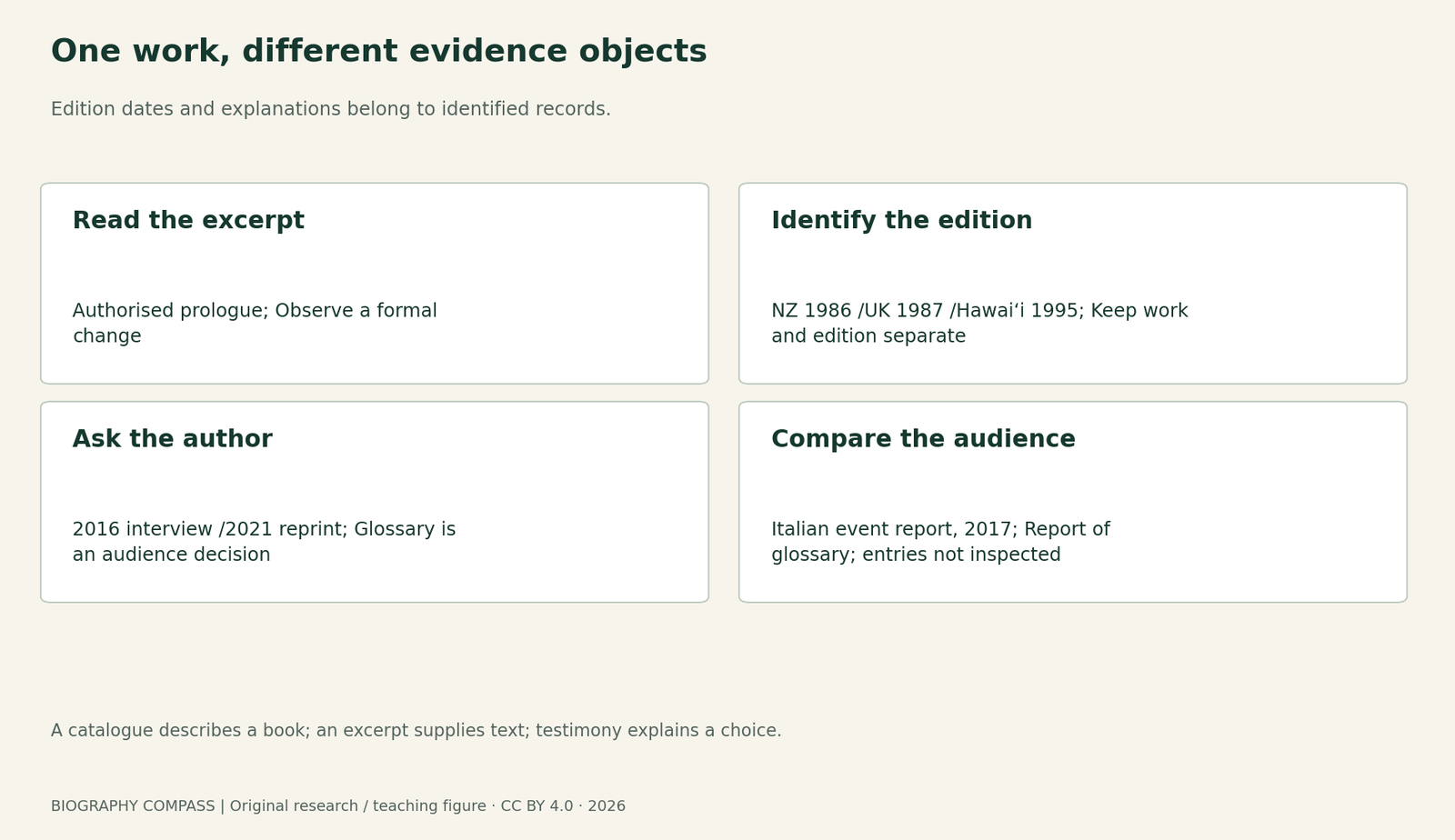
A title is not enough to identify the evidence in front of you. Potiki may mean the novel as a work, a particular printed edition, a translated edition or an excerpt placed on a website. Each object answers different questions. The Academy of New Zealand Literature provides both a bibliography and an authorised prologue excerpt, accompanied by Grace’s account of composition. A publisher supplies an edition record, while a university press report describes an author–translator discussion. Put the object type at the top of a reading note before extracting a claim. This simple step prevents a catalogue description from becoming an assertion about a passage that has never been read.
Publication records distinguish circulation from composition
The Academy bibliography lists a New Zealand Penguin edition in 1986, a British Women’s Press edition in 1987 and a University of Hawai‘i Press edition in 1995. The American publisher dates its Talanoa edition to March 1995 and supplies an ISBN. The National Library’s record for that edition includes a note identifying the earlier New Zealand publication. Those are records of circulation; none says the novel was first written in 1995. They also illustrate the limits of pagination. The library description gives 185 pages while the publisher lists 192. Record that discrepancy rather than using page count alone to declare that two records concern different works.
Read the supplied prologue before applying an explanation
The authorised excerpt opens with a carver and the emergence of ancestral figures from wood. It moves between a general account of making and the history of a particular practitioner. Skills pass between generations; the people also contribute care and work around the meeting house. An unfinished figure carries the account toward a future beyond the maker’s control. These are observations about the supplied prologue, not a summary of the whole novel. For an initial reading, mark the changes between general statement, narrated event and reported speech. Then ask who knows the meaning of an object at each point, and who must wait for further knowledge.
Sources for this section: [1]
Let an author’s account suggest a question, not dictate every answer
Grace’s accompanying note says the novel began with a short story about the carver, prompted by her husband and son learning carving. Her attention then moved toward the people associated with the house. This gives a documented route from one piece of writing into a larger work. It does not prove that every motif was planned at the beginning, nor does it remove readers’ responsibility to examine the sentences. A useful research question is how the prologue’s movement between a maker and a community prepares a reader for multiple lives. Answering it fully would require reading the rest of the novel in an identified edition.
Sources for this section: [1]
A glossary positions a reader as well as explaining a word
In the 2016 Dudding interview, Grace distinguishes using language familiar to her characters from wanting to exclude readers. Her deliberate refusal of a glossary and italics for Māori in Potiki addressed its status within New Zealand. This makes an editorial convention part of the work’s relationship with its audience. A glossary may aid recognition, but its presence can also imply that some language belongs outside the book’s ordinary world. That is an interpretation of the practical issue her account raises. It should not become a claim that every reader had the same response, or that every unfamiliar word must remain unexplained in every context.
Sources for this section: [5]
Translation changes the audience without cancelling the earlier decision
Wai-te-ata Press reported a 2017 conversation between Grace and Italian translator Antonella Sarti-Evans. They had included a glossary for Italian readers, for whom Māori occupied a different linguistic position. Read that as a decision attached to this audience and edition. It does not establish a universal translation policy or demonstrate the contents of every overseas edition. The report also identifies the translator as a participant in decisions about idiom and phrasing. A history of circulation should preserve that named labour. Comparing editions therefore involves more than plotting a map of countries reached: it asks what information, explanation and language each new readership encounters.
Sources for this section: [6]
Exercise: build an edition-aware reading note
Make a five-column table headed Object, Date, Observation, Explanation and Limit. Enter the Academy excerpt, Grace’s interview, the Hawai‘i publisher record and the Italian event report. For the excerpt, describe a visible formal change without quoting the prose. For the interview, identify the speaker and distinguish the original interview year from the 2021 reprint. For the publisher record, separate the edition date from first publication. For the event report, distinguish what the reporter says the participants explained from an observation of the actual glossary. Finally, write one question that the evidence cannot answer. Use the comparison table below to check that each source has retained its proper job.
Reference answer: preserve uncertainty where the object is missing
A defensible note might identify the excerpt’s shift from general craft to a particular carver, place the language explanation with Grace’s 2016 testimony, record March 1995 as the Hawai‘i edition date and attribute the Italian glossary decision to the 2017 report. It should leave the exact Italian entries and their translations unresolved because those pages were not inspected here. Another open question concerns how typography differs between physical editions; a discussion of intention does not itself collate their printed pages. These limits make a better next research step possible: obtain the editions, record their publication details, and compare the relevant passages directly before extending a conclusion about one reader’s position to another.
Continue the chronology
Related history guides
Biography context
Explore New Zealand through connected lives
Connected biographies
People in the evidence
1937–
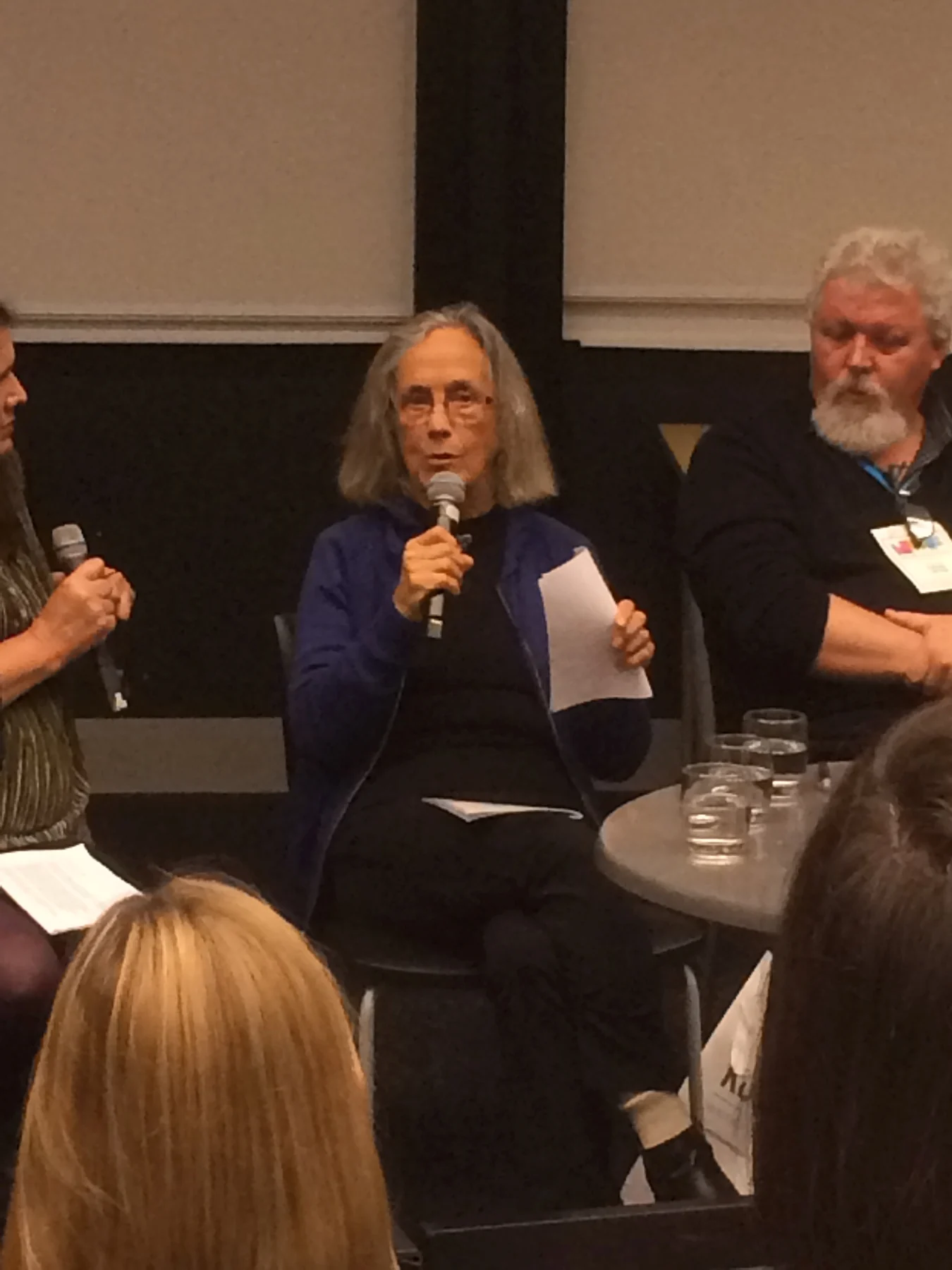
Patricia Grace
Novelist, short-story writer and children’s authorPatricia Grace developed a varied body of fiction through teaching, family life and close attention to voices around her. Her books give Māori characters distinct perspectives across generations and places.Read biographyQuick answers
Common questions
- Was the full novel read for this guide?
- Only the complete authorised prologue excerpt was read. Other claims come from identified publication records, author testimony and a translation-event report.
- Does an Italian glossary contradict Grace’s New Zealand policy?
- The reported choices address different audiences. The evidence supports an edition-specific explanation, not a rule that every readership needs identical paratext.
Primary and institutional sources
How this history was checked
The complete authorised prologue excerpt was read. The whole novel, Italian glossary and physical editions were not inspected. The guide distinguishes direct textual observation, participant testimony, bibliographic description and event reporting. This article was reviewed on 27 October 2026.
- Academy of New Zealand Literature / Patricia Grace / Penguin50 Years of NZ Book Awards: Patricia Grace; author note and Potiki prologue excerpt
- Academy of New Zealand LiteratureBibliography: Patricia Grace
- University of Hawai‘i PressPotiki: Talanoa edition,March 1995
- National Library of New ZealandPotiki:1995 Honolulu edition record
- Academy of New Zealand Literature / E-TangataAn interview with Patricia Grace: Adam Dudding, 2016; reprinted 7 March 2021
- Wai-te-ata Press / Victoria University of WellingtonA New Zealand/Italian Birthday Party, 24 October 2017