
The short answer
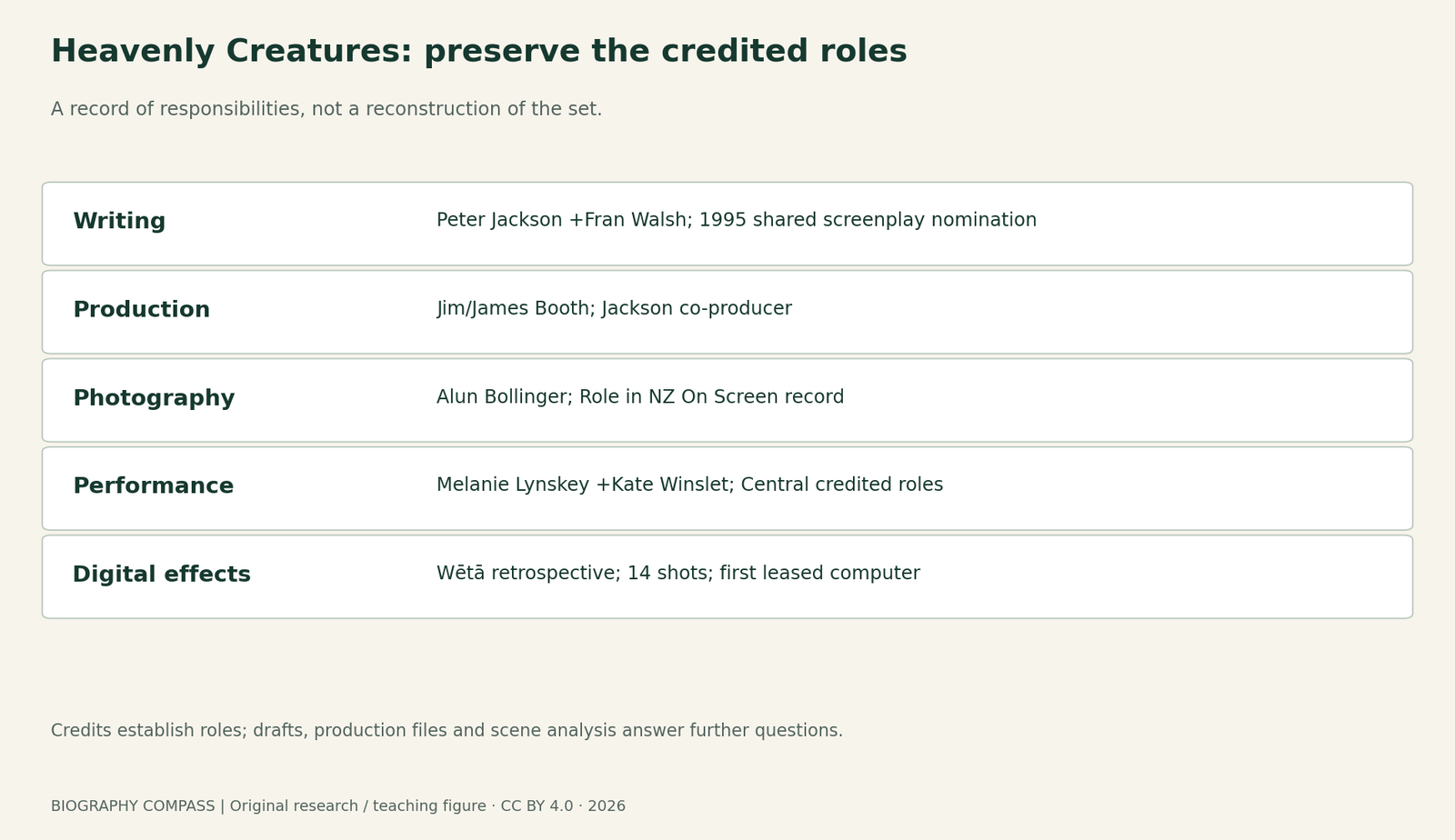
How do credits and production records change a director-centred account of a film? Use Heavenly Creatures to separate shared writing, producing, cinematography, performance and digital effects without claiming to have reconstructed the whole shoot.
Original evidence comparison
What each record can establish
Keep the object, speaker and date attached to each claim.
| Country | Record | What it supplies | What it leaves open |
|---|---|---|---|
| Film catalogues | Names and credited responsibilities. | Shared writers, producers, cast and cinematographer. | Every daily decision or an exhaustive crew list. |
| Wētā filmography | A participant company’s selected production history. | A leased computer and 14 effects shots in its account. | An independent shot count or all practical techniques. |
| Academy results | A dated institutional nomination record. | 1995 writing nomination for Walsh and Jackson. | A win or recognition of every creative department. |
Chronology
A timeline of the turning points
Film and production
Institutional catalogues date Heavenly Creatures to 1994 and identify writers, producers and performers.
An early digital-effects project
Wētā’s later filmography identifies 14 effects shots and a leased computer.
Academy nomination
Frances Walsh and Peter Jackson are nominated for the original-screenplay award.
Separate the film from the records describing its making
Heavenly Creatures is a 1994 drama based on the Parker–Hulme murder case. A catalogue synopsis can identify that subject, but it does not establish how each scene was staged, shot or edited. This guide uses the Film Commission’s listing, NZ On Screen’s key credits, Te Ara’s explanatory caption, Wētā’s production note and the Academy’s nomination record. Each has a narrower purpose than a full production archive. Start by asking which organisation made the record and why. An awarding body identifies eligible achievement; a company filmography selects work from its own history; a national screen catalogue helps people locate films and contributors.
Producing and directing are responsibilities that can overlap
NZ On Screen describes Jackson as director, writer and co-producer while identifying Jim Booth as producer. The Film Commission uses James Booth in its producer listing. Preserve the records’ naming while recognising the familiar Jim Booth credit. Their overlap of roles is more informative than replacing the whole team with a director’s name. A producer may help make resources and working arrangements possible; the listed credit alone does not specify every negotiation or guarantee that a particular decision originated with that person. For a research file, retain the exact institutional role label and record an uncertainty before trying to turn it into a daily task description.
Performance and photography are parts of construction
The screen catalogue names Melanie Lynskey and Kate Winslet in the central roles, and NZ On Screen names Alun Bollinger as cinematographer. This provides a starting map of creative responsibility beyond the screenplay. It does not amount to an analysis of performances or lighting: those require viewing an identified version and describing observable choices. A credit survey can nevertheless improve the questions asked during that viewing. Instead of asking only what the director intended, ask how a character is performed, how framing directs attention and how the image permits a transition between ordinary surroundings and imagined experience. Keep any eventual interpretation connected to the scene actually examined.
The effects company records a small, specific production problem
Wētā’s own filmography describes Heavenly Creatures as its first visual-effects project. It reports leasing a first computer for fourteen effects shots and identifies work involving balconies and landscapes transformed into imagined settings. This is evidence from a production participant about a delimited contribution. It is not an independently counted shot breakdown or proof that every unusual image was digital. The useful historical question is how a small technical operation met the demands of a particular film. A later reputation for enormous fantasy productions can make those beginnings look inevitable, but the record here identifies a concrete resource decision at an early stage.
Sources for this section: [3]
An award record measures a particular institutional judgement
The Academy record gives Heavenly Creatures one nomination at the 1995 ceremony, in the writing category, credited jointly to Walsh and Jackson. It does not list an Oscar win for the film. Separating nomination, category, ceremony year and recipient avoids a chain of common errors: turning recognition for writing into a directing prize, moving the film’s release to the following year, or giving one collaborator sole ownership of a shared credit. Awards are also selective. Absence from one results page does not measure the quality or importance of every department. Use the record to establish what that institution recognised, then return to other evidence for the film’s wider making and reception.
Sources for this section: [5]
Exercise: replace a compressed caption with an evidence map
Consider this deliberately inaccurate hypothetical caption: “Jackson made every image himself and won the 1994 screenplay Oscar.” Break it into claims about authorship, image production, timing and award outcome. Match each claim with the record needed to test it. Then write a replacement of no more than sixty words that names the film, preserves shared writing credit, identifies one other creative responsibility and describes the Academy result accurately. Add a separate note for a claim that cannot be settled by these sources, such as the origin of a particular shot idea. This is an exercise about attributing evidence, not an invitation to invent undocumented production stories.
Reference answer: a collaboration has several documentary traces
A corrected caption could say that the 1994 film was directed by Peter Jackson and written with Fran Walsh, with Alun Bollinger responsible for cinematography and Wētā contributing early digital effects. Walsh and Jackson received a screenplay nomination at the 1995 Academy Awards. The remaining research note should state that the sources do not assign every image decision to a named individual. To go further, seek an authorised screenplay, production files and interviews with the relevant departments, then compare them with the finished film. The map already changes the account: a widely recognised director remains central while the evidence keeps other practitioners visible in their own roles.
Continue the chronology
Related history guides
Biography context
Explore New Zealand through connected lives
Connected biographies
People in the evidence
1961–
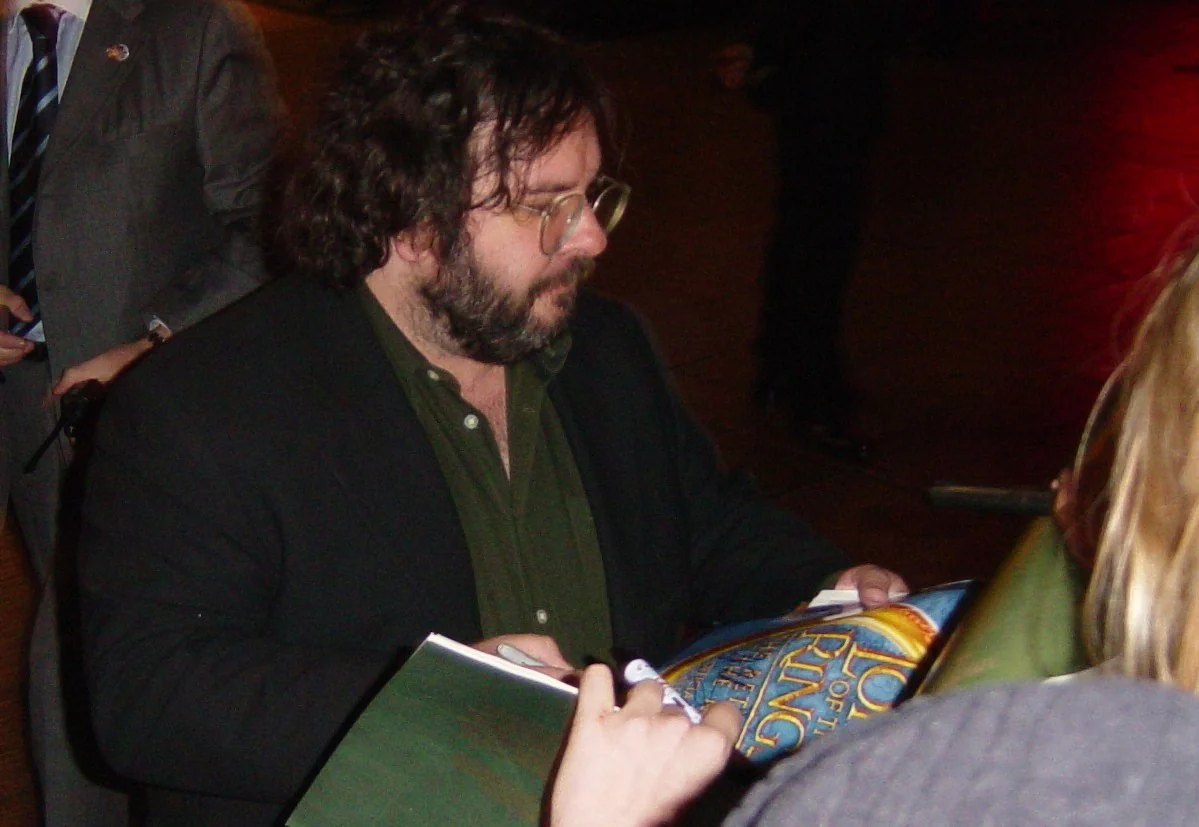
Peter Jackson
Film director, screenwriter and producerPeter Jackson moved from small-scale New Zealand genre filmmaking to internationally financed fantasy films and major documentary projects. His work depended on sustained collaborations in writing, production, performance and effects.Read biographyQuick answers
Common questions
- Was the film watched for this guide?
- No. The guide examines readable credits, catalogue records and a production-company account. It makes no original scene, performance or shot-by-shot analysis.
- Does Wētā’s fourteen-shot figure count every effect in the film?
- The company describes its own visual-effects contribution. The guide does not convert that statement into an independently verified count of every practical or digital effect.
Primary and institutional sources
How this history was checked
Film and award catalogue records and the complete short Wētā production note were read. No film, trailer, interview video, screenplay, storyboard or complete production archive was inspected. This article was reviewed on 27 October 2026.
- New Zealand Film CommissionHeavenly Creatures: film and credit record
- NZ On ScreenHeavenly Creatures: key cast and crew
- Wētā FXHeavenly Creatures: filmography
- Te Ara / Manatū TaongaHeavenly creatures, 1994: catalogue caption
- Academy of Motion Picture Arts and SciencesThe 67th Academy Awards, 1995: Heavenly Creatures nomination