
The short answer
How do the Titanic inquiry’s shipyard and regulatory records divide responsibility for a passenger ship?
Compare the documents
Authority, evidence and limits
These records describe different responsibilities; one should not silently substitute for another.
| Record | What it establishes | What it does not establish |
|---|---|---|
| Senate record, p. 7288 | Distinguishes davit capability from installed boats and person-capacity. | A possible handling figure is not the number of boats actually carried. |
| Commons 18 April 1912 answers | Explains the regulatory scale and corrects a question’s premise. | Compliance alone does not prove provision adequate for all aboard. |
| Pirrie biographies | Establish shipyard leadership and commercial relationships. | A title does not prove sole authorship of each safety decision. |
Three measurements answer three different questions
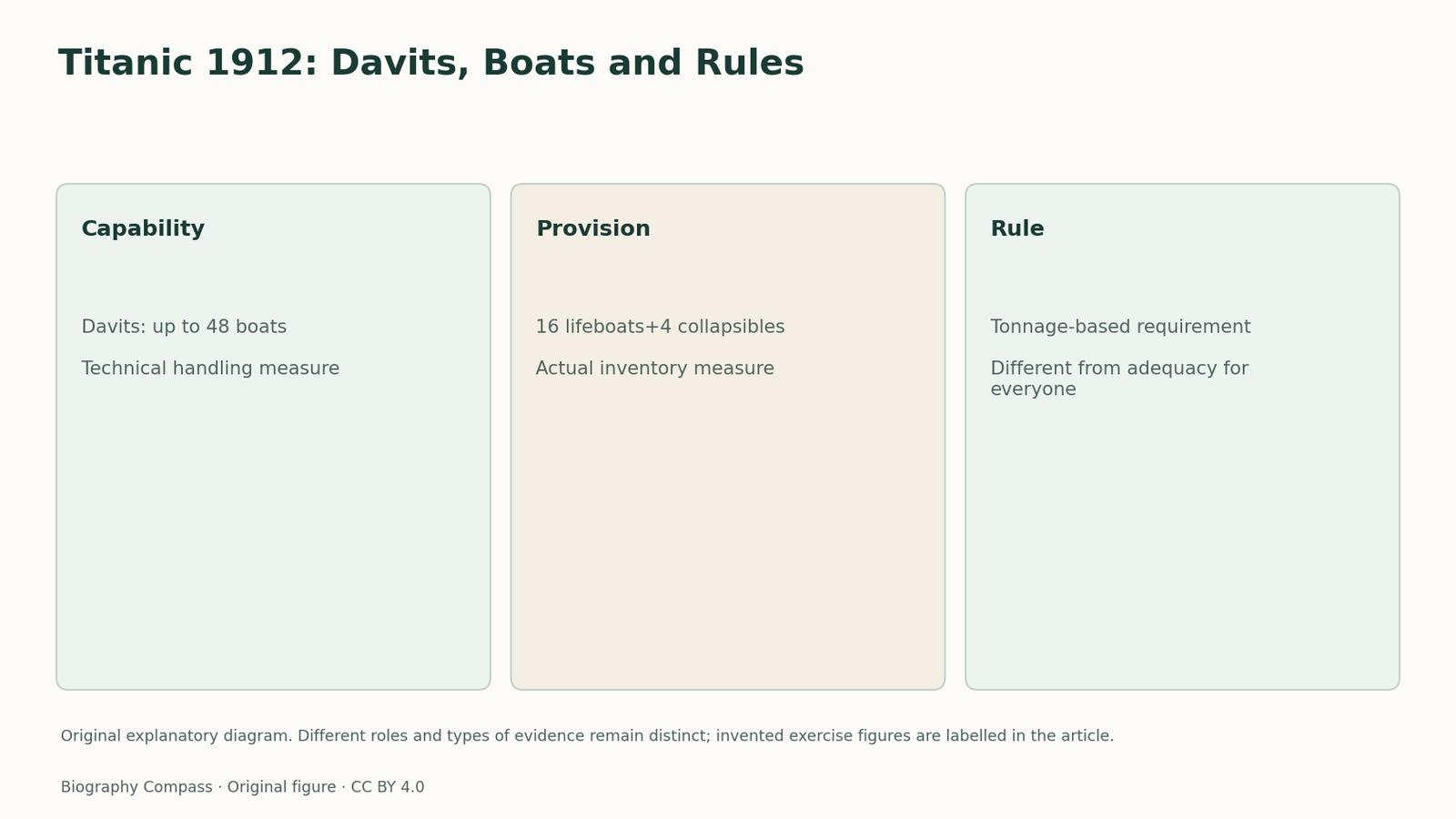
The Senate record describes 16 sets of davits capable of handling up to 48 boats, while the ship carried 16 lifeboats and 4 collapsible boats. Capability of a launching arrangement is not an inventory of boats actually carried. Nor is either count automatically the same as the number of people the equipment could accommodate. This distinction matters before discussing responsibility: an impressive technical capability can coexist with a much smaller installed provision. The source passage gives equipment figures, not proof that every possible alternative loading arrangement was practicable or that a single named executive personally rejected all other options.
Sources for this section: [3]
A rule’s minimum was a separate institutional standard
In the 18 April 1912 Commons exchange, the minister explained the Board of Trade’s tonnage-based scale and corrected the premise of a question about the required number of boats. The exchange shows why a question’s asserted figure should not automatically be quoted as the official answer. It also distinguishes a regulatory requirement from a judgment that provision was adequate for everyone aboard. Compliance describes a relationship between equipment and a specified rule; it does not by itself establish that the rule anticipated the needs of a much larger liner. The later Senate passage and the early parliamentary answers therefore need their dates and functions kept visible.
Sources for this section: [4]
Chairmanship does not identify every decision-maker
Pirrie’s leadership of Harland and Wolff connects him with the industrial enterprise that built Titanic. The biographical records also show relationships with shipping clients and other institutions. Those connections supply context, not a substitute for a document identifying who proposed, approved or changed a particular arrangement. A responsible comparison can show how builders, owners and regulators occupied different positions without claiming that seniority proves sole personal blame. The inspected official passages concern equipment and standards; they are not a complete reconstruction of the ship’s design meetings, operation during the sinking or every conclusion of the inquiries. Narrowing the conclusion protects the important distinction the sources actually establish.
Capacity exercise and reference answer
Imagine an original diagram with three boxes: davit handling capability, boats carried and regulatory minimum. Place 48 in the first and 16 plus 4 in the second, then put the relevant rule description rather than an invented matching number in the third. Now test two claims: the ship carried 48 boats, and compliance proves every passenger had an individual lifeboat place. The reference answer rejects both shortcuts. The first confuses a capability with installed inventory; the second requires a separate comparison of person-capacity and those aboard. This is a document-classification exercise, not a simulated evacuation or a calculation of final casualty totals. Its purpose is to make a safety discussion begin with compatible measurements and identified responsibilities rather than one dramatic number detached from its record.
Continue the chronology
Related history guides
The Victoria Bridge: Engineer and Contractor
Identify the different engineering, contracting and construction-record roles behind Montreal’s Victoria Bridge, with an original responsibility-map exercise.
Read the timeline1833–1834; recollection 1893Westland Row: Designer, Builder and Roof
Use Westland Row’s architectural record and Le Fanu’s recollection to separate railway design, building and roof work, with an original credit-allocation exercise.
Read the timelineBiography context
Explore Ireland through connected lives
Connected biographies
People behind the collaboration
1847–1924
William Pirrie
Shipyard leader and Belfast public figureWilliam Pirrie expanded Harland and Wolff through technical, commercial and shipping relationships, while working in Belfast public life and wartime merchant-ship production.Read biography1854–1931
Charles Parsons
Steam turbine engineer and industrialistParsons developed steam turbines for electricity generation and marine propulsion.Read biography1805–1870
Thomas Brassey
Railway contractor and partnership organiserThomas Brassey organised railway construction through contracting partnerships, linking engineers’ plans with finance, materials, workshops and large construction workforces.Read biographyQuick answers
Common questions
- Did Titanic carry 48 lifeboats because its davits could handle that many?
- No. The inspected Senate passage distinguishes a 48-boat handling capability from the 16 lifeboats and 4 collapsibles carried.
Primary and institutional sources
How this history was checked
The bibliography distinguishes contemporary records, retrospective participant accounts and later institutional research. Access limits and uncertain attributions are identified in the article; the exercise is an original teaching example. This article was reviewed on 7 November 2026.