
The short answer
How do Westland Row’s records distinguish a railway station’s designer, building contractor and roof supplier?
Compare the documents
Authority, evidence and limits
These records describe different responsibilities; one should not silently substitute for another.
| Record | What it establishes | What it does not establish |
|---|---|---|
| IAA Westland Row record | Separates Vignoles, Dargan and Bradley by the work described. | A general building credit does not establish every design decision. |
| IAA qualified roof attribution | Identifies probable design alongside roof work. | Probable must not silently become certain. |
| Le Fanu’s 1893 recollection | Describes an engineer settling a contractor’s accounts. | Personal praise is not the station’s original contract or a complete audit. |
A station does not necessarily have one maker
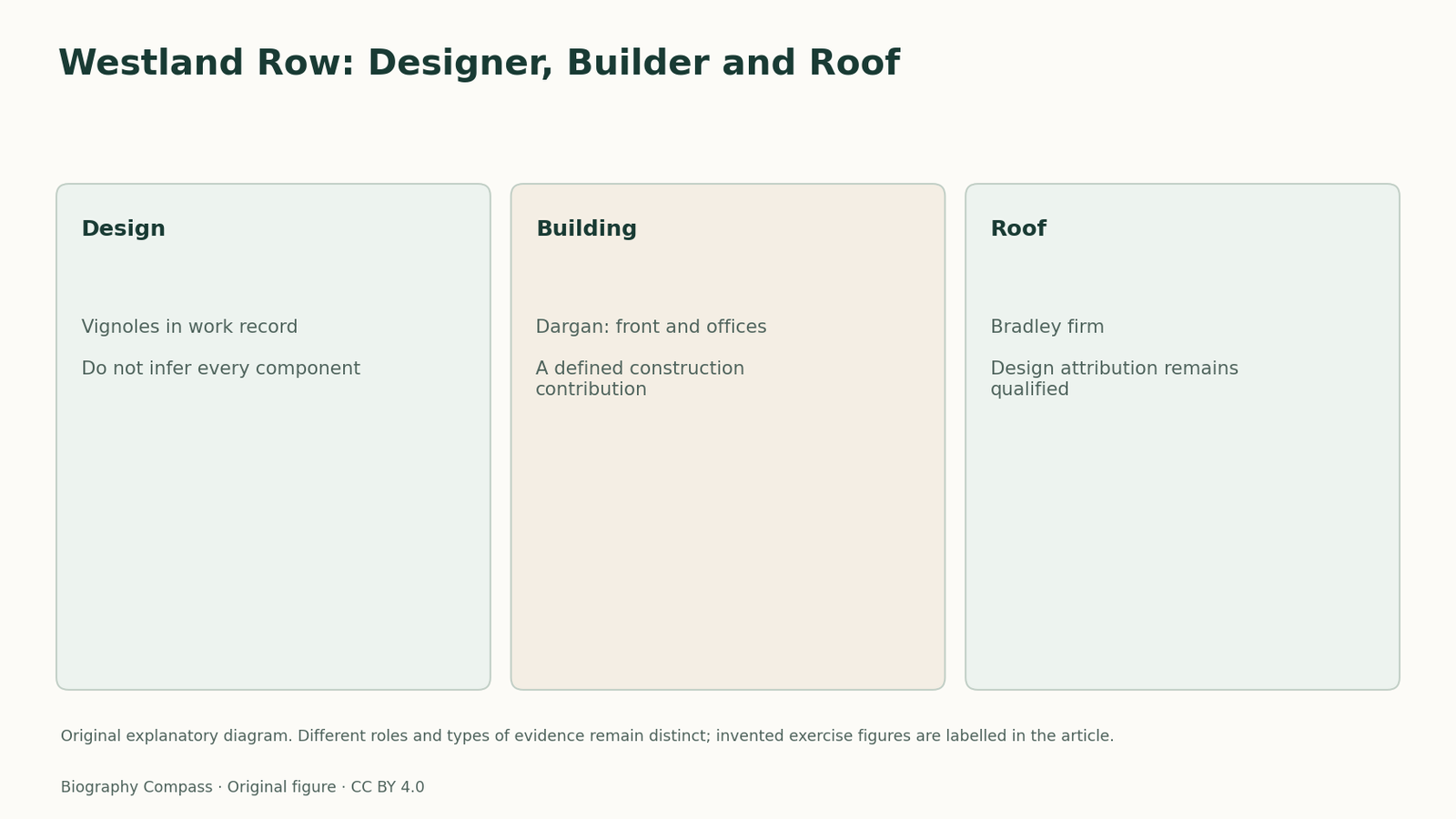
The Irish Architectural Archive’s Westland Row work record identifies Charles Vignoles in connection with design and Dargan with the front and offices. It separately names John Bradley and Company for the roof. These are component-specific credits, not a competition to select one name for the entire station. A railway undertaking brings building, engineering and supply into contact, and one contractor’s prominence in the wider line does not establish authorship of every part of its terminus. The record’s strength is its specificity. It allows an account more informative than simply saying that a famous contractor built the railway.
Sources for this section: [3]
Keep a qualified attribution qualified
The catalogue describes Bradley’s firm as probably responsible for the roof’s design. That qualification must remain attached to the claim: roof supply and definite design authorship are not identical propositions. The entries point to an 1834 report and a later engineering publication, but their citations do not mean that we inspected every underlying drawing or original contract. This guide compares the catalogue’s stated evidence with a participant recollection of professional practice. It does not present an inferred design credit as a newly established archival discovery. A careful public caption can give the firm its documented role while acknowledging where attribution remains less certain.
Sources for this section: [3]
An engineer’s recollection describes another relationship
In his 1893 memoir, William Le Fanu recalls settling Dargan’s accounts for railway companies and praises his conduct in disputed matters. This is a contemporary colleague’s retrospective assessment, not a neutral audit certificate or a clause from the Westland Row contract. It nevertheless helps identify a working distinction: the engineer acting for a company and the contractor submitting work and accounts could cooperate without occupying the same position. The modern Dargan biography provides the railway’s 1833–1834 chronology. Together, the sources support a discussion of responsibilities while leaving the detailed terms of uninspected contracts outside the conclusion.
Credit-allocation exercise and reference answer
Write three original labels for a station display: design, front-and-office construction and roof work. Assign the names recorded by the archive and keep the word probably beside the roof-design attribution. Now test the caption Dargan designed every part because he built the railway. The reference answer replaces that unsupported inference with the separate documented credits. A second question asks whether Le Fanu’s praise proves that every Dargan account was undisputed and independently audited. Again the answer is no: his recollection describes his own experience and opinion. The exercise uses the actual record’s distinctions without copying plans or inventing contract clauses. It shows how retaining component roles and uncertainty makes a short historical caption more accurate and more useful than one sweeping name.
Continue the chronology
Related history guides
The Victoria Bridge: Engineer and Contractor
Identify the different engineering, contracting and construction-record roles behind Montreal’s Victoria Bridge, with an original responsibility-map exercise.
Read the timeline1820s–1830s; retrospective account 1864Babbage and Clement: Who Owned What?
Separate the Difference Engine’s design, workshop tools, bills and government ownership through Babbage’s account and museum research, with a worked exercise.
Read the timelineBiography context
Explore Ireland through connected lives
Connected biographies
People behind the collaboration
1799–1867
William Dargan
Railway contractor and industrial patronWilliam Dargan developed a major Irish railway-contracting business through work with engineers and companies, and used part of his fortune to support the 1853 Dublin exhibition.Read biography
1757–1834
Thomas Telford
Civil engineer, surveyor and infrastructure organiserThomas Telford rose from stonemasonry to direct major roads, canals and bridges across Britain. His work joined design, surveying, public finance and construction management, relying on resident engineers, contractors and labourers as well as his own practical judgement.Read biography1805–1870
Thomas Brassey
Railway contractor and partnership organiserThomas Brassey organised railway construction through contracting partnerships, linking engineers’ plans with finance, materials, workshops and large construction workforces.Read biographyQuick answers
Common questions
- Did one contractor necessarily design every part of Westland Row?
- No. The archive distinguishes design, building and roof roles, and qualifies the roof-design attribution as probable.
Primary and institutional sources
How this history was checked
The bibliography distinguishes contemporary records, retrospective participant accounts and later institutional research. Access limits and uncertain attributions are identified in the article; the exercise is an original teaching example. This article was reviewed on 7 November 2026.