
The short answer
Why can repeated photon absorption cool atoms even though spontaneous emission is random?
Read the evidence
Cooling, recoil and confinement
The records distinguish the velocity distribution from the atoms’ residence within the light field.
| Record or test | What it establishes | What remains different |
|---|---|---|
| 1985 journal abstract | Reports sodium cooling and finite-time viscous confinement. | Cooling is not a promise that no atoms escape. |
| 1985 conference account | Describes six red-detuned beams and a viscous random-walk model. | Random recoil and boundaries remain part of the dynamics. |
| Later award record | Recognises a broader family of cooling and trapping methods. | Shared recognition does not make the separate laboratories one experiment. |
Light can change motion without contact
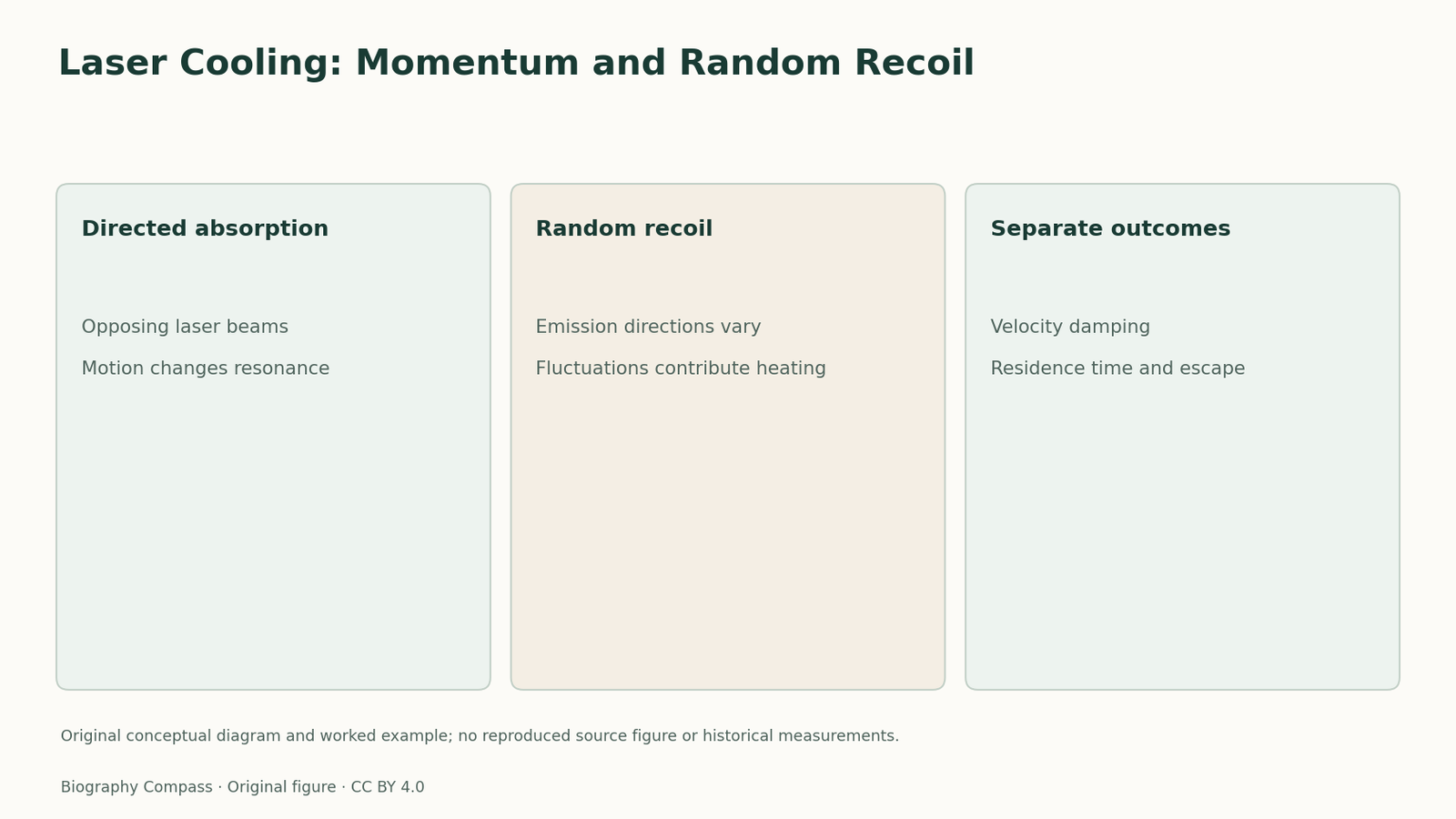
A photon carries momentum. In the optical-molasses arrangement, laser beams oppose one another along three directions, and their frequencies are chosen in relation to an atomic transition. An atom moving toward a suitably detuned beam interacts with that beam differently from the opposing one because of the Doppler shift. The resulting average force can resist the atom’s motion. The important word is average: the method does not require every emitted photon to leave in the same direction or every interaction to remove an identical amount of kinetic energy.
Random emission does not cancel the average force
Absorption can be biased by the chosen beam geometry and resonance condition, while spontaneous emission adds recoil in varying directions. Those random kicks contribute heating and diffusion. Cooling depends on the balance between the motion-dependent damping and these fluctuations, not on pretending that recoil is absent. The 1985 conference account describes six red-detuned beams and models atomic confinement as a random walk in a viscous medium with a boundary. That provides a more useful picture than imagining light as a solid cage around each atom.
Sources for this section: [4]
What the 1985 report actually measured
The original Physical Review Letters abstract reports three-dimensional cooling and viscous confinement of sodium atoms, including a temperature and a finite escape timescale. A low temperature describes the spread of velocities; confinement describes how long atoms remain within a volume. They are different observations. In particular, a force that opposes velocity does not automatically pull an atom back toward the centre after it has wandered away. The paper’s measured escape behaviour therefore belongs in the account, rather than being treated as a failure inconsistent with the cooling result.
Sources for this section: [3]
A force-and-motion exercise
Consider an invented atom moving to the right between two opposing cooling beams. If it absorbs more momentum from the beam travelling left, the average absorption force resists its rightward motion. Now let its spontaneous emissions point in randomly varying directions. The supported answer is that their mean need not provide the same directed push, but their fluctuations still matter for heating. Finally place an already slow atom near the edge of the illuminated region and ask whether damping alone guarantees return to the centre. It does not. The exercise separates velocity damping, random recoil and positional trapping. It is a conceptual classroom example, not a simulation of the sodium experiment or a new numerical estimate of its temperature.
Continue the chronology
Related history guides
The Zeeman Slower: Speed and Resonance
Read Phillips and Metcalf’s 1982 sodium-beam experiment, showing how magnetic and Doppler shifts work together and why slowing is distinct from cooling.
Read the timeline1995BEC Evidence: Narrow Peak and Transition
Read the 1995 rubidium-condensate signatures together, distinguishing a colder thermal cloud from a new component and a corroborating expansion test.
Read the timelineBiography context
Explore United States through connected lives
Connected biographies
Researchers and related approaches

1948–
Steven Chu
Experimental physicist and former U.S. Secretary of EnergySteven Chu moved from mathematics and physics training into experimental research at Bell Labs, Stanford and Berkeley, followed by service as U.S. energy secretary.Read biography
1918–2020
Katherine Johnson
Research mathematician at NACA and NASAKatherine Johnson applied mathematics to flight research and space trajectories at Langley. Her career joined calculation, verification and published technical work within engineering teams, while challenging the racial and gender barriers around that work.Read biographyQuick answers
Common questions
- Why can random photon emission coexist with cooling?
- The absorption process can provide a directed average damping force even while random emission produces recoil fluctuations.
- What is the difference between optical molasses and a positional trap?
- Molasses primarily damps velocity. A positional trap also needs a restoring mechanism that brings displaced atoms back toward a centre.
Primary and institutional sources
How this history was checked
The 1985 journal abstract supplies the reported result; the same team’s conference account explains the beam geometry and model. The exercise adds no historical measurements. This article was reviewed on 7 November 2026.
- Optica Historical ArchiveSteven Chu
- Stanford UniversitySteven Chu’s Profile
- Chu, Hollberg, Bjorkholm, Cable and Ashkin / American Physical SocietyThree-dimensional viscous confinement and cooling of atoms by resonance radiation pressure
- Hollberg, Chu, Bjorkholm, Cable and Ashkin / Optica 1985 conferenceLaser cooling and confining of atoms
- Nobel Prize OutreachSteven Chu — Facts
- Nobel Prize OutreachSteven Chu — Biographical