
The short answer
Hunt’s petition explains both why he attended Manchester and why he asked Parliament to intervene after the meeting.
Evidence comparison
Read the records together
The records were created for different purposes and support different kinds of claims.
| Record | What it establishes | Question to keep open |
|---|---|---|
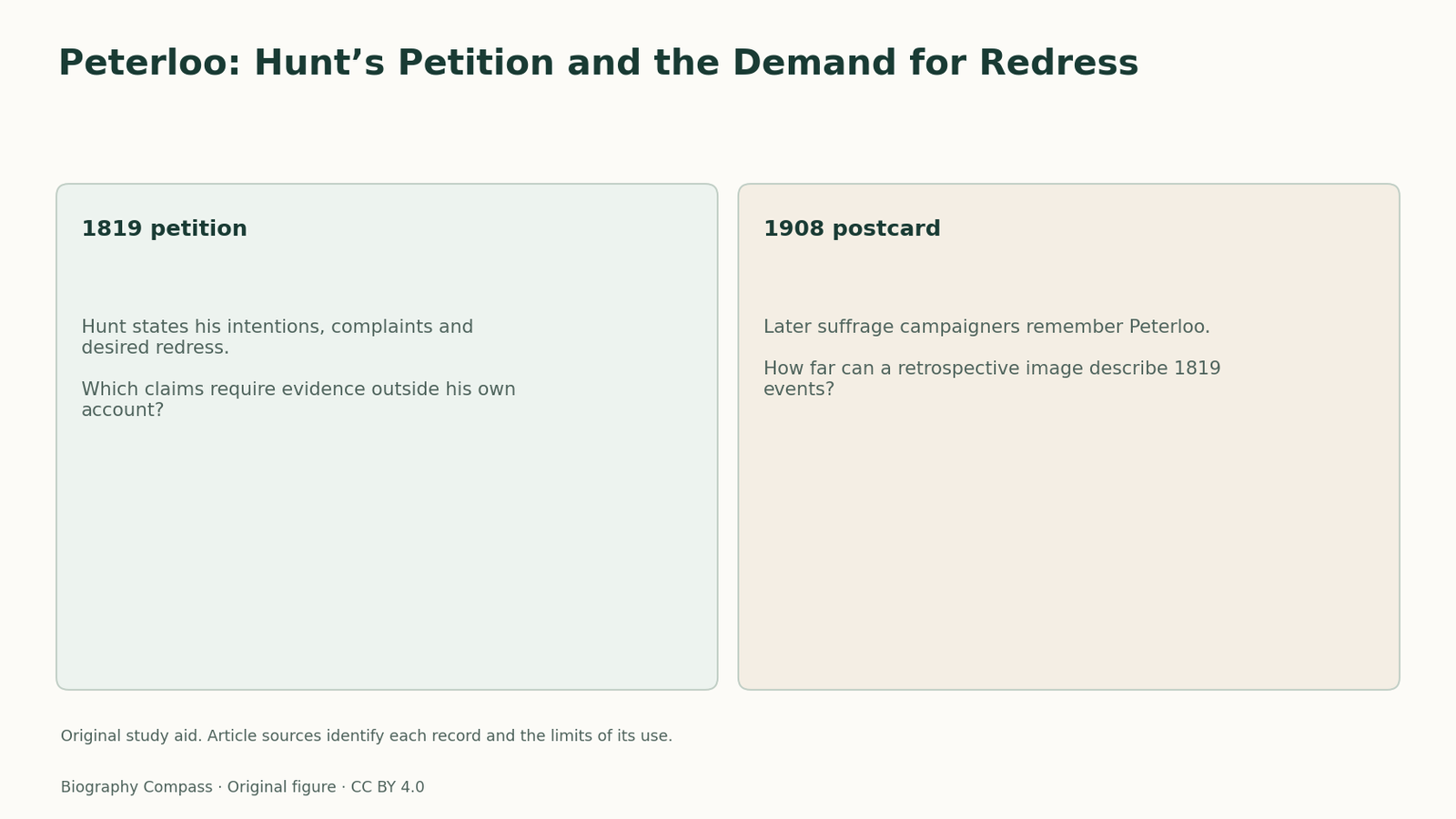
| 1819 petition | Hunt states his intentions, complaints and desired redress. | Which claims require evidence outside his own account? |
| 1908 postcard | Later suffrage campaigners remember Peterloo. | How far can a retrospective image describe 1819 events? |
Chronology
A timeline of the turning points
Meeting and petition
The Manchester gathering is followed by Hunt’s appeal.
Voting petition
Hunt presents an individual woman’s petition.
Identify the petitioner’s purpose
The November 1819 petition reports that Hunt had been invited to chair a meeting about reform of the Commons. It reproduces his instructions that participants should remain peaceful. Those passages establish the defence he wished to put before Parliament. They also identify a particular document and audience. They do not independently prove how every person behaved across a large crowd or settle responsibility for all the events that followed.
Sources for this section: [2]
Trace the requested remedy
Hunt described attempts to obtain legal action against magistrates and members of the yeomanry. He alleged that local connections and procedural barriers had frustrated his efforts. The petition therefore did more than narrate violence: it asked the House to consider whether existing avenues of redress were adequate. To understand its structure, separate each alleged wrong from the institution to which he had already appealed and the further intervention he wanted.
Sources for this section: [2]
Keep later memory on another date
Parliament’s collection includes a suffrage postcard from 1908 depicting Hunt at Peterloo. That object connects later voting campaigns with the earlier meeting. It is evidence of retrospective political memory, rather than a photograph or contemporaneous account of 1819. Hunt’s later parliamentary work, including presentation of a woman’s voting petition in 1832, helps explain the connection without making the postcard an eyewitness record of the event it depicts.
Compare claims with findings
Make three columns headed intention, allegation and later commemoration. Place Hunt’s instructions in the first, his complaints about legal obstacles in the second and the postcard in the third. A careful answer leaves a fourth heading, independent findings, available for additional records. This exercise lets the petition be used fully while preventing the confidence of its language from substituting for evidence from every other participant or institution involved.
Continue the chronology
Related history guides
Biography context
Explore United Kingdom through connected lives
Connected biographies
People behind the records
1773–1835
Henry Hunt
Radical speaker and parliamentarianHunt carried the language of public meetings into disputes over representation and parliamentary accountability.Read biographyQuick answers
Common questions
- Is Hunt’s petition a court judgment?
- No. It records his account and his request to Parliament, including allegations that require independent comparison.
Primary and institutional sources
How this history was checked
Sources support the chronology and the record comparison. The reading exercise is original. This article was reviewed on 7 November 2026.