
The short answer
The reform debate contains a proposed framework and a later claim about its effects. Their authors, audiences and evidentiary reach differ.
Evidence comparison
Read the records together
The records were created for different purposes and support different kinds of claims.
| Record | What it establishes | Question to keep open |
|---|---|---|
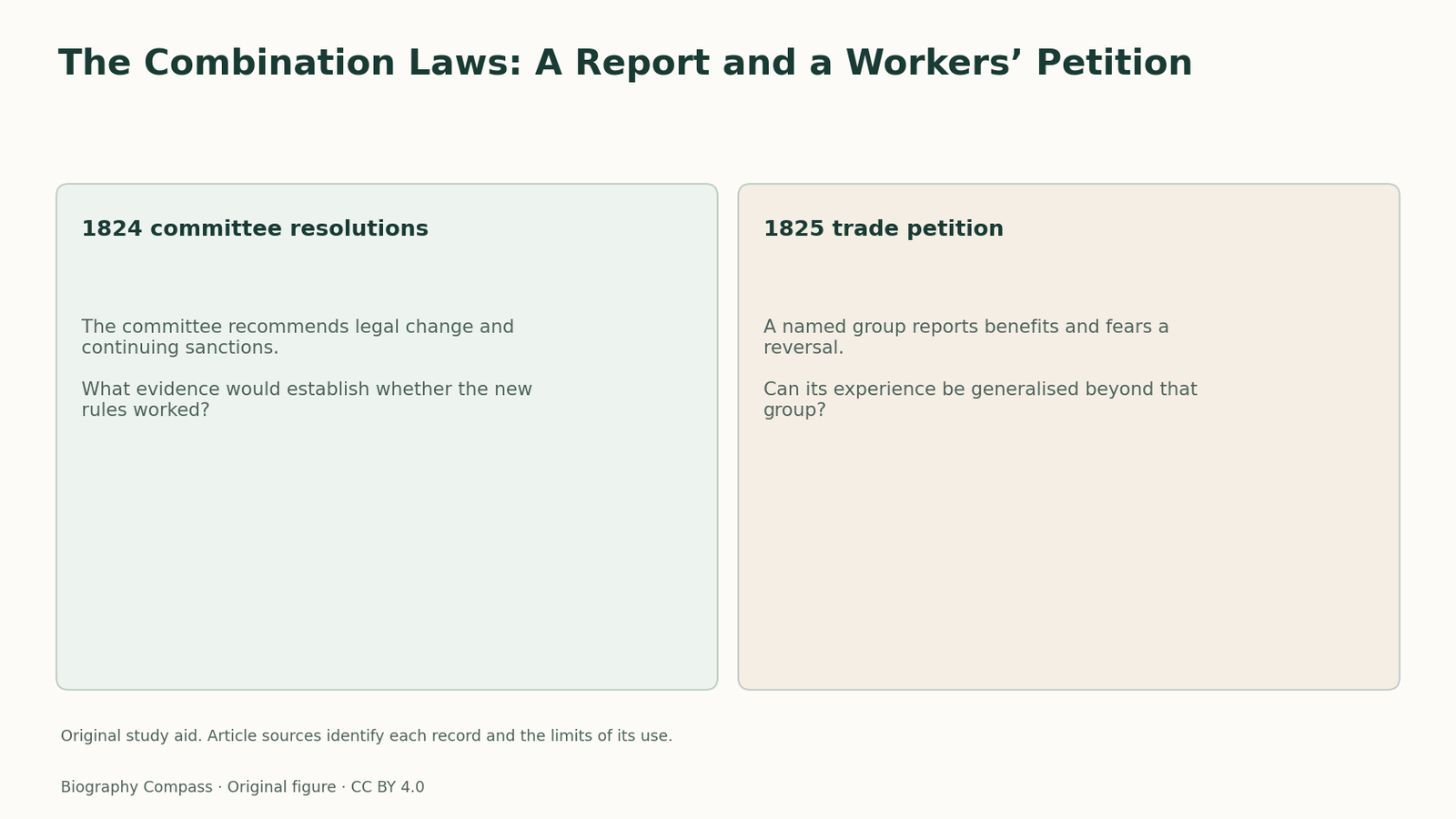
| 1824 committee resolutions | The committee recommends legal change and continuing sanctions. | What evidence would establish whether the new rules worked? |
| 1825 trade petition | A named group reports benefits and fears a reversal. | Can its experience be generalised beyond that group? |
Chronology
A timeline of the turning points
Report presented
The committee recommends changes to combination law.
Petition received
Fustian-cutters defend the gains they attribute to repeal.
Read the committee’s reasoning
Hume’s 1824 report presentation described combinations that continued despite legal prohibitions. The committee therefore questioned whether the existing laws achieved their stated purpose. It also recommended punishment for intimidation and violence. These positions belong together: the proposed freedom to organise did not imply acceptance of every method used during a dispute. Identify the conduct being permitted and the conduct still subject to sanction before summarising the recommendation.
Sources for this section: [2]
Identify the petition’s constituency
In April 1825 Hume presented a petition from fustian-cutters in Manchester and the surrounding area. They claimed repeal had benefited their trade and improved relations between workers and employers. Their petition also expressed fear of reversal. This is a valuable report of organised opinion from a named group. Its claim about experience is narrower than a statistical finding about wages, strikes or employer behaviour throughout the country.
Sources for this section: [3]
Compare a recommendation with a reaction
The report looks forward to an altered legal framework; the petition looks back on what its authors considered a successful change. Both entered Parliament through Hume, but he did not write in the same capacity as the petitioners. A shared presenter does not make the documents one voice. Their connection instead reveals a political feedback process in which people affected by legislation tried to shape the next stage of parliamentary consideration.
Test a generalisation
Consider the statement that repeal improved every workplace. Underline the part supported by the fustian-cutters and replace the remaining claim with a research question. A sound answer attributes improvement to that trade’s petition and asks for evidence from other occupations, places and dates. Add a second question about enforcement of intimidation offences. The exercise turns the contrast between legislative intention and local experience into a practical plan for further reading.
Continue the chronology
Related history guides
Biography context
Explore United Kingdom through connected lives
Connected biographies
People behind the records
1777–1855
Joseph Hume
Radical parliamentarianHume brought evidence and petitions into disputes over how Parliament regulated labour and public administration.Read biographyQuick answers
Common questions
- Does the petition show the experience of all British workers?
- It records the claims of Manchester-area fustian-cutters. Other trades and places need their own evidence.
Primary and institutional sources
How this history was checked
Sources support the chronology and the record comparison. The reading exercise is original. This article was reviewed on 7 November 2026.