
The short answer
How did chemical constraints support the 1951 alpha-helix model before complete protein structures were known?
Read the evidence
Different records within the same investigation
The following comparison distinguishes the specific questions answered by the inspected records.
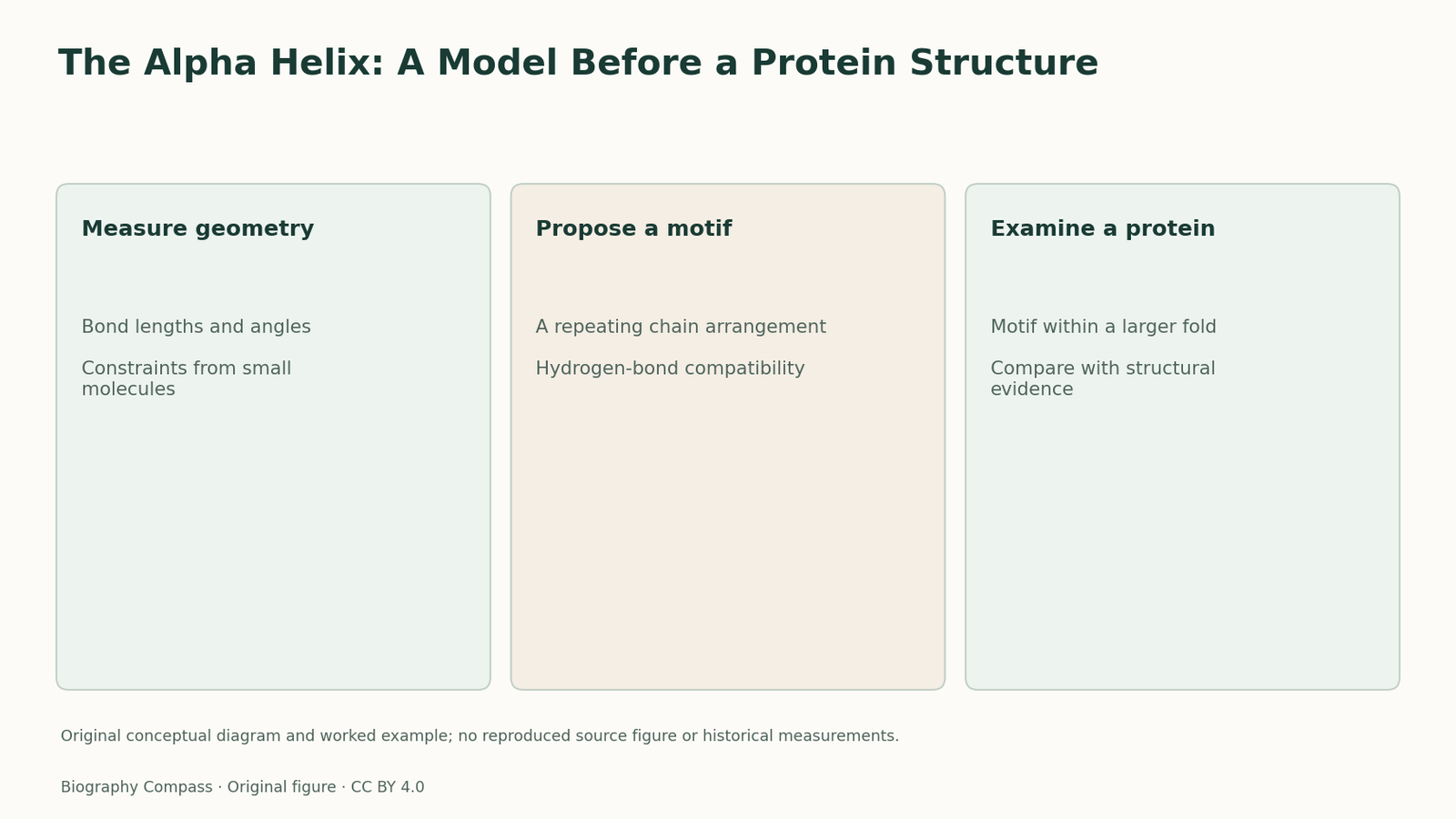
| Record or test | What it establishes | What remains different |
|---|---|---|
| Small-molecule measurements | Supply constraints on bond geometry. | Do not directly specify the entire protein fold. |
| Helical chain model | Proposes a regular arrangement satisfying selected constraints. | Is a motif rather than a universal complete structure. |
| Protein structural evidence | Tests how the motif appears in an actual architecture. | May reveal additional folding and interactions. |
Start with measured chemical geometry
The 1951 paper explains that its authors used structural information from amino acids, peptides and related small molecules to investigate protein chains. Bond distances and angles were not arbitrary artistic choices. They constrained which arrangements of a polypeptide backbone were chemically plausible. The research question was therefore narrower than drawing any attractive spiral: could a repeating chain configuration satisfy the relevant geometry and hydrogen-bonding requirements? That gave model building an explicit, testable chemical basis.
Sources for this section: [1]
A recurring motif is different from a whole protein
The proposed helices described regular configurations of one polypeptide chain. They did not specify the complete fold of every protein containing such a segment. Pauling’s Nobel account places the alpha helix within a broader programme connecting chemical bonds with complex substances. This distinction explains why the proposal could be valuable before complete globular-protein structures were determined. A local repeating motif and the larger arrangement of many segments answer different structural questions.
Use a model to organise further measurements
Pauling’s lecture emphasises the interaction of chemical facts and quantum principles in building useful molecular descriptions. Applied to a protein motif, that approach connects constraints with consequences that later measurements can examine. A plausible helix should not be confused with a direct photograph of every atom in an intact protein. Its value is that it defines an arrangement clearly enough to compare with diffraction and other structural evidence. The chemical assumptions make the proposal informative rather than merely decorative.
An original model-building exercise
Imagine a set of fictional chain models made from identical links. Model A forms a smooth spiral but requires several bond angles to change freely. Model B is less visually regular but preserves the specified geometry and allows the required interactions. Which should be preferred as a chemical candidate? B has the stronger initial case because the constraints matter more than visual smoothness. Now suppose a model satisfies those constraints but a measured protein fold differs. That does not establish that all helical motifs are impossible; it tests whether the proposed arrangement describes that particular structure. The example contains no historical bond lengths or copied atomic coordinates. Its supported answer separates a chemically plausible motif, a complete molecular fold and the evidence needed to connect them.
Continue the chronology
Related history guides
Myoglobin: From a 6 Å Map to Atomic Detail
Compare Kendrew’s 1958 low-resolution map with the 1960 myoglobin model, using a worked exercise on what improved resolution can reveal about protein structure.
Read the timeline1962–1970Haemoglobin Cooperativity: Structure and Function
Connect Perutz’s structural work with his 1970 account of oxygen binding, using an original exercise to distinguish molecular states from binding measurements.
Read the timelineBiography context
Explore United States through connected lives
Connected biographies
Researchers and related approaches
1901–1994
Linus Pauling
Chemist, structural theorist and peace campaignerLinus Pauling connected quantum chemistry with molecular structure, helped propose the alpha helix and became a prominent campaigner against nuclear testing.Read biography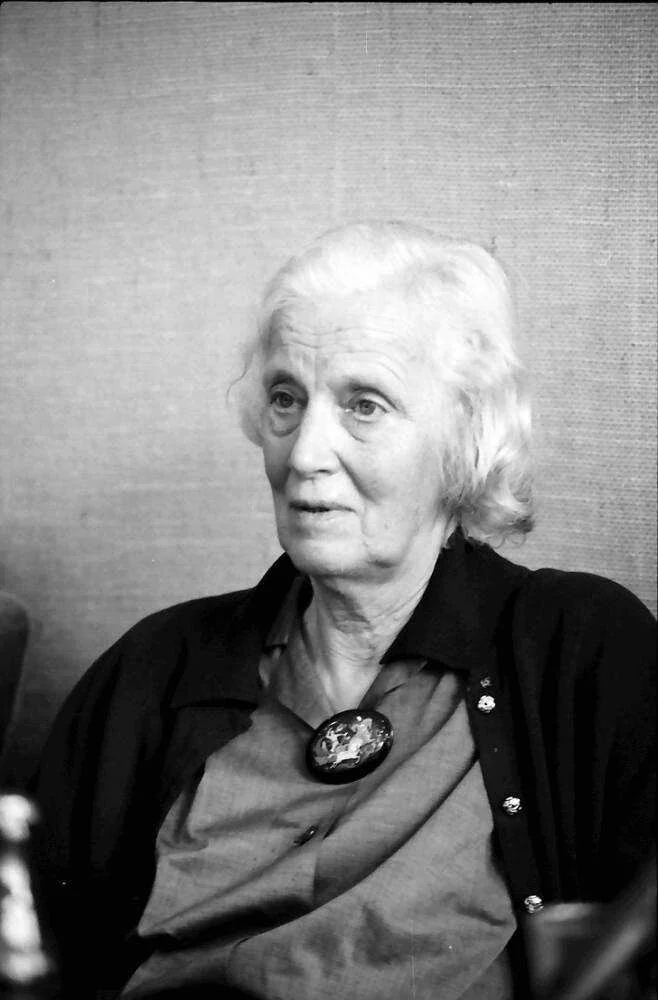
1910–1994
Dorothy Hodgkin
Chemist, crystallographer and university teacherDorothy Hodgkin used X-ray crystallography to investigate the three-dimensional structures of biologically important molecules. Her career joined experimental technique, mathematical interpretation, teaching and international research collaboration.Read biographyQuick answers
Common questions
- Why did small molecules matter?
- Their measured geometry supplied constraints for plausible polypeptide configurations.
- Is a visually smooth model necessarily chemically better?
- No. Agreement with chemical constraints and experimental evidence is the relevant test.
Primary and institutional sources
How this history was checked
The references below distinguish the original study from later explanations. The worked exercise and comparison are newly written for this article. This article was reviewed on 8 November 2026.