
The short answer
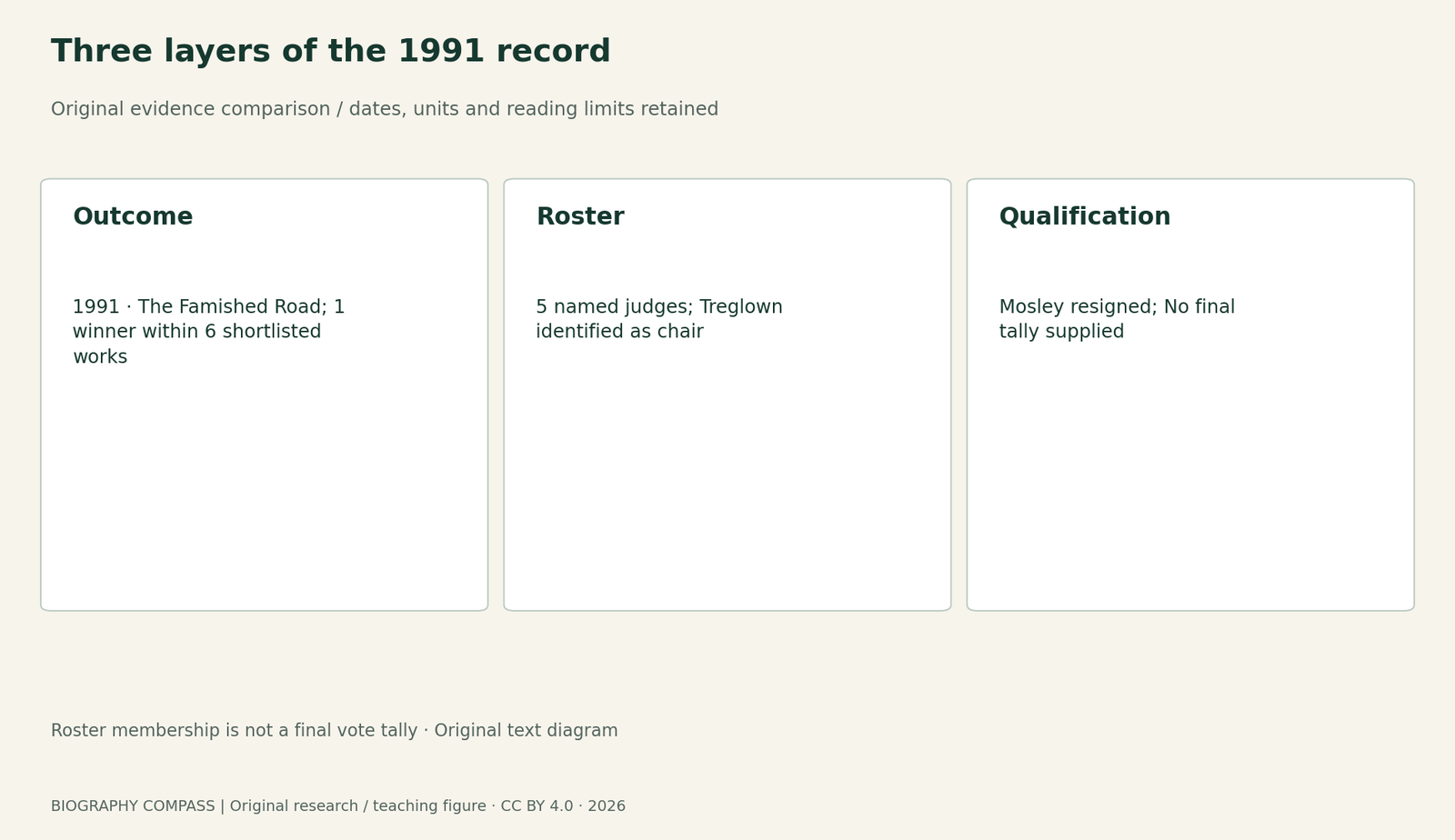
The 1991 Booker archive is more than a list of successful novels. Its shortlist and judge roster sit beside an account of a resignation. This guide asks how to combine those records without inventing deliberations or pretending to have reviewed all six books.
Original source comparison
Match the evidence to the question
Separate the object, event and inference before writing a conclusion.
| Country | What the record supports | Limit or next step |
|---|---|---|
| Prize-year archive | Winner, shortlisted works, names and resignation. | No vote tally or ranking of non-winning books. |
| Author biography | Earlier works and a career beyond the 1991 novel. | A participant’s career account is not an independent reading of each book. |
| Invented label | A bounded set of claims to test and revise. | Exercise wording is original teaching material, not historical testimony. |
Chronology
A timeline of the turning points
Earlier career
Flowers and Shadows preceded the award by eleven years.
Winner and shortlist
The archive identifies one winner within six shortlisted works.
Resignation
The archive records Mosley leaving after a disagreement over the shortlist.
Record review
Archive text was consulted; ceremony video and full novels were not inspected.
Start with the object that received the award
The archive names The Famished Road by Ben Okri as the 1991 winner and credits Jonathan Cape as its publisher. Record those fields before explaining what the outcome might mean. An award year identifies an institutional event; a publisher credit identifies the edition context represented by the archive. Neither is a complete account of a book’s composition, publication in every country or later reception. Okri’s author biography supplies a separate career chronology, placing early novels and story collections before this result. Comparing the records keeps a single prize from becoming the supposed beginning of a writer’s work.
Treat the shortlist as a set rather than a ranking
The six shortlisted works are Time’s Arrow by Martin Amis, The Van by Roddy Doyle, Such a Long Journey by Rohinton Mistry, The Redundancy of Courage by Timothy Mo, The Famished Road by Ben Okri and Reading Turgenev by William Trevor. The winner appears within that set. The page does not assign second through sixth places. Its display order is not evidence that a runner-up exists or that one book was preferred to another in a particular vote. A researcher can count six distinct shortlisted titles, but cannot transform six visible positions into six finishing ranks. That distinction applies even when a page’s visual hierarchy makes such a ranking feel intuitive.
Sources for this section: [1]
Read the roster beside the account of resignation
The named judges are Jeremy Treglown, Penelope Fitzgerald, Jonathan Keates, Nicholas Mosley and Ann Schlee. A ceremony caption identifies Treglown as chair. The same archive explains that Mosley resigned after disagreement about the exclusion of Allan Massie’s The Sins of the Fathers from the shortlist. The roster therefore records association with the judging panel, while the narrative qualifies participation. It is reasonable to report both. It is not reasonable to write that five named judges necessarily cast five final votes, that Mosley voted for Okri, or that the winner was unanimous. Those claims would need further evidence, such as reliable minutes or explicit testimony.
Sources for this section: [1]
Separate award history from a reading of the novel
The Booker page includes short descriptions and links to ceremony footage. An author biography identifies the novel’s place in a larger career. Those sources answer institutional and biographical questions; they do not supply a close reading of its narration. The exercise here concerns evidence structure, not a contest between six literary interpretations. A later reader studying the novels should identify the edition and passages used, then make an argument supported by the text. A useful research note records what was not inspected too: no full shortlisted novel and no ceremony video was reviewed in preparing this guide. A link on a page is access to a possible next source, not proof that it has been examined.
Original exercise: repair an overconfident exhibition label
An invented exhibition label reads: “In 1991 five judges unanimously ranked The Famished Road first, with The Van second. Mosley’s presence on the panel proves that he voted for Okri.” Using only the archive fields described above, mark each assertion as supported, contradicted or not established. Then write a replacement of no more than 55 words. Your label must name the winner, identify the shortlist as a set, and retain the resignation. This is an exercise in editing claims to fit evidence, not a reconstruction of an actual exhibition or a quotation from the Booker archive.
Sources for this section: [1]
Reference answer: preserve the outcome and uncertainty
The winning title and year are supported. A second-place result, unanimity and Mosley’s vote are not established; the participation claim also ignores the explicit resignation. A suitable replacement is: “The Famished Road by Ben Okri won the 1991 Booker Prize from a shortlist of six books. The archive lists five judges and records Nicholas Mosley’s resignation after a shortlist disagreement. It does not provide a final vote tally or rank the other five shortlisted works.” The repair retains useful facts while removing invented precision. A stronger claim could be reconsidered if a new, properly scoped source supplied the missing evidence.
Sources for this section: [1]
Continue the chronology
Related history guides
Biography context
Explore Nigeria through connected lives
Connected biographies
People in this guide
1959–
Ben Okri
Novelist, poet and essayistBen Okri is a Nigerian-born writer whose work moves among novels, short stories, poetry, essays and drama. The Famished Road won the 1991 Booker Prize, making a long developing literary career internationally visible.Read biographyQuick answers
Common questions
- Does the shortlist show the runner-up?
- The consulted page does not rank the five non-winning works.
- Can the judge roster be used as a final vote count?
- No. The page separately records Mosley’s resignation and gives no final tally.
Primary and institutional sources
How this history was checked
Read the named record for its stated scope. No full novel, audio recording, film or music video was inspected for this guide. This article was reviewed on 27 October 2026.