
The short answer
Calling one prize an African version of another can conceal the form of writing each recognizes. Start with Habila’s Love Poems and Okri’s The Famished Road, then ask a second question: which year’s rules can a source actually establish?
Original source comparison
Match the evidence to the question
Separate the object, event and inference before writing a conclusion.
| Country | What the record supports | Limit or next step |
|---|---|---|
| Historical winner records | Identify title, author, award and year. | Do not supply all historical entry conditions. |
| Detailed current criteria | Provide a cycle-labelled rule set for provisional checking. | Page conflicts must be resolved; do not apply backwards. |
| Author biography | Distinguishes judging from winning and story from novel. | A career summary cannot replace the relevant prize rulebook. |
Chronology
A timeline of the turning points
Booker outcome
The Famished Road is the recorded winner.
Caine outcome
Love Poems is the recorded winner.
Novel publication
Waiting for an Angel followed the short-story prize.
Booker change
Booker’s history dates the opening to any nationality to this year.
A different role
Atta served as a Caine judge.
Conflicting page
Current page includes 2027-labelled criteria and inconsistent windows/deadlines.
Name the awarded work before comparing the prizes
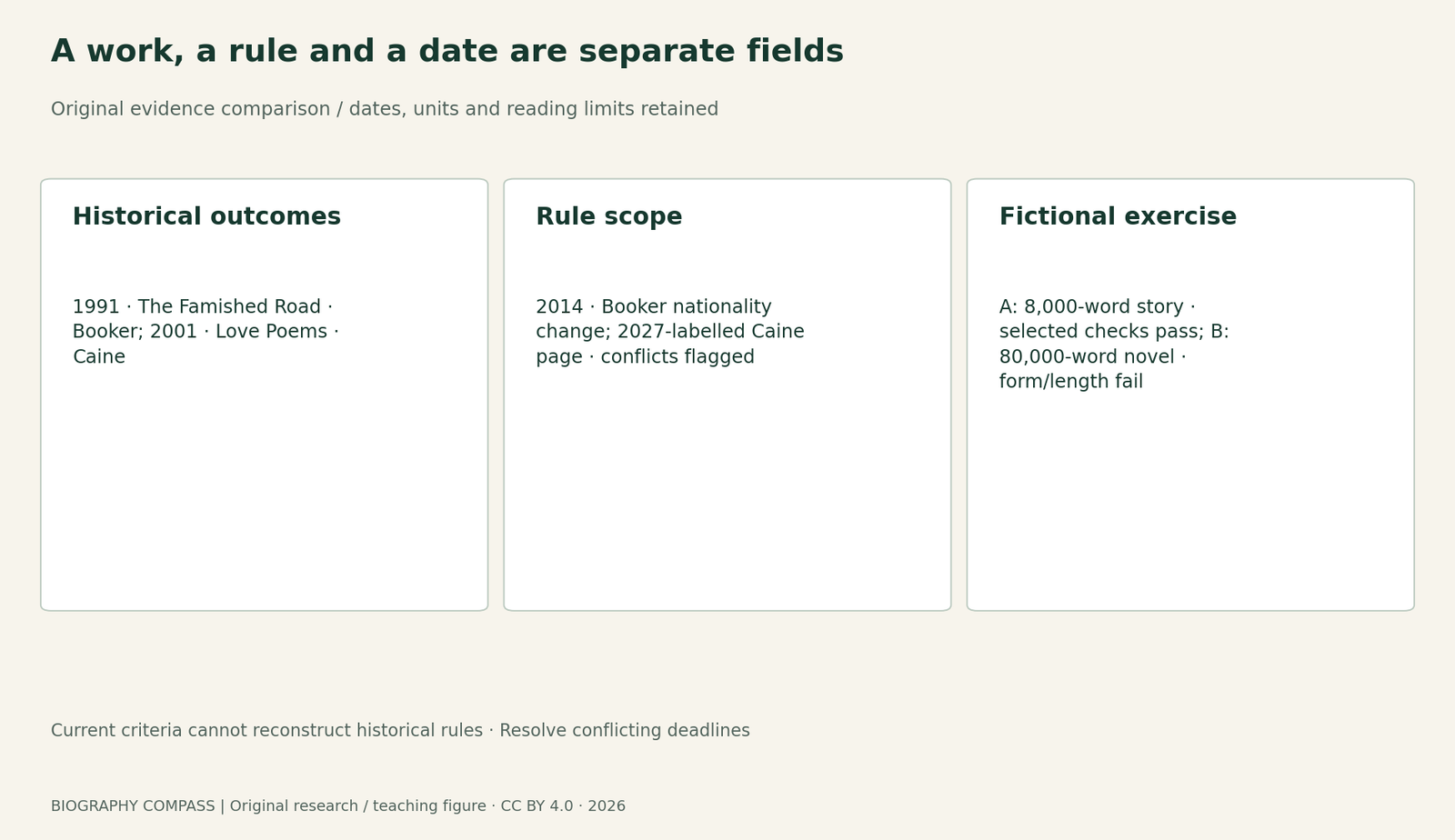
The Caine history names Love Poems by Helon Habila as its 2001 winner. Georgetown places it in the 2000 collection Prison Stories; Habila’s first novel Waiting for an Angel followed in 2002. The Booker archive names The Famished Road by Ben Okri as its 1991 winner. These are two different award objects, not equivalent-sized units of a writer’s career. A story can circulate within a collection or later connect with a novel without changing the title and form named in an award record. The comparison starts with those particulars rather than an assumption that prestigious literary prizes all reward novels.
Distinguish an outcome record from a rulebook
A winner list proves what that institution records as an outcome. It does not reproduce every rule governing entries in the winning year. The current Caine description concerns an African writer’s short story published in English; the current Booker description concerns sustained fiction in English published in the UK and Ireland. Booker’s own history dates its opening to authors of any nationality to 2014. That later change is a reason to avoid projecting present eligibility backwards onto Okri’s 1991 award. This guide does not reconstruct a complete 1991 Booker or 2001 Caine rulebook from modern descriptions. An unknown historical requirement should remain unknown until a dated source answers it.
The current Caine page needs a conflict note
On 27 October 2026, the submissions page contains rules labelled for 2027. Its opening description says stories from the preceding five years; its detailed criterion instead gives a three-year period and the dates 24 October 2023 through 24 October 2026. Its headline opening and closing dates also differ from the FAQ dates. These are internal conflicts in one source, not evidence that an applicant may choose a preferred window. The detailed rules consistently give a 3,000–10,000-word range and reject novels, but that agreement cannot resolve the other conflicts. A responsible note identifies the discrepancy and seeks a corrected, cycle-specific statement before a real submission decision. No definitive deadline is supplied here.
Sources for this section: [6]
Keep the person’s role separate from the winning title
Atta’s author biography says she judged the Caine Prize in 2019. That is different from Habila’s status as its 2001 winner. A person may appear on a prize website or in a literary biography as a judge, juror, shortlisted author or recipient; the surrounding role label matters. The same discipline applies to Habila’s first novel and his awarded story. When building a research table, give role, work, form, institution and date separate fields. Empty fields are preferable to importing a familiar title or assuming that every person associated with a prize won it. This small design choice prevents several common biographical errors.
Original exercise: triage two invented entries
Use only the detailed 2027-labelled Caine criteria, while keeping its date conflicts unresolved. Entry A is an 8,000-word fictional story by an adult Ghanaian national, published by an independent journal on 1 December 2024, never previously entered, with author consent and a publisher submitting it. Entry B has the same facts but is an 80,000-word novel. Decide which clears the listed form, length and publication-date checks. Then answer two separate questions: can A’s historical eligibility for the 2001 prize be inferred, and is either entry ready for real submission without checking the conflicting current page? All entry details are fictional.
Sources for this section: [6]
Reference answer: a provisional check is not full eligibility
A clears the stated fictional-story, word-count and explicit publication-date checks under the selected 2027 criteria. B fails form and length. The facts deliberately address several other listed conditions, but this limited exercise is not a guarantee of eligibility or selection. A cannot be judged under 2001 rules using a 2027 page; its publication date is also decades later. Neither entry is ready for a real submission decision based on this internally inconsistent page alone. Preserve the rule version and access date, list unresolved questions, and obtain clarification. The valuable result is a traceable decision with limits, not a confident answer assembled from incompatible years.
Continue the chronology
Related history guides
Reading the 1991 Booker Shortlist and Jury Record
Read the 1991 Booker winner, shortlist and judge roster together, then test what those records establish about participation and the final decision.
Read the timeline2020–2025Reading Nigerian Grammy Records: Category, Work and Credit
Use Burna Boy, Wizkid and Tems to distinguish Grammy album, performance and video awards, separate wins from nominations, and retain credited roles.
Read the timelineBiography context
Explore Nigeria through connected lives
Helon Habila
Follow the story, collection and first novel in their separate publication contexts.
Explore the biographiesRead the biographyBen Okri
Compare a named novel and a different prize-year record.
Explore the biographiesRead the biographySefi Atta
See the difference between a judging role and a winner entry.
Explore the biographiesConnected biographies
People in this guide
1967–
Helon Habila
Novelist, short-story writer and teacherHelon Habila is a Nigerian writer whose journalism, fiction, editing and teaching connect several ways of telling public stories. Love Poems won the 2001 Caine Prize; Waiting for an Angel followed as his first novel in 2002.Read biography1959–
Ben Okri
Novelist, poet and essayistBen Okri is a Nigerian-born writer whose work moves among novels, short stories, poetry, essays and drama. The Famished Road won the 1991 Booker Prize, making a long developing literary career internationally visible.Read biography1964–
Sefi Atta
Novelist, short-story writer and playwrightSefi Atta is a Nigerian writer working in novels, short stories, radio, stage and screen. Everything Good Will Come appeared in 2005, and she received the Wole Soyinka Prize for Literature in Africa in 2006.Read biographyQuick answers
Common questions
- Did the exercise establish every condition for entry?
- No. It tests named conditions and keeps conflicting deadlines unresolved; it is not application advice.
- Can current Caine word limits be assigned to 2001?
- Not from the sources used here. A dated historical rule source would be needed.
Primary and institutional sources
How this history was checked
Read the named record for its stated scope. No full novel, audio recording, film or music video was inspected for this guide. This article was reviewed on 27 October 2026.
- The Caine Prize for African WritingThe Prize: historical winners
- Georgetown University Lannan CenterHelon Habila: guest biography
- Windham-Campbell Prizes; YaleHelon Habila: 2015 Fiction recipient
- Booker Prize FoundationThe Booker Prize 1991: winner, shortlist and judges
- Booker Prize FoundationThe Booker Prize: description and origins
- The Caine Prize for African WritingSubmissions: page consulted 27 October 2026
- Sefi Atta official siteSefi Atta: biography