
The short answer
What did location-related hippocampal firing establish, and how did movement and behaviour complicate a simple map claim?
Read the evidence
Different records within the same investigation
The following comparison distinguishes the specific questions answered by the inspected records.
| Record or test | What it establishes | What remains different |
|---|---|---|
| Spatial correlation | Associates firing with a place or orientation. | Other variables may coincide with it. |
| Behavioural comparison | Tests sensory, movement or state alternatives. | Needs adequate variation and recording stability. |
| Map interpretation | Connects activity with a broader spatial account. | Is not identical to one isolated unit response. |
The original question concerned activity during behaviour
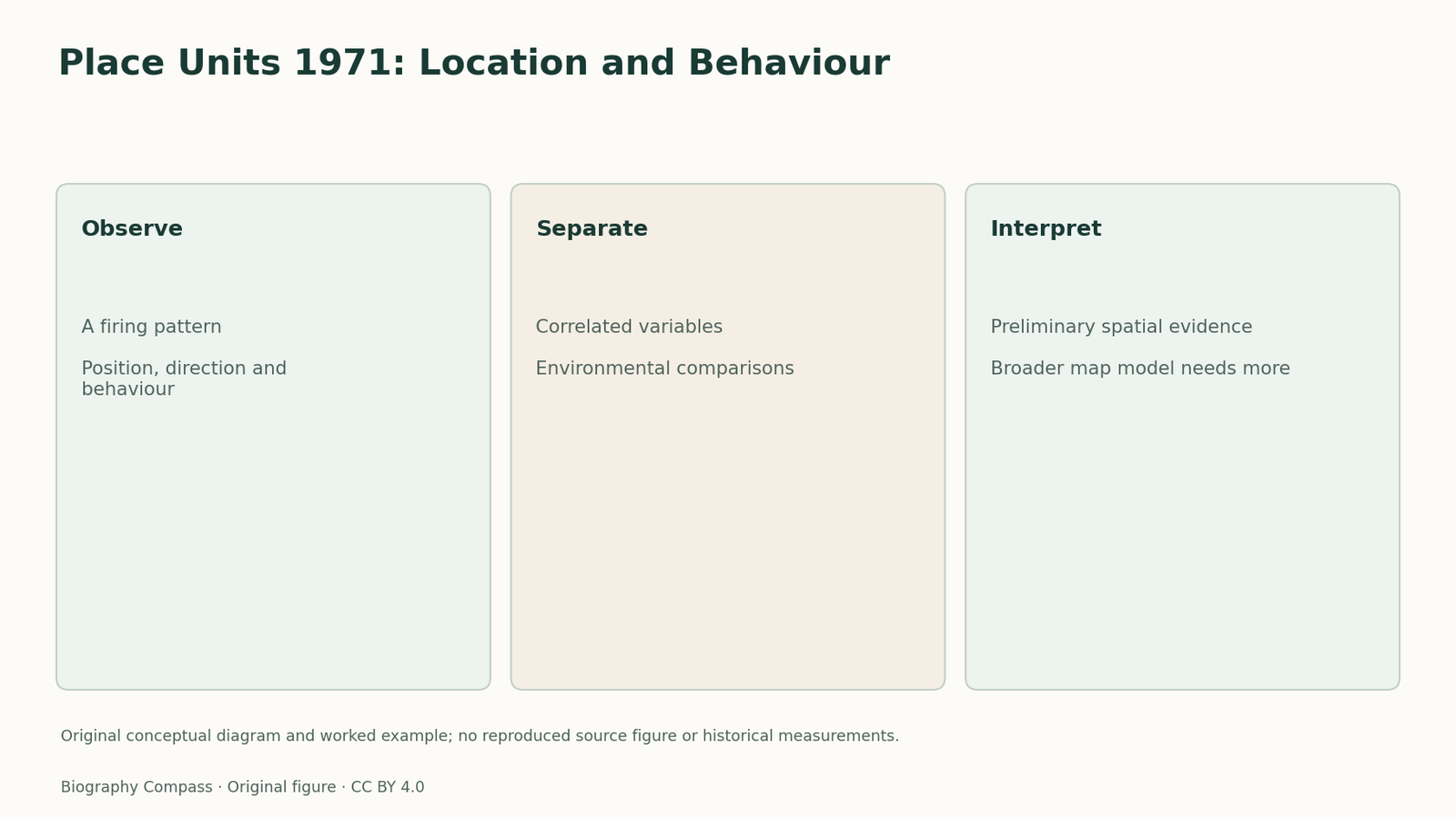
The 1971 O’Keefe–Dostrovsky paper recorded hippocampal units while rats moved and engaged in different behaviours. The authors proposed that selected response patterns supported a spatial-map interpretation. The concrete question is what made a response spatial rather than merely movement-related or sensory. A neuron’s activity at one location is an observation worth investigating, but the location may also coincide with a direction, stimulus or behavioural state. The original report’s details make those alternatives visible.
Sources for this section: [1]
The preliminary observations included mixed requirements
The paper discussed eight units with preferred spatial orientations among a larger set of recordings. Several examples also required appropriate sensory stimulation or arousal. One illustrated unit combined spatial orientation with a particular tactile condition. Those details prevent a misleading summary in which every response depends only on position. The authors tested environmental changes and explicitly described some interpretations as suspected rather than proved. Their caution belongs in the explanation itself, because it identifies what further comparisons would be informative.
Sources for this section: [1]
Later classifications addressed the behaviour comparison more explicitly
O’Keefe’s 1976 report classified place, displace and other units. Its abstract defines place units through the necessity of the rat’s position for maximal firing, while also describing responses associated with environmental novelty or expected items. Environmental manipulations helped examine simple sensory and motor alternatives. That later evidence should not be silently included as though every classification and comparison had already been completed in the first short paper. It represents refinement of the question across a research programme.
Sources for this section: [2]
A positioning system is broader than one isolated response
The 2014 Nobel record connects O’Keefe’s work with a wider account of positioning cells, alongside the Mosers’ contributions. His biographical account also places the discovery within years of electrophysiological method development. Neither the later recognition nor a memorable place-cell label removes the need to examine behaviour and context in a particular recording. A useful interpretation distinguishes an individual correlation, the controls that constrain alternatives and the population-level model proposed to explain spatial behaviour. These levels can support each other without becoming identical claims.
Continue the chronology
Related history guides
Inhibition in 1951: A Voltage Change, Not Silence
Read Eccles, Brock and Coombs’s intracellular recordings through an original evidence exercise separating an inhibitory voltage change from an absence of firing.
Read the timeline1954–1970Quantal Release in 1954: Small Events and a Model
Use Katz’s account of small end-plate responses and the 1954 publication record to distinguish observations, quantal inference and an original worked example.
Read the timelineBiography context
Explore United Kingdom through connected lives
Connected biographies
Researchers and related approaches
1939–
John O’Keefe
Neuroscientist and spatial-memory researcherJohn O’Keefe studied hippocampal activity in freely moving rats, connecting place-related neuronal responses with a developing account of spatial representation.Read biographyBorn 1918
Brenda Milner
Neuropsychologist and teacherMilner investigated human learning and memory.Read biographyQuick answers
Common questions
- Did every 1971 example depend only on position?
- No. Several had additional sensory or state-related requirements.
- Were the 1976 classifications already all in the first short report?
- No. They represent later refinement.
Primary and institutional sources
How this history was checked
The references below distinguish the original study from later explanations. The worked exercise and comparison are newly written for this article. This article was reviewed on 8 November 2026.
- John O’Keefe and Jonathan Dostrovsky, Brain Research, 1971The hippocampus as a spatial map. Preliminary evidence from unit activity in the freely-moving rat
- John O’Keefe, Experimental Neurology, 1976Place units in the hippocampus of the freely moving rat
- Nobel Prize OutreachJohn O’Keefe — Facts
- Nobel Prize OutreachJohn O’Keefe — Biographical