
The short answer
What made a voltage recorded inside a motor neuron a test of a theory about inhibition?
Compare the records
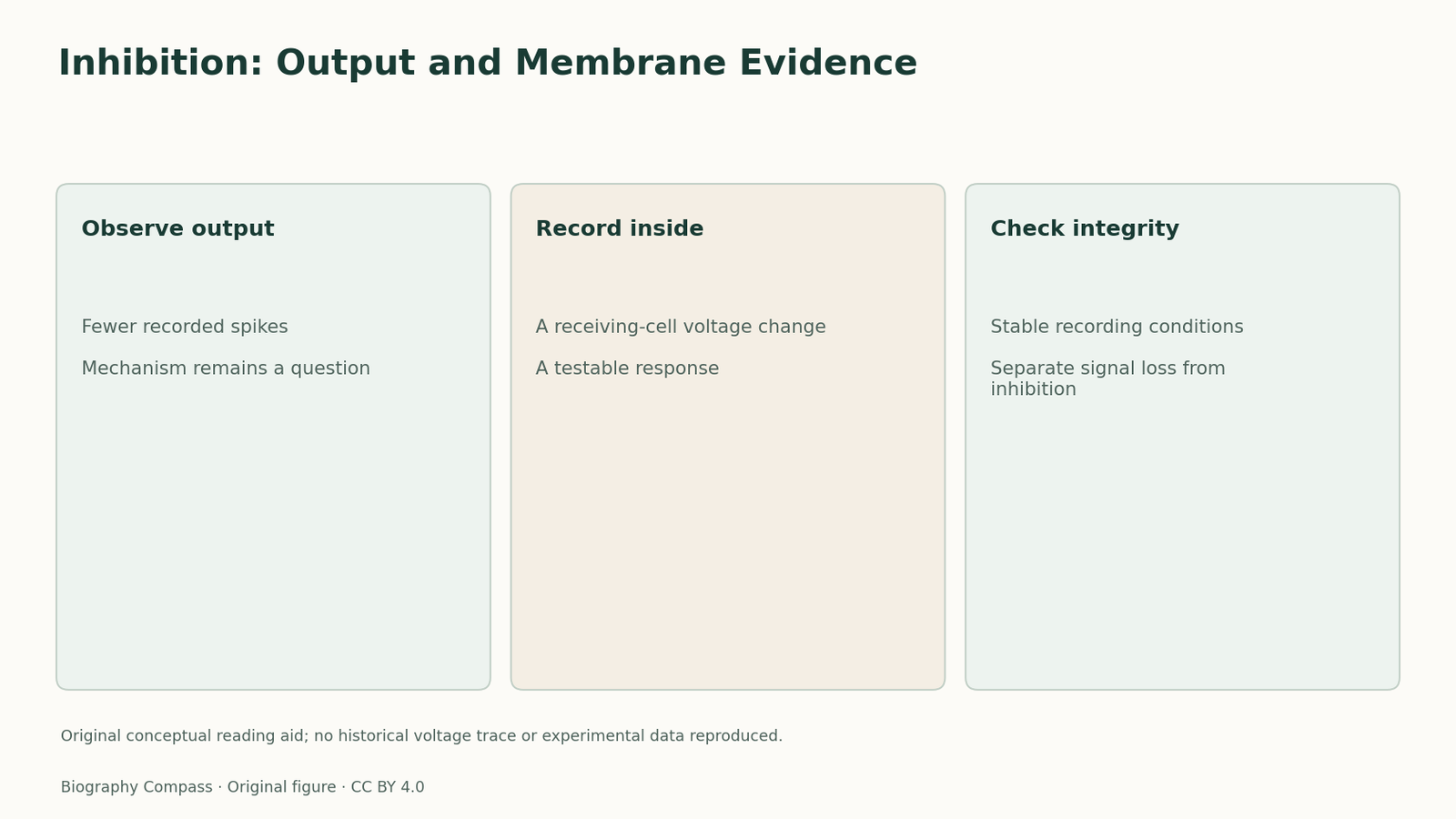
Output, membrane response and interpretation
These records address different levels of the inhibition question.
| Record | What can be assessed | What remains unproven |
|---|---|---|
| Reduced spike output | A change in observed firing. | Its particular membrane mechanism. |
| Intracellular potential | A response in the receiving cell. | Transmitter identity from voltage alone. |
| Recording loss | A possible technical failure. | Physiological inhibition. |
A hypothesis had to predict something observable
Eccles’s disagreement with chemical transmission was a working scientific position that could be tested. NHMRC’s historical account explains how his central-synapse theory was made more explicit during the 1940s. The critical step was choosing a measurement that could discriminate between explanations. Seeing fewer impulses after stimulation established an effect, but did not by itself identify the process producing that effect. Recording from within the receiving cell offered a different kind of evidence: a change in its membrane potential with a direction and a time course.
Sources for this section: [4]
The instrument and the electrode answered different needs
The Academy memoir credits Coombs with the electronic stimulating and recording unit and describes Brock’s work on glass microelectrodes. A useful signal depended on both access to the cell and equipment capable of recording it. Their contributions should therefore remain visible beside Eccles’s interpretation. The preparation also matters: this was an investigation of spinal motor neurons, rather than an undifferentiated measurement of an entire brain. Moving from an extracellular field signal to an intracellular record changed what the researchers could infer about the receiving cell.
Sources for this section: [3]
Inhibition could produce a positive observation
The important distinction is between recording an inhibitory response and merely failing to record a spike. The memoir describes a hyperpolarizing response that opposed the prediction of Eccles’s earlier explanation. His Nobel lecture subsequently examined the ionic mechanisms of postsynaptic inhibition. This does not turn every downward trace into proof of one mechanism: the recording convention, the preparation and the experimental manipulation still have to be specified. A failed or damaged recording could also produce little apparent activity, so absence alone is an inadequate substitute for a discriminating observation.
An experiment, its paper and an award carry different dates
The historical accounts locate the pivotal recordings in 1951. The inspected journal record dates Brock, Coombs and Eccles’s substantial intracellular-electrode paper to 1952. The medicine Nobel followed in 1963 after further work on membrane mechanisms. Keeping those stages separate prevents an award date from becoming a fictional discovery date. It also prevents the 1951 result from being presented as a complete modern explanation of every synapse. The later lecture includes structural and ionic questions beyond the initial change of theoretical position.
Original reading exercise and reference answer
Consider three editorial observations, not recovered experimental data. A: stimulation is followed by fewer output spikes, but no intracellular record survives. B: a stable intracellular record shows a reproducible potential change under the inhibitory condition. C: the recording disappears whenever the electrode moves. Which observation most directly permits a membrane-level test? B supplies the relevant positive record. A establishes a change in output without isolating its membrane mechanism; C raises a recording-integrity problem. None of these short statements independently identifies the transmitter molecule. A strong answer names the receiving cell, the measured variable and an additional control needed before expanding the claim.
Continue the chronology
Related history guides
Hodgkin: Gates Are Not Conductance
Inspect the conductance terms, then solve an invented gate-factor example showing why equal fractions need not mean equal conductances or currents in the same model.
Read the timeline1954–1970Quantal Release in 1954: Small Events and a Model
Use Katz’s account of small end-plate responses and the 1954 publication record to distinguish observations, quantal inference and an original worked example.
Read the timeline1967–2014Place Units 1971: Location and Behaviour
Read O’Keefe and Dostrovsky’s early spatial-map evidence beside later place-unit classifications, with an original exercise separating position from correlated behaviour.
Read the timelineBiography context
Explore Dunedin, New Zealand through connected lives
Connected biographies
Researchers and linked investigations
1903–1997
John C. Eccles
Neurophysiologist and investigator of synaptic transmissionJohn Eccles investigated nerve-cell communication with collaborators in Oxford, Sydney, Dunedin and Canberra, sharing the 1963 Nobel Prize in Medicine.Read biographyQuick answers
Common questions
- Is inhibition simply a flat recording?
- No. An inhibitory input can produce a measurable postsynaptic response; recording failure must also be excluded.
- Why distinguish 1951 and 1952?
- They refer to the experimental milestone and a later journal publication, respectively.
Primary and institutional sources
How this history was checked
The sources distinguish the experimental milestone, participant interpretation and later historical accounts. The reading exercise is newly written. This article was reviewed on 8 November 2026.
- Nobel Prize OutreachJohn C. Eccles — Facts
- Nobel FoundationJohn C. Eccles — Biographical
- David R. Curtis and Per Andersen / Australian Academy of ScienceJohn Carew Eccles 1903–1997
- National Health and Medical Research CouncilA foundation for neuroscience
- John Carew Eccles / Nobel FoundationThe ionic mechanism of postsynaptic inhibition — 1963 lecture
- L. G. Brock, J. S. Coombs and J. C. Eccles / Journal of PhysiologyThe recording of potentials from motoneurones with an intracellular electrode, 1952