
The short answer
How can small electrical responses support a claim about packets of chemical transmitter?
Compare the records
What a response measures and what a model infers
Keep the observable signal separate from its interpretation.
| Level | Reading task | Common mistake |
|---|---|---|
| Small local response | Identify the measured electrical event. | Call it a photograph of a vesicle. |
| Quantal model | State the unit and comparison assumptions. | Equate one packet with one molecule. |
| Physical mechanism | Seek a separate test of release machinery. | Treat arithmetic as complete structural evidence. |
The receiving muscle supplied a measurable signal
Katz’s Nobel lecture describes the end-plate region as a detector that converts the action of acetylcholine into a local electrical response. This allowed researchers to investigate release indirectly through its effects on a receiving membrane. The distinction matters because a voltage trace is not a direct photograph of a packet leaving the nerve terminal. The interpretation connects a measured response with a proposed release event. It therefore depends on the properties of the detector as well as on the amount and timing of transmitter reaching it.
Sources for this section: [4]
Unexpected miniature events created a comparison
Katz recalled observing small, discrete end-plate potentials with Paul Fatt even when no nerve stimulation was imposed. The later quantal argument compared such events with larger evoked responses. The journal record identifies del Castillo and Katz’s 1954 paper as a separate publication within that developing programme. One should preserve both collaborations: noticing miniature responses and examining the components of evoked responses were related stages, rather than interchangeable descriptions of one paper. The historical sequence helps explain why an unexpected observation could become a basis for a more general model.
A packet is a proposed unit of release
In the lecture, a quantum contains many transmitter molecules. It should not be confused with one molecule, one ion channel or the whole nerve impulse. Nor does describing a discrete unit mean that every recorded response must look identical under every condition. A model connects a pattern of measurements to an explanation, while noise and the response of the receiving membrane remain relevant. The useful reading question is which feature is actually measured and which quantity is inferred from a comparison between measurements.
Sources for this section: [4]
Original worked example: identify the assumption
Imagine an editorial teaching case with a typical small response of 0.4 arbitrary units and larger responses of approximately 0.8 and 1.2 units. These are invented values, not data from 1954. A simple interpretation assigns two and three elementary contributions to the larger responses. What assumption makes that arithmetic useful? The response per contribution must remain comparable, and the measurement must support adding the contributions. If detector sensitivity changes between records, the ratios no longer isolate the number of release events. The answer must therefore state its assumptions instead of treating division alone as experimental proof.
Sources for this section: [4]
Reference answer: observation, model and further test
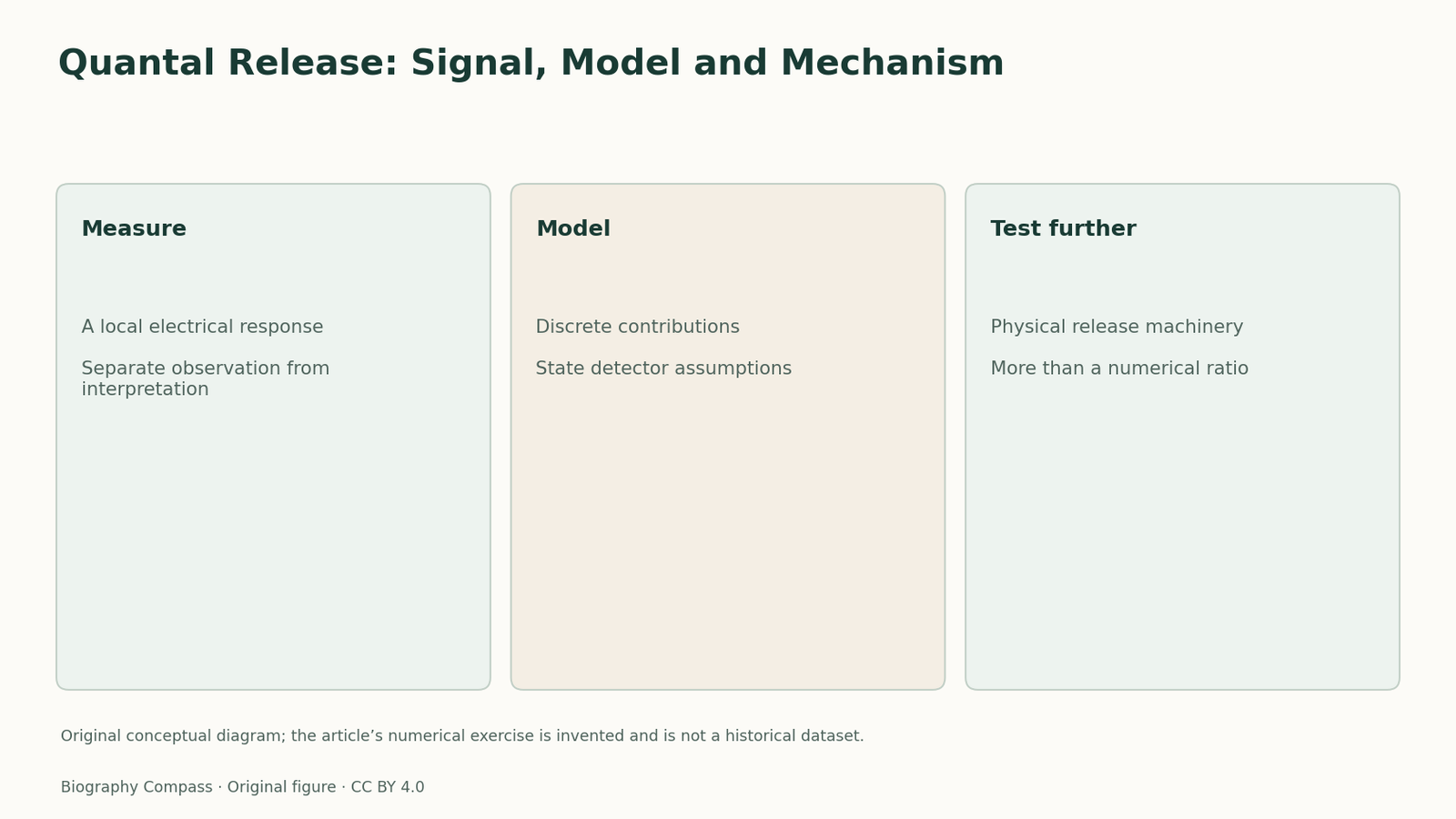
A strong explanation separates three claims. First, small responses and larger responses are observed. Second, their relationship is interpreted using a model of discrete contributions. Third, a physical account of the release machinery requires additional evidence. The worked example supports practising the second step; it does not reconstruct Katz’s original distribution, establish a molecular packet size or identify a particular vesicle in a photograph. Re-read the cited lecture with those categories in mind. Ask which statements describe a trace, which introduce an inference and which refer to a later question about the mechanism of release.
Continue the chronology
Related history guides
Hodgkin: Gates Are Not Conductance
Inspect the conductance terms, then solve an invented gate-factor example showing why equal fractions need not mean equal conductances or currents in the same model.
Read the timeline1951–1963Inhibition in 1951: A Voltage Change, Not Silence
Read Eccles, Brock and Coombs’s intracellular recordings through an original evidence exercise separating an inhibitory voltage change from an absence of firing.
Read the timeline1990–2013Synaptotagmin 1992: Binding and a Sensor Hypothesis
Read the 1992 synaptotagmin study beside earlier domain evidence, separating calcium-dependent binding from a fully established physiological release mechanism.
Read the timelineBiography context
Explore United Kingdom through connected lives
Connected biographies
Researchers and linked physiological questions
1911–2003
Bernard Katz
Physician and biophysicistBernard Katz investigated chemical communication between nerves and muscle, developing quantal-release ideas with collaborators and sharing the 1970 medicine Nobel.Read biographyQuick answers
Common questions
- Are the exercise values historical measurements?
- No. They are invented arbitrary values for practising model assumptions.
- Can a voltage ratio alone identify a vesicle?
- No. A physical identification requires evidence beyond the arithmetic comparison.
Primary and institutional sources
How this history was checked
The 1954 record establishes authorship and publication; the inspected participant lecture explains the conceptual development. No full reading of the scanned paper is claimed. This article was reviewed on 8 November 2026.
- Nobel Prize OutreachBernard Katz — Facts
- Nobel FoundationBernard Katz — Biographical
- University College LondonHistory of neuroscience, physiology and pharmacology
- Bernard Katz / Nobel FoundationOn the quantal mechanism of neural transmitter release — 1970 lecture
- José del Castillo and Bernard Katz / Journal of PhysiologyQuantal components of the end-plate potential, 1954