
The short answer
A headline number is not an entire wage policy. This study separates the objective, the components and the method of adjustment before asking what a simplified worked case can establish.
Record comparison
Read the evidence by function
Separate the object established by a record from an inference requiring other evidence.
| Record | What it establishes | What it does not establish |
|---|---|---|
| Policy objective | Restructure towards higher productivity. | Not measured success. |
| Specified components | Cash adjustment and separate contributions. | Not all take-home pay. |
| Invented illustration | $600 salary; 4% offset; $50 result. | Not an actual payroll determination. |
Chronology
A timeline of the turning points
Letter dated
A proposal’s date differs from its release.
Press release
Read the attached components and qualifications.
An advisory institution with several constituencies
The National Wages Council was founded in 1972 as a tripartite advisory body. Government, employer and union representatives worked towards consensus; its first chairman was Lim Chong Yah.
A recommendation therefore needs to be read as the work of an institution. A chair’s name on a document does not make it a unilateral decree or establish the results of later bargaining.
Sources for this section: [2]
Read the proposed restructuring beside the costs
The letter dated 12 June 1979, released 23 June, proposed higher wage costs to encourage restructuring. Its components included $32 plus 7% with group offsetting, an additional employer CPF contribution and a Skills Development Fund contribution.
Those are different destinations for expenditure. An employer-cost component should not be silently presented as cash received by a worker. Nor does the document’s stated objective establish that every firm actually upgraded its technology or that every worker benefited.
Sources for this section: [1]
Exercise: isolate one adjustment
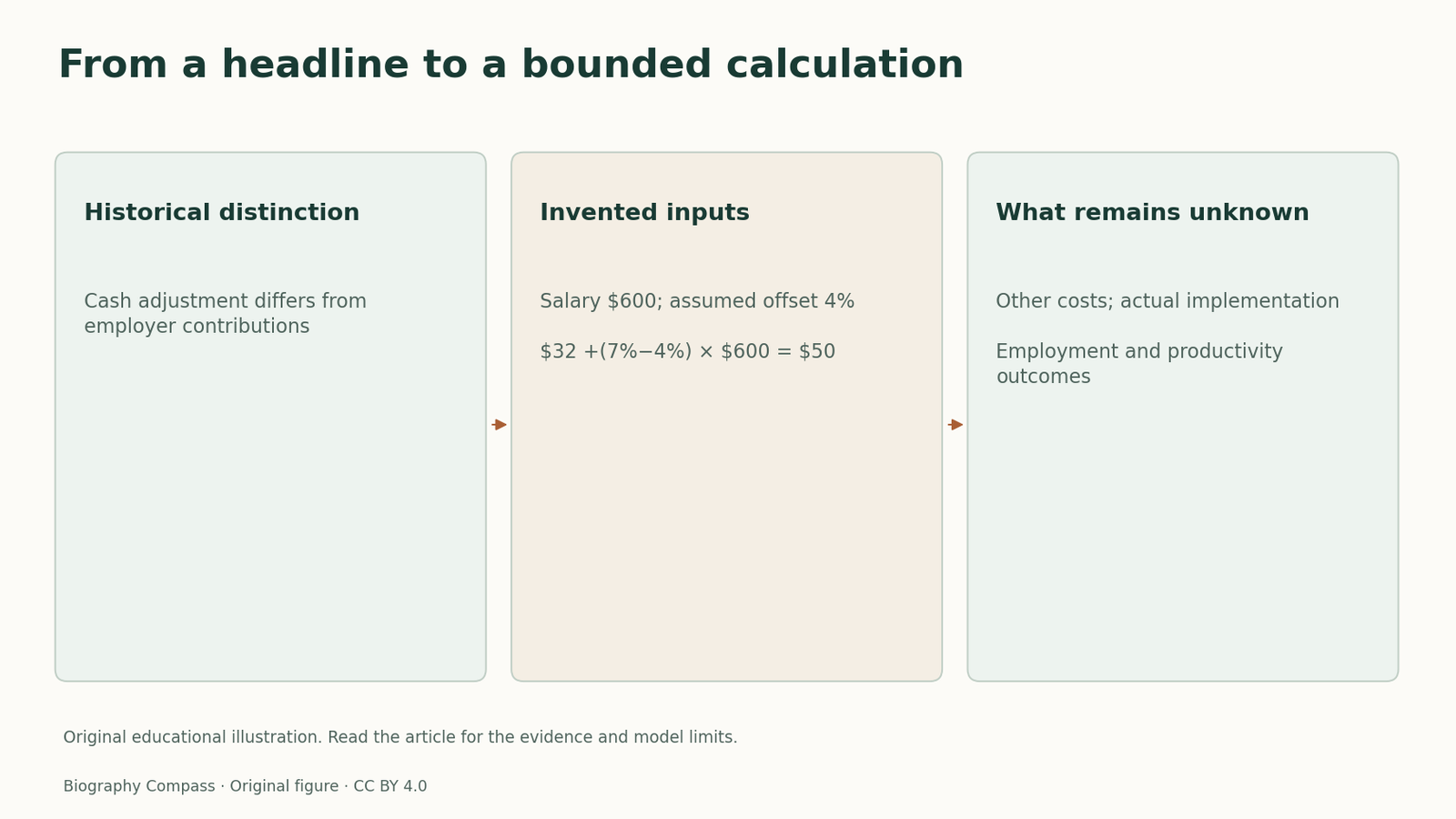
For a deliberately simplified case, use only the cash-adjustment expression $32 plus (7% minus the offset percentage) times individual salary. Invent a salary of $600 and an already established offset of 4%. Assume no other qualification, exception or July-increment modification applies. Calculate this component, then state why it is not total employer cost.
Reference answer: 7%−4% = 3%; 3% of $600 is $18, giving $50. The invented calculation omits the separately identified contributions and all other remuneration. It does not compute a real employee’s entitlement. Changing the assumed offset would change the result even if the headline percentage stayed the same.
For an actual historical application, one would need the correct payroll group, relevant wage-bill components and the document’s exceptions. Supplying a convenient offset here avoids pretending that a single salary can reproduce the group calculation.
Sources for this section: [1]
Recommendation, implementation and outcome
Three evidence questions remain separate. What did the council recommend? What did a particular employer and workforce implement? What changed in productivity, employment or living standards afterwards? The first can be studied in this record. The other two require additional implementation and outcome evidence. A mathematically correct illustration answers neither by itself.
Continue the chronology
Related history guides
Biography context
Explore Singapore through connected lives
Connected biographies
People connected with this study
Quick answers
Common questions
- Does the worked result include every cost?
- No. It isolates a stated component under invented assumptions and excludes the other contributions and qualifications.
Primary and institutional sources
How this history was checked
Read the named selected records together; the notes distinguish direct texts, later accounts and limits of access. This article was reviewed on 31 October 2026.