
The short answer
A negotiation can seek agreement throughout its work and still end with a recorded vote. To understand the result, identify which group made which decision, at what stage, and what the official record actually counts.
Record comparison
Read the evidence by function
Separate the object established by a record from an inference requiring other evidence.
| Record | What it establishes | What it does not establish |
|---|---|---|
| Participant outline | Collective consensus in the collegium. | Not universal agreement by all states. |
| Meeting record | A recorded adoption decision. | Not each state’s later treaty status. |
Chronology
A timeline of the turning points
Working process
A participant later describes the leadership’s decisions.
Recorded adoption
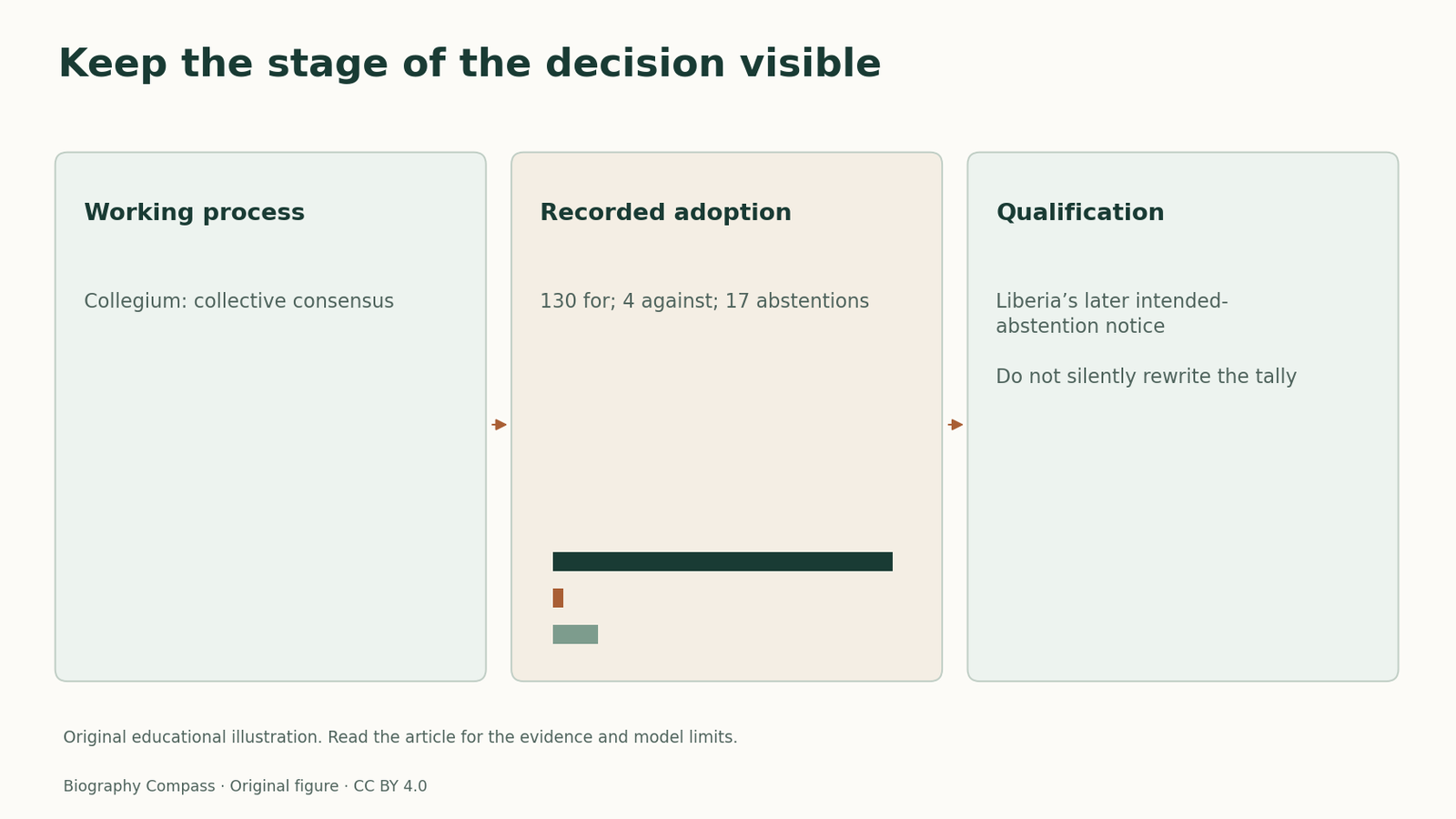
The meeting record preserves a tally and a later-intention footnote.
A participant describes the working process
Koh’s 2009 outline describes a collegium of conference leaders meeting weekly in 1981–1982 and deciding collectively by consensus. It also identifies committees, informal groups, the secretariat and NGOs.
The account concerns a working process with several participants. It is not a claim that every state accepted every provision, or that one president supplied the entire text.
Sources for this section: [1]
The meeting record establishes a different decision
The 182nd meeting record, 30 April 1982, states that the Convention and resolutions I–IV were adopted by 130 votes to 4, with 17 abstentions. A footnote says Liberia later informed the Secretariat that it had intended to abstain.
The footnote reports a later communication about intention. It should remain attached to the recorded tally rather than being silently used to manufacture a revised vote. A reader can preserve both the result and the qualification without confusing them.
Sources for this section: [2]
Exercise: test three documentary claims
A fictional catalogue says: A, “The negotiating leadership sought consensus”; B, “The final text had no recorded opposition”; C, “A later statement of intention can simply be inserted into the published tally.” Which claims are compatible with the inspected records? Rewrite the misleading claims without inventing a new result.
Reference answer: A is compatible with the participant account at the leadership level. B is contradicted by the recorded opposing votes. C erases the distinction between the published result and its later qualification. Write instead: the adoption record contains a vote and an accompanying intended-abstention notice.
An additional exercise is to list the documents needed for a different question, such as whether a particular state later became bound by the Convention. The adoption tally alone does not supply that answer. Do not treat a vote, signature and ratification as interchangeable entries.
Credit the process without exaggerating the outcome
The two records complement rather than cancel each other. One describes how negotiating work was organised; the other records a particular collective decision. A useful historical explanation can credit leadership and supporting institutions while retaining dissent. It need not convert a widely supported result into unanimity.
Continue the chronology
Related history guides
Biography context
Explore International negotiations through connected lives
Connected biographies
People connected with this study
1937–present
Tommy Koh
Diplomat and lawyerPresident of UNCLOS III during its concluding negotiations.Read biographyQuick answers
Common questions
- Can leadership consensus and recorded dissent coexist?
- Yes. Identify the decision-making body and stage rather than assuming the two records describe the same act.
Primary and institutional sources
How this history was checked
Read the named selected records together; the notes distinguish direct texts, later accounts and limits of access. This article was reviewed on 31 October 2026.