
The short answer
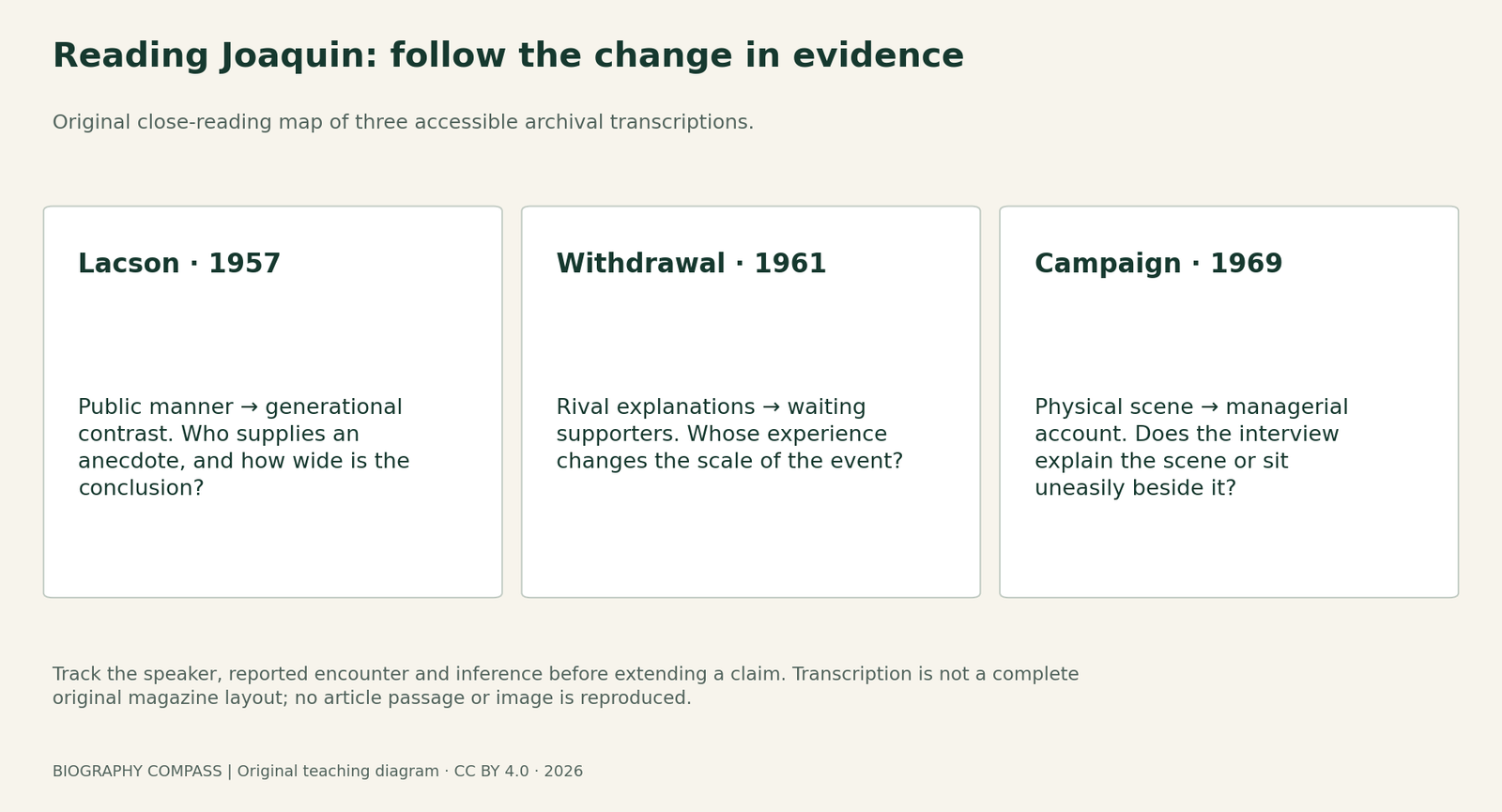
What changes when a political report begins with a body, a crowd or a machine? Read three accessible articles by Nick Joaquin, writing as Quijano de Manila, to separate the scene a narrator constructs from the statements he attributes to other people.
Original reading comparison
Ask what each move can establish
The same paragraph can be vivid, attributed and interpretive. Identify the move before extending its claim.
| Country | Move to inspect | Useful question | Limit to retain |
|---|---|---|---|
| Lacson profile | Gesture and generational contrast | How does manner become a public identity? | Anecdote and observed action are not interchangeable. |
| Withdrawal report | Competing voices, then disappointed supporters | Whose experience changes the scale of the event? | An accusation proves its circulation, not its truth. |
| Campaign report | Dusty arrival, then an account of organisation | How do scene and interview frame each other? | A candidate’s explanation is not an independent audit. |
Chronology
A timeline of the turning points
A political personality
In this corner: Lacson builds a profile through public manner and reputation.
A withdrawal and its audience
A report follows competing political explanations into a crowd of supporters.
The campaign as spectacle and system
Winding It Up moves from a helicopter arrival to an interview about organisation.
Begin with a question about form, not a verdict on a politician
These articles make a useful small reading set because they do different jobs. The 1957 piece profiles Arsenio Lacson; the 1961 report follows Roger de la Rosa’s withdrawal from the presidential contest; Winding It Up visits Ferdinand Marcos’s 1969 campaign. Their shared subject is public political life, but their organising devices differ. A practical first pass is to mark each paragraph as scene, attributed speech, background or narrator’s judgement. Allow a paragraph to contain more than one. The point is to see how the prose moves between kinds of evidence, before deciding whether a compelling sentence has established the claim it invites.
Lacson: a personal style becomes a historical comparison
The Lacson profile contrasts an older political manner, associated with Manuel Quezon, with a vigorous postwar public personality. Clothing, movement, speech and broadcasting matter to that comparison. Joaquin does not simply introduce a politician and then append a policy list: he makes recognisable behaviour carry an account of a changed public world. Read the contrast as the profile’s construction, then ask what supports it. A described gesture, an anecdote told by friends and a sweeping judgement about a generation have different evidentiary reach. The writer can connect them persuasively without turning every remembered story into a directly witnessed occurrence.
Sources for this section: [1]
The withdrawal report: listen for the change in speaker
In the de la Rosa report, rival explanations circulate through press statements, broadcasts and political allegations. The prose then gives sustained attention to supporters waiting at the candidate’s home. Some describe money and effort already spent; their disappointment becomes part of the event being reported. The shift changes the question from which faction benefits to what a withdrawal does to people who have invested in a campaign. Follow the attribution carefully. A partisan’s accusation establishes that an accusation circulated. The narrator’s account of a waiting crowd establishes a different sort of reported encounter. Neither should silently become an omniscient explanation of the candidate’s private motive.
Sources for this section: [2]
Winding It Up: bodily disorder meets managerial order
The 1969 report opens with a helicopter arrival whose dust and movement disrupt the people on the ground. The candidate’s composed appearance sits within that physical scene. Later, Marcos describes campaign organisation, information and planning in an interview. The juxtaposition creates two scales: politics as a bodily public encounter, and politics as a system described by its principal operator. An analytical reading can ask what the transition does to the reader’s confidence. Does the orderly account explain the opening, suppress its disorder, or coexist uneasily with it? Those are questions about the article’s arrangement; its interview alone cannot audit the campaign’s claims about its own effectiveness.
Sources for this section: [3]
Literary technique changes emphasis without cancelling reporting
Across the set, figurative openings and contrasts direct attention before an explicit argument arrives. A political personality becomes a style, a withdrawal becomes a public disappointment, and a campaign becomes both spectacle and administrative account. This guide’s comparison is a reading hypothesis to test against the articles, rather than a description of all Joaquin’s journalism. His wider career crossed fiction, theatre, history and reportage; the Magsaysay citation recognised that range. The short story and play collected in the 2017 Penguin volume belong to other reading tasks. Their presence in a publisher’s catalogue does not make their complete texts available here or supply evidence for interpreting their scenes.
Check which version you are reading
Free Press Online makes these articles readable as selected archival transcriptions. Its own account says the material draws substantially on work assembled for a 2001 magazine history, with some editing, commissioned pieces and later contributions. This is a valuable route into the writing, but it is not a facsimile of every original issue. Record the article title, stated original date and archive address in a reading notebook. If an argument depends on a particular punctuation mark, photograph placement or original page sequence, it needs an issue copy. The narrative comparisons here concern the accessible prose and do not reconstruct an unexamined magazine layout.
Sources for this section: [4]
Exercise: build a claim ladder
Use three invented notebook statements: “The reporter describes people waiting”; “A campaign official says organisation is efficient”; “The whole electorate trusted the candidate.” For each, name the document or observation that would support it and decide whether a described scene or quoted interview is enough. Then return to one article and select a paragraph without copying it into your notes. Summarise its movement in three short labels, such as encounter, attributed explanation and inference. Finally, propose one alternative arrangement of those parts. Explain how moving the interview before the scene could alter emphasis even if the factual statements remained unchanged.
Reference answer: preserve both force and scope
The first invented statement needs a reported scene and must retain its source. The second needs attribution to the official; it does not establish efficiency independently. The third generalises beyond either kind of evidence and would need a different research design. In the article exercise, more than one set of labels may work if the reader identifies who speaks and explains the transitions. An interview-first arrangement may make later action seem like an illustration of an already supplied explanation; a scene-first arrangement may let a problem emerge before anyone explains it. This is an original test of narrative organisation, not a reconstruction of Joaquin’s intentions or a verdict on an election.
Continue the chronology
Related history guides
How Did Abad Build a Trapunto Painting?
Compare Pacita Abad’s stitched paintings, collected textiles and collaborative prints through an artist interview, museum records and an original exercise.
Read the timeline1976–2023How Was Himala Made and Remembered?
Follow Himala from Ricky Lee’s script and Nora Aunor’s performance to festival records, a public vote and restoration, with an original evidence exercise.
Read the timelineBiography context
Explore Philippines through connected lives
Nick Joaquin
Nick Joaquin worked across fiction, theatre, history, biography and magazine reporting. His English-language writing joined Philippine memories and social change to an unusually wide range of narrative forms.
Explore the biographiesBiographyRicky Lee
Read about this collaborator’s wider career and creative practice.
Explore the biographiesWriting across formsRicky Lee
Compare another writer’s work in literature, screenwriting and teaching.
Explore the biographiesConnected biographies
Artists, writers and collaborators
1917–2004
Nick Joaquin
Writer, journalist, playwright and cultural historianNick Joaquin worked across fiction, theatre, history, biography and magazine reporting. His English-language writing joined Philippine memories and social change to an unusually wide range of narrative forms.Read biographyQuick answers
Common questions
- Does literary reportage mean that the facts are invented?
- No. The exercise distinguishes narrative arrangement from the evidentiary basis of a claim. Check attribution and corroboration rather than treating vivid writing itself as proof of either accuracy or invention.
- Have the original magazine pages been examined?
- The linked prose transcriptions were read. The original issue layouts, photographs, editorial files and interview notes were not examined.
Primary and institutional sources
How this history was checked
Follow the linked original reporting, artist testimony and institutional records. The comparison, exercise and teaching figure are original. Access notes distinguish readable records from artworks, manuscripts or films not examined in full. This article was reviewed on 27 October 2026.
- Philippines Free Press; Free Press Online archiveIn this corner: Lacson, 11 May 1957, by Quijano de Manila
- Philippines Free Press; Free Press Online archiveThe Untimely Withdrawal of Roger de la Rosa, November 1961, by Quijano de Manila
- Philippines Free Press; Free Press Online archiveWinding It Up, 1 November 1969, by Quijano de Manila
- Philippines Free Press Online, maintained by Manuel L. Quezon IIIAbout the Philippines Free Press Online: archive and editorial provenance
- Ramon Magsaysay Award FoundationNick Joaquin: 1996 award citation and biographical account
- Penguin Classics, Penguin Random House AustraliaThe Woman Who Had Two Navels and Tales of the Tropical Gothic: 2017 edition