
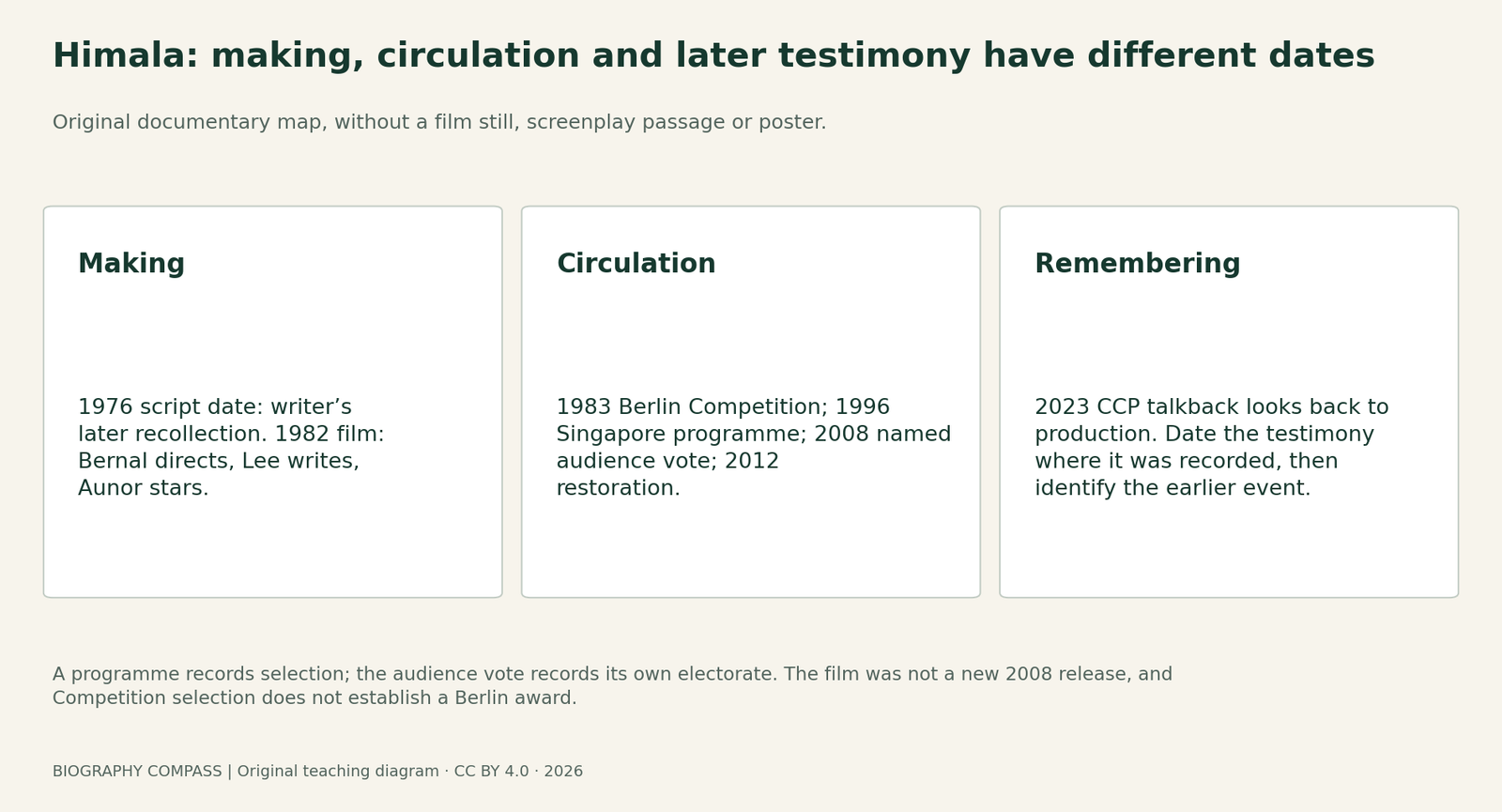
The short answer
Himala’s history includes making a film, presenting it at festivals, remembering production choices and returning an older work to audiences. Follow those stages through cast records, Ricky Lee’s testimony and dated reception documents.
Original film-history comparison
Production and reception require different records
A testimony, programme and vote can all be valuable without answering the same question.
| Country | What the source establishes | What remains open |
|---|---|---|
| Lee’s later testimony | A participant’s account of rejection and on-location revision. | The complete sequence of drafts and independent corroboration. |
| 1983 Berlin record | A Competition programme appearance for the 1982 film. | Any award must be checked in an award record. |
| 1996 Singapore programme | Selected cast, curatorial grouping and print source. | A complete crew list and every production responsibility. |
| 2008 APSA announcement | A specifically named online audience vote. | Universal agreement or a prize for a new 2008 release. |
| 2012 restoration account | Preservation work and the institutions involved. | Close analysis of a film copy not watched for this guide. |
Chronology
A timeline of the turning points
A script, according to its writer
Ricky Lee later recalled writing the screenplay in 1976 and encountering repeated rejection.
Himala
Ishmael Bernal directed Lee’s screenplay with Nora Aunor in the lead.
Berlin Competition
The festival’s archive records the Philippine film in its Competition programme.
Singapore tribute
A Bernal programme placed Himala beside other features and short films.
Audience recognition
A CNN APSA online vote honoured the older film.
Restoration and discussion
Restoration created a further stage of circulation; a later CCP talkback revisited the production.
A script’s difficult passage into production
In a 2022 television interview, Ricky Lee recalled writing Himala in 1976 and having it rejected repeatedly. He remembered producers objecting to a commercially difficult combination: no conventional love team, an unhappy story and religion as subject. This is testimony from the writer looking back, not a set of dated rejection letters. Even with that distinction, it supplies a concrete production question: how did a screenplay outside a preferred formula become a film in 1982? Its history begins before release and involves decisions about what an audience might accept. A surviving contract, draft or production correspondence would be needed to reconstruct each intervening step.
Sources for this section: [1]
The director, writer and lead performer are a starting team
Institutional programmes identify Ishmael Bernal as director, Lee as writer and Nora Aunor as Elsa. The 1996 Singapore festival listing also names Spanky Manikan and Laura Centeno; NYU’s later programme discusses the film within Bernal’s career. These records make collaboration visible without pretending that a short festival entry supplies complete screen credits. Aunor’s performance is central to the film’s reputation, but casting also includes an ensemble and a working unit beyond the most celebrated names. At a 2024 UP vigil, Joel Lamangan recalled beginning his friendship with Bernal while playing the priest in Himala, adding another participant’s connection to the production.
A revised speech shows writing responding to filmmaking
At the CCP’s 2023 talkback, Lee described revising the concluding speech on location after seeing filmed material and the assembled crowd. He recalled giving Aunor a new version and the pressure of filming the performance before many extras. The account links writing, direction, acting and production logistics in one decision. It complicates an image of a finished screenplay simply being executed. The relevant distinction is between a participant’s remembered explanation and a verified draft history: the event report preserves what Lee said, while earlier script versions, call sheets and unedited footage would answer further questions about timing and alternatives. The dialogue itself is not reproduced here.
Sources for this section: [5]
Berlin records selection, not an invented victory
The Berlinale archive places Himala, also listed as Miracle and Wunder, in Competition in 1983 and identifies it as a Philippine film from 1982 directed by Bernal. That is precise, significant evidence of international festival presentation. It should remain a selection claim unless a separate award record supports more. A programme entry does not mean the film won the Golden Bear or that Aunor received a Berlin acting prize. Keep the production year and festival year in separate columns when making a timeline. This simple discipline prevents a later accolade, a release date and a competition appearance from collapsing into a single misleading award sentence.
Sources for this section: [6]
A 1996 programme builds a retrospective argument
Singapore’s 1996 tribute juxtaposes Himala with Nunal sa Tubig and Manila After Dark, linking very different settings within one director’s career. It also lists short films alongside the Himala presentation, including work by Nick Deocampo. The print source named for the features is the Cultural Center of the Philippines. These details show that a retrospective is a constructed encounter among films, institutions and audiences. It preserves more than a plot summary: the choice of companions and access to a screening copy shape what viewers can compare. The tribute took place before Bernal’s death in June 1996, so its title should not automatically be read as a posthumous memorial.
The 2008 result was a named audience vote
The Asia Pacific Screen Awards’ announcement of 11 November 2008 identifies Himala as the CNN APSA Viewers Choice Award winner for Best Asia Pacific Film of All Time. It describes an online vote involving film fans. The scope matters as much as the superlative: this was a specific public poll that honoured an older film. It was not the jury’s award for the best new film released in 2008, and it cannot establish unanimous regional opinion. Its historical value is evidence of continuing mobilisation and audience attachment decades after production. Preserve the organiser, voting format, year and award title when discussing what the result demonstrates.
Sources for this section: [7]
Restoration creates another stage of the work’s history
The IASA account describes ABS-CBN Film Archives and Central Digital Lab restoring Himala in 2012. Film preservation changes the conditions under which an older work can be encountered, while also requiring technical and institutional labour. The CCP’s later screening discussion belongs to that continuing circulation. NYU’s 2021 programme likewise documents a particular online event; its old viewing window is not a promise of present access. None of these records substitutes for watching an authorised complete copy when making claims about editing, sound or a scene’s duration. This guide studies the production and reception documents and does not infer a close reading from their synopses.
Exercise: repair a hypothetical festival label
An invented label says: “Bernal wrote Himala alone in 1982; Aunor won the Berlin award that year; in 2008 a jury named it the best new film.” Rewrite it in three sentences using the records above. Each sentence must name the evidence that changes the claim. Then add one research question that these records cannot settle. For a more demanding extension, make two parallel timelines: the making of the film and the circulation of the film. Put a participant’s later recollection at the date it was recorded, with an arrow back to the production event it describes, rather than silently turning the interview into a contemporary production document.
Reference answer: give each record its own job
A defensible repair identifies Bernal as director and Lee as screenwriter of the 1982 film, with Aunor in the lead. It records the 1983 Berlinale Competition appearance without adding an unsupported acting award. It names the 2008 CNN APSA viewers’ vote and retains its audience format. A suitable unanswered question concerns the exact sequence of screenplay drafts or the working responsibilities of crew members omitted from a short programme. The two timelines then show why a film’s cultural life cannot be reduced to its release: exhibition, voting, preservation and retrospective testimony create later encounters with the same work, each producing a different kind of historical evidence.
Continue the chronology
Related history guides
Joaquin’s Reportage: Scene and Testimony
Trace scene, reported speech and judgement across three Quijano de Manila articles, with an original exercise on how literary reportage makes public claims.
Read the timelineEarly 1980s–2003How Did Abad Build a Trapunto Painting?
Compare Pacita Abad’s stitched paintings, collected textiles and collaborative prints through an artist interview, museum records and an original exercise.
Read the timelineBiography context
Explore Philippines through connected lives
Ishmael Bernal
Ishmael Bernal worked across popular genres and formally adventurous films, collaborating with writers and performers while treating the city, belief and intimate relationships as complex social worlds.
Explore the biographiesBiographyNora Aunor
Read about this collaborator’s wider career and creative practice.
Explore the biographiesBiographyRicky Lee
Read about this collaborator’s wider career and creative practice.
Explore the biographiesBiographyMarilou Diaz-Abaya
Marilou Diaz-Abaya developed an exacting film practice through collaboration with writers, actors, cinematographers and designers. Her work moved from women-centred dramas to historical epics, sea stories, television and film education.
Explore the biographiesBernal’s mentorshipMarilou Diaz-Abaya
Follow the separate career of a filmmaker Bernal mentored; she is not credited as a Himala production participant here.
Explore the biographiesConnected biographies
Artists, writers and collaborators
1938–1996
Ishmael Bernal
Film, television and stage director, screenwriter and mentorIshmael Bernal worked across popular genres and formally adventurous films, collaborating with writers and performers while treating the city, belief and intimate relationships as complex social worlds.Read biography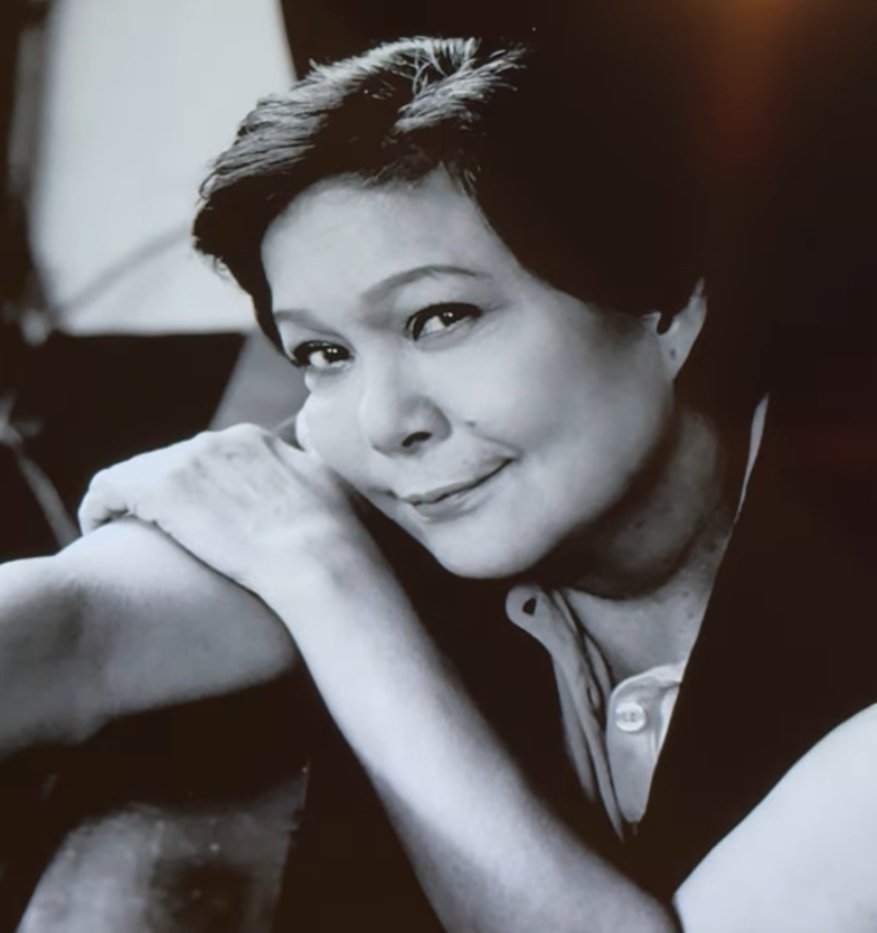
1953—2025
Nora Aunor
National Artist for Film and Broadcast ArtsA singer and actor whose emotional restraint, voice and working-class screen presence made her one of Philippine cinema’s defining artists.Read biography
Born 1948
Ricky Lee
Filipino screenwriter, fiction writer and teacherRicky Lee is a Filipino screenwriter and fiction writer whose films, novels and free workshops combine experiments in storytelling with attention to unequal power.Read biographyQuick answers
Common questions
- Does the guide offer access to the full film?
- No. It links to institutional and participant records. The NYU page documents an expired 2021 screening window; it does not establish current viewing availability.
- Was the 2008 honour a jury award for a new film?
- No. The APSA announcement identifies a CNN APSA viewers’ online vote for Best Asia Pacific Film of All Time. Himala was already an older film.
Primary and institutional sources
How this history was checked
Follow the linked original reporting, artist testimony and institutional records. The comparison, exercise and teaching figure are original. Access notes distinguish readable records from artworks, manuscripts or films not examined in full. This article was reviewed on 27 October 2026.
- GMA News OnlineRicky Lee discusses Himala’s rejected screenplay, Unang Hirit interview, 13 June 2022
- Singapore International Film FestivalTribute to Ishmael Bernal: 9th Singapore International Film Festival 1996 programme, printed pp. 73–74
- Sulo: Philippine Studies Initiative, New York UniversityThe Miracle / Himala: film programme and curator’s commentary by Gil Quito, 2021
- University of the PhilippinesUP community joins vigil for reinterment of National Artist Ishmael Bernal, September 2024
- Cultural Center of the PhilippinesCCP Cine Icons honors National Artists, screens classic film Himala, 28 March 2023
- Berlin International Film FestivalHimala / Miracle / Wunder: Competition 1983 archive record
- Asia Pacific Screen AwardsAPSA Winners Announced, 11 November 2008: CNN APSA Viewers Choice Award
- International Association of Sound and Audiovisual Archives; restoration participant accountABS-CBN Film Archives restores Ishmael Bernal’s Himala, 1982