
The short answer
A qualifying age is easy to remember. The harder historical question is whether reaching that age settled entitlement, and what evidence would show that a particular person actually received a payment.
Compare the claims
A rule is not a completed award
Keep the conclusion within the record’s scope.
| Evidence | What it establishes | What still needs evidence |
|---|---|---|
| Enacted clauses | Selected conditions and calculation rules | Every qualification and the individual decision |
| Historical account | Context and political significance | A claimant’s completed application |
| Holdings guide | Possible record series and gaps | The contents of a particular file |
Chronology
A timeline of the turning points
A reform with boundaries
The pension established in 1898 was financed through taxation. NZHistory places it after earlier proposals, including Harry Atkinson’s, and describes tests of means, residence and character.
This context changes the question from “was there a pension?” to “which claimants could qualify, on what terms?” A public programme can be a substantial reform without reaching everyone who shares its headline age.
Sources for this section: [2]
Read the enacted qualification and procedure
The Act set the age at 65. Section 8 required twenty-five years’ residence, with specified absence exceptions. Section 64 excluded Chinese and other Asian applicants even if naturalised; its Māori exclusion concerned recipients of specified other Native-purpose payments, not all Māori. Claims required a declaration and examination in open court by a Stipendiary Magistrate.
These selected clauses do not reproduce every qualification. They do show why age alone was insufficient. An application rule also differs from proof that a specific application succeeded: that is an administrative event, not a deduction from a birth date.
Sources for this section: [1]
The amount was another question
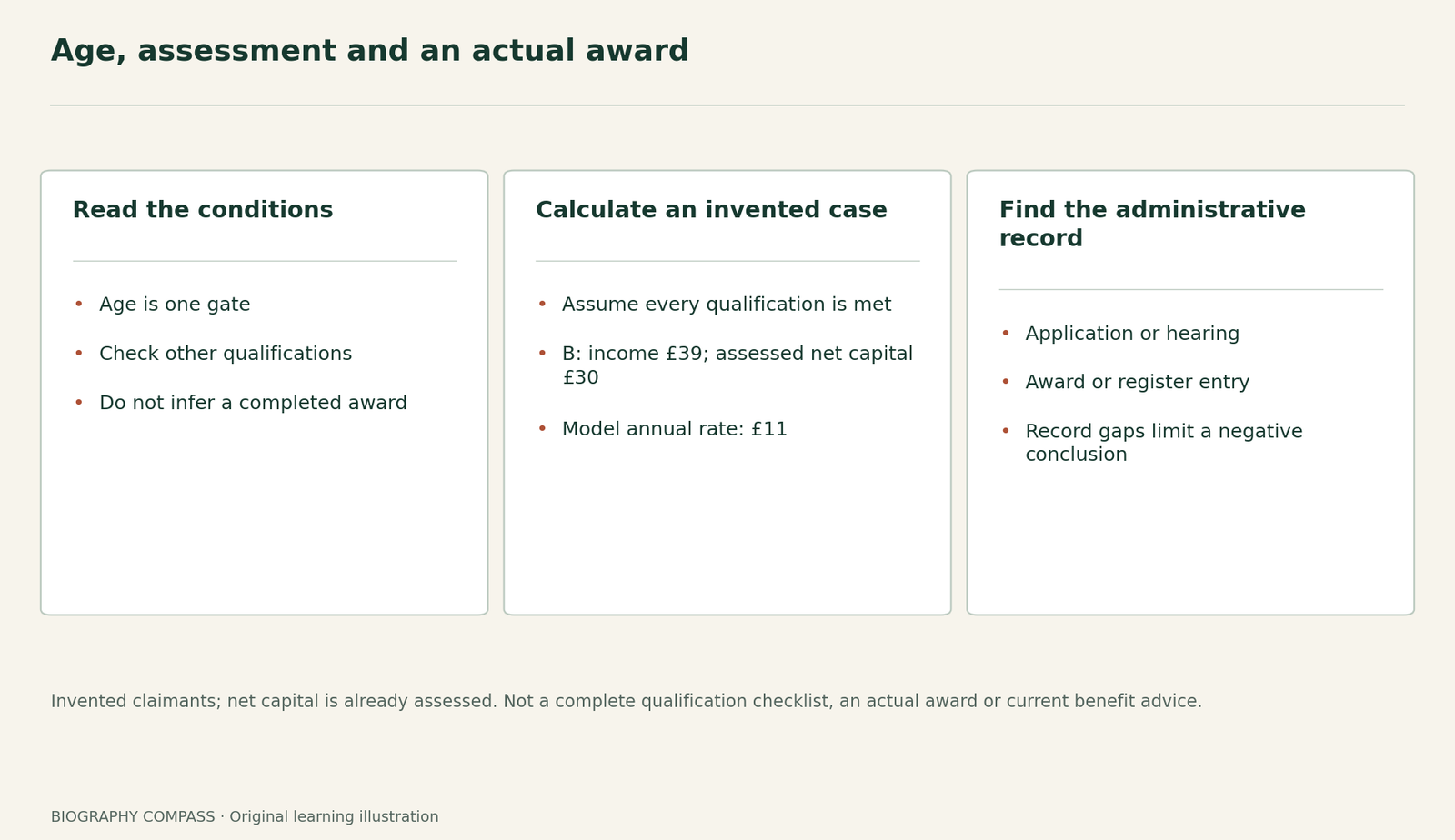
Section 9 began with £18 a year, subtracting £1 for each complete pound of income above £34 and for each complete £15 of net capital. Section 10 defined the capital assessment, including deductions.
To isolate that rate calculation, assume three invented claimants have already satisfied every qualification and their net capital has already been assessed. A has annual income £34 and net capital £0; B has £39 and £30; C has £33 and £14. Calculate each annual rate. These assumptions deliberately prevent the exercise from becoming an incomplete test of statutory eligibility.
Sources for this section: [1]
Worked answer and a claimant’s evidence
A receives £18 in the model. B loses £5 for income and £2 for capital, leaving £11. C loses nothing: the income does not exceed the threshold and the capital contains no complete assessment unit. These are results under the stated assumptions, not awards to real people.
Archives New Zealand describes surviving pension registers and minute books but warns that welfare holdings are incomplete and some access is restricted.
For a real claimant, seek the relevant application, hearing or register entry. A missing entry in an incomplete series does not establish that no payment ever occurred. The strongest conclusion records both the evidence found and the coverage of the search. That distinction is useful to family historians as well as to readers assessing the scale of reform.
Continue the chronology
Related history guides
Biography context
Explore New Zealand through connected lives
Connected biographies
People and political choices
1845–1906
Richard Seddon
PremierRichard Seddon consolidated Liberal government while combining social reform with an assertive imperial outlook.Read biographyQuick answers
Common questions
- Are these examples real pension claimants?
- No. They are invented calculations with qualification and net-capital assessment already assumed.
- Does failure to find a record prove no pension was paid?
- No. The coverage and survival of the searched series must also be established.
Primary and institutional sources
How this history was checked
Selected enacted clauses, a later historical account and an archival holdings guide were inspected. No individual claimant file was read; the selected clauses are not a complete eligibility checklist. This article was reviewed on 30 October 2026.