
The short answer
The 1938 Act brought several forms of social protection into one framework. Its parts created different entitlements, administrators and starting dates; the ambition of comprehensive security must be read alongside those provisions.
Original comparison
One statute, different routes to support
Compare the original cash and health designs and the records needed to test implementation.
| Country | Monetary benefits | Health benefits |
|---|---|---|
| Administration | Social Security Department and Commission | Minister and Department of Health |
| Starting dates | Part II: April 1939; superannuation: April 1940 | Separate staged starts for maternity, hospital and medical schemes |
| Conditions | Category, age, residence and, for many benefits, means | Residence, service class, arrangements and specified exceptions |
| Evidence of delivery | Departmental payments and beneficiary records | Health accounts, practitioner arrangements and service records |
Chronology
A timeline of the turning points
Act received assent
A comprehensive framework combined cash support, health benefits and funding.
Part II commenced
The new department administered monetary benefits.
Maternity benefits began
The Health Department’s later expenditure table identifies the start.
Hospital benefits began
A separate health-service starting date.
Superannuation began
The initial annual rate was £10 for qualifying people aged 65 and over.
Medical capitation scheme
An initial arrangement for general medical benefits began.
General medical services scheme
The Health Department records a subsequent arrangement.
Begin with the Act’s architecture
The Social Security Act 1938, No. 7, received assent on 14 September. Part I established a department and commission; Part II dealt with monetary benefits; Part III provided a health-service framework; and Part IV organised revenue. This structure helps answer an elementary historical question: who had to deliver which promise? The Social Security Department administered cash benefits, whereas the Minister of Health administered the health component and the tax administration collected contributions. A single title therefore covered several administrative systems. It did not create an individual insurance account from which each person could simply withdraw the amount previously paid in.
The cash scheme extended earlier pensions
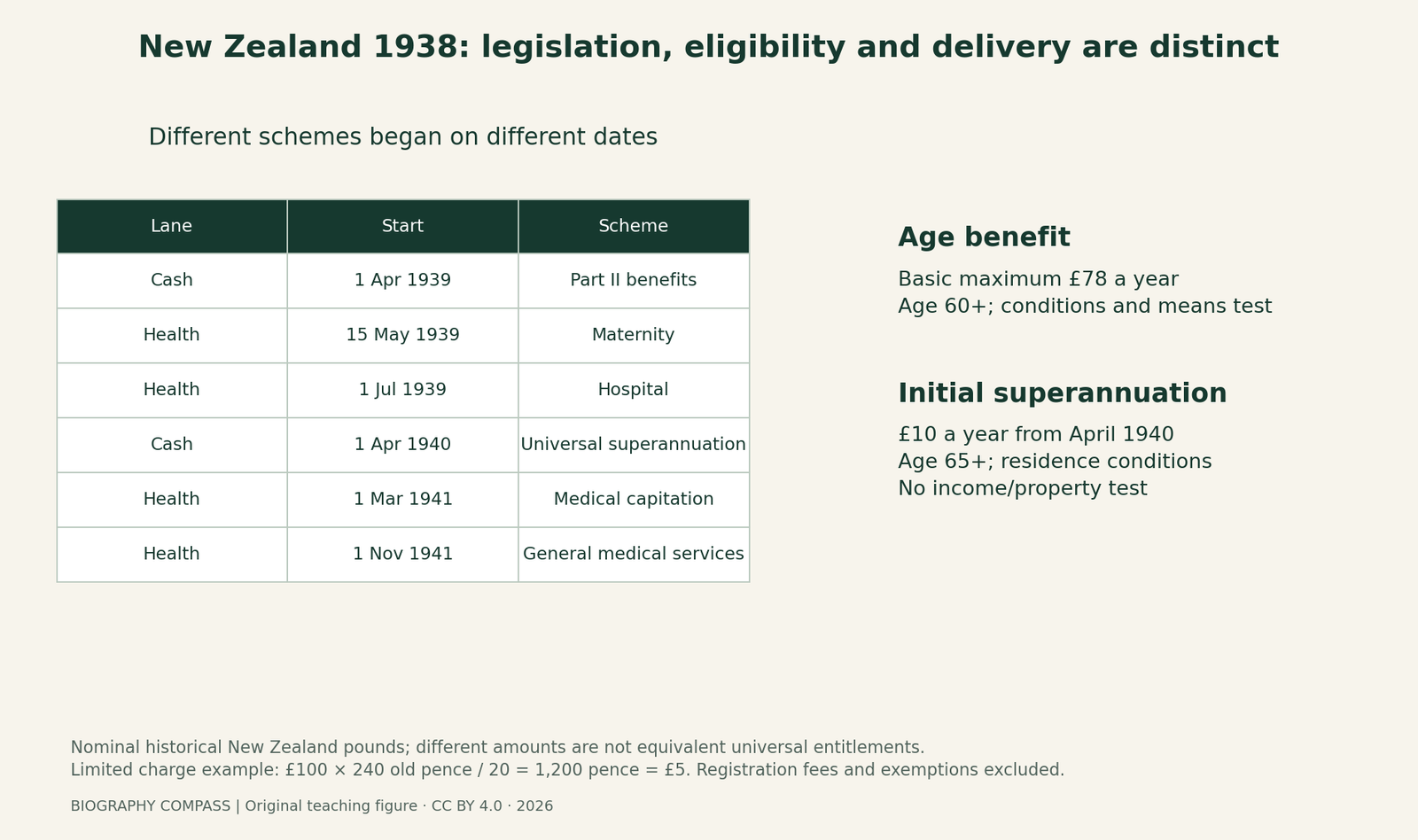
The legislation built on earlier pensions rather than introducing state assistance into an empty field. The 1939 Official Year-Book compares the new categories with existing provision for older people, widows, invalidity, miners and family allowances. It also explains new sickness and emergency benefits. Part II commenced on 1 April 1939. The first departmental report covers its initial year to 31 March 1940 and expressly distinguishes its cash responsibilities from health administration. That report is evidence of an operating department, while the preceding yearbook chiefly explains the intended scheme. Neither document alone measures the experience of every eligible household.
Age benefits and superannuation were different
The distinction between two provisions for older people is essential. Age benefits were available from 60, subject to qualifying conditions and reductions linked to income and accumulated property. Their basic maximum was £78 a year, equivalent to 30 shillings a week. Superannuation applied to qualifying people aged 65 and over without an income or property test, but still had residence requirements. It began on 1 April 1940 at £10 a year, with scheduled annual increases of £2 10s until £78. Describing the scheme as an immediate universal £78 pension confuses its initial amount, age threshold, conditions and starting date. The yearbook explains that a person qualifying for both would receive the universal amount as part of, rather than on top of, the full age benefit.
Entitlement did not mean every household qualified
Other benefits also carried conditions. The yearbook explains that widowhood alone did not establish entitlement for every widow, while unemployment support required continuing qualification and could be postponed after refusal of suitable work or other specified circumstances. Family benefits were means tested and related to children within the prescribed age limit. These details reflect contemporary assumptions about family relationships, work and dependency. They explain why broad political language about protection should not be substituted for the rules. The correct historical question is which statutory category a person could enter, and what conditions or deductions then applied.
Health provisions anticipated staged implementation
Sections 78–80 listed medical, pharmaceutical, hospital and maternity benefits and set ordinary residence requirements for claimants. Section 79 envisaged availability from 1 April 1939, but expressly permitted the earliest practicable later date if administrative arrangements could not be completed. That qualification was part of the original law. General medical benefits also excluded services requiring specialist skill under the relevant provision. The scheme included arrangements with practitioners and special arrangements for isolated areas. Legal authority was therefore a starting point for organising services, not proof that all people could obtain every kind of treatment free of charge on the cash scheme’s first day.
Implementation dates can be checked against accounts
The Health Department’s 1949 expenditure table retrospectively labels the commencement dates of its benefit categories. It records maternity benefits from 15 May 1939, hospital benefits from 1 July 1939, the medical capitation scheme from 1 March 1941 and the general medical services scheme from 1 November 1941. The 1941 departmental record also identifies the March medical arrangements. These records show why “1939 health benefits” is too coarse a date for all services. Expenditure records establish when particular schemes operated; they do not by themselves show complete geographic access, the elimination of patient charges or equal treatment in each practice.
Funding combined a charge, fees and public revenue
Section 108 divided the social security contribution into a registration fee and a charge on salaries, wages and other income. Section 113 set the ordinary income charge at one penny per one shilling and eightpence, or part of that amount: one penny per twenty pence. For an exact multiple, that is 5%. Separate registration fees, exemptions and transitional rules also mattered, and the Act authorised grants from the Consolidated Fund. Consequently, calling it a 5% charge is a useful description of one component, not a complete household tax calculation or a statement that benefits rose in proportion to a person’s payments.
Administrative discretion could produce unequal treatment
A scheme with broad coverage could still discriminate in administration. Section 72(2) permitted reductions, except to superannuation, where the commission considered the maximum unnecessary for maintenance in special circumstances. It did not expressly name Māori as a separate reduced-rate category. The Ministry of Social Development’s historical chronology explains that the discretion was used to continue lower payments to Māori beneficiaries. That is an attributed account of administrative prejudice, distinct from claiming the section’s wording expressly imposed a racial rate. Comparing text with practice makes the inequality visible without changing what the law actually said.
Worked exercise: read dates, amounts and coverage
Consider three claims: every benefit began in April 1939; every qualifying older person received £78 immediately; and a 5% contribution purchased an individually proportional benefit. The reference answers are no, no and no. Use the health commencement table and the April 1940 superannuation start for the first; distinguish the £10 initial superannuation rate from the maximum age benefit for the second; and compare funding rules with entitlement conditions for the third. As a separate arithmetic example, £100 of fully assessable income equals 24,000 old pence; dividing by twenty gives 1,200 pence, or £5. Exclude registration fees and all exemptions from this deliberately limited example.
What the comparison can and cannot establish
The original comparison places the cash and health arrangements beside their delivery requirements. It explains the policy’s breadth without treating one opening date as a complete outcome. A reader investigating a particular family should seek its benefit file, location, income, residence history and relevant service records rather than infer its experience from the national framework. A reader comparing administrations should separate what Savage’s government legislated from negotiations and services continued under Fraser. The historical achievement was the creation and operation of a wider system; its exclusions, uneven administration and evolving health arrangements remain part of that same history.
Continue the chronology
Related history guides
Connected biographies
People and the institutions they worked through

1872–1940
Michael Joseph Savage
Union organiser and first Labour prime minister of New ZealandMichael Joseph Savage brought years of Australian and New Zealand labour organising to the premiership in 1935. His government built state houses and legislated a broader welfare system, with major work shared by ministers and public servants.Read biography1884–1950
Peter Fraser
Labour organiser, education and health minister, and wartime prime ministerPeter Fraser moved from union militancy and imprisonment to parliamentary leadership. As a minister and prime minister, he linked welfare and education reform with wartime administration and a more independent international role.Read biographyQuick answers
Common questions
- Was the initial universal superannuation £78 a year?
- No. It began in April 1940 at £10 a year, with scheduled increases. The £78 maximum age benefit was a different provision.
- Did the original Act allow later health starting dates?
- Yes. Section 79 expressly allowed later dates where arrangements could not be completed by 1 April 1939.
- Did Section 72 explicitly set a lower Māori rate?
- No. The statutory discretion was general; the MSD historical account identifies its discriminatory use in administration.
- Can the 5% example be used as a complete tax calculation?
- No. It isolates the ordinary charge on an exact multiple of fully assessable income and excludes registration fees, exemptions and transitional rules.
Primary and institutional sources
How this history was checked
The original legislation and contemporary records establish the scheme and sequence. Later institutional histories help interpret administration and political context. This article was reviewed on 27 October 2026.
- New Zealand Parliamentary Counsel OfficeSocial Security Act 1938, No. 7, as enacted
- New Zealand Census and Statistics DepartmentNew Zealand Official Year-Book 1939, Social Security
- New Zealand Social Security Department; National Library of New ZealandSocial Security Department: first annual report, H-9, 1940
- New Zealand Department of Health; National Library of New ZealandDepartment of Health annual report, H-31, 1941, medical benefits
- New Zealand Department of Health; National Library of New ZealandDepartment of Health annual report 1949, H-31, Table 21: expenditure since commencement of benefits
- United States Social Security BoardThe New Zealand Social Security Act — Almon F. Rockwell, May 1939
- New Zealand Ministry of Social Development1938: Social Security Act — historical chronology