
The short answer
A larger number on an account can describe the same value in a different unit. The historical task is to separate the conversion rule, the implementation date and any evidence of changes in prices or purchasing power.
Compare the claims
Equivalence, implementation and purchasing power
Keep the conclusion within the record’s scope.
| Evidence | What it establishes | What still needs evidence |
|---|---|---|
| Unit equation | A value expressed in another unit | A rise in real income |
| Changeover account | When the historical transition occurred | The wording of every earlier statutory version |
| Price evidence | What an amount could purchase | A conclusion without matched dates and goods |
Chronology
A timeline of the turning points
Compare a legal rule with an implementation account
The Office of the Clerk’s anniversary feature dates the changeover to 10 July 1967. It traces a government decision and the Decimal Currency Act rather than presenting the change as a new currency invented by a single politician.
The legislation text inspected here is a reprint as at 1 February 1990, not an unamended copy from enactment. Sections 5–7 define units, equivalence and the construction of older monetary references.
The two records therefore do different work. A later reprint supplies the wording being analysed; the historical feature supplies the event account. Neither should be silently substituted for an original implementation file.
Keep a unit change separate from a real gain
The dollar contains 100 cents. The equivalences are £1 to $2, one shilling to 10 cents and one penny to five-sixths of a cent.
The old system divided a pound into twenty shillings and a shilling into twelve pence.
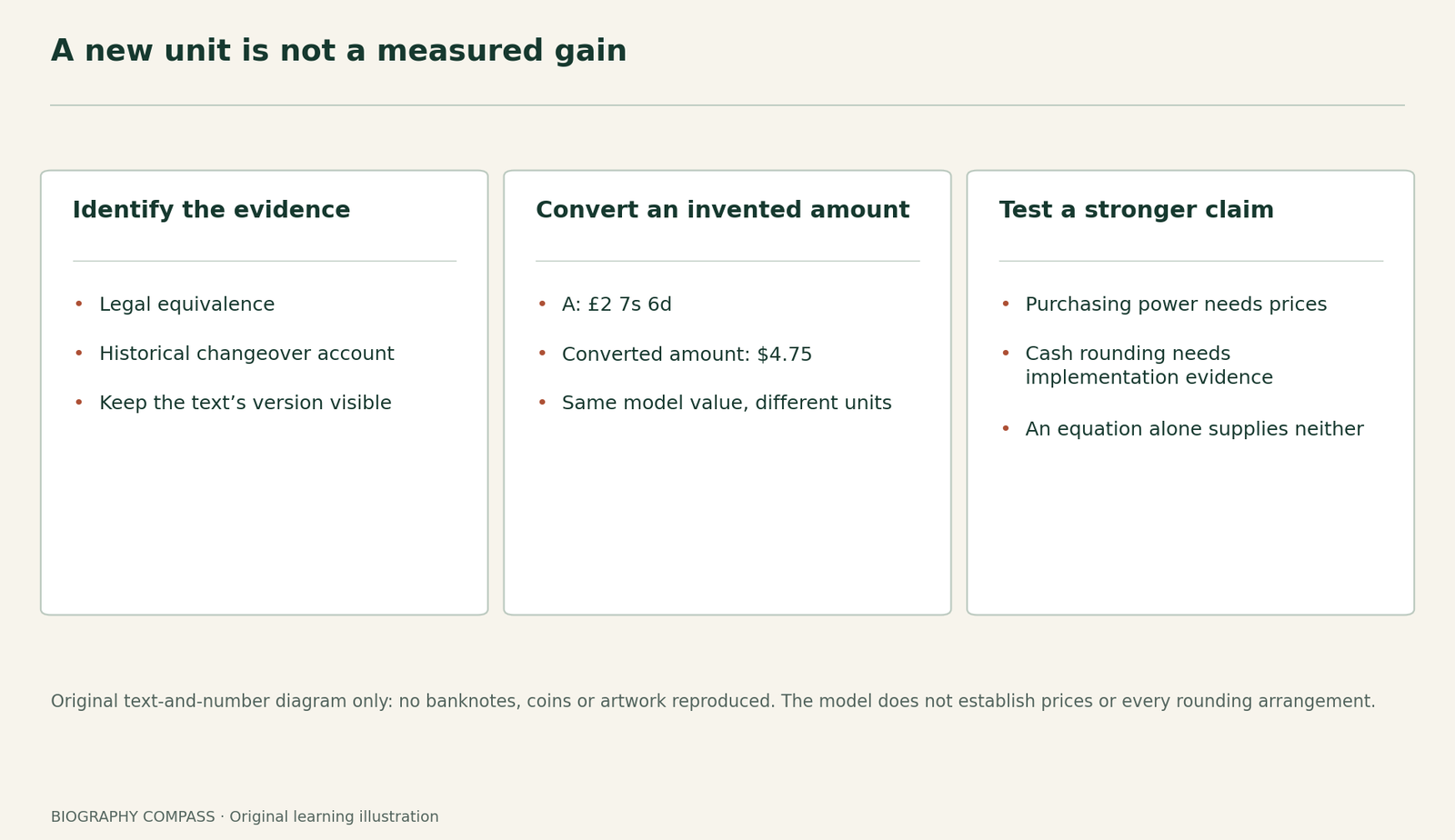
A number can double because the new unit is half the old unit’s value. To establish a real gain, compare what the amount would buy, using consistent prices, dates and goods. The conversion rule alone cannot answer that question. Nor does a fractional mathematical equivalence settle how an actual cash transaction was rounded.
Worksheet: convert the amount and diagnose the claim
Use three invented entries, not archival bank balances: A has £2 7s 6d; B has £3 10s; C has one old penny. Convert each exactly under the stated equivalence. Then assess two research notes: “the number doubled, so spending power doubled” and “an exact fraction proves every shop gave a fractional-cent coin”. Identify what extra evidence each note would need.
Reference answer and historical follow-up
A converts to $4.75: $4 for the pounds, $0.70 for the shillings and $0.05 for the pence. B becomes $7. C is exactly five-sixths of a cent as a ratio, not a newly identified circulating denomination.
Neither research note is established. The first needs evidence about prices and purchasing power. The second needs implementation and rounding records, not just a unit equation. A useful next comparison would match an actual dated price list or account before and after conversion, retaining its units and transaction rules. This exercise does not reconstruct those prices or offer instructions for settling present obligations.
Continue the chronology
Related history guides
Biography context
Explore New Zealand through connected lives
Connected biographies
People and political choices
1904–1983
Keith Holyoake
Prime minister and governor-generalKeith Holyoake led National governments before moving from party politics to the office of governor-general.Read biography1921–1992
Robert Muldoon
Prime minister and finance ministerRobert Muldoon combined the premiership with economic management, defending intervention as national finances came under pressure.Read biographyQuick answers
Common questions
- Does a conversion prove inflation or a pay rise?
- No. Those claims require price or income evidence beyond a change of monetary unit.
- Are the worksheet balances archival examples?
- No. They were invented to test the arithmetic and its limits.
Primary and institutional sources
How this history was checked
Selected sections of a later statutory reprint are compared with a retrospective parliamentary feature. No complete implementation file or original bank account was inspected. This article was reviewed on 30 October 2026.