
The short answer
New Zealand chose MMP through two referendums with different legal effects. Reading the original declarations alongside the legislation reveals why choosing an alternative, authorising change and conducting the first election were separate events.
Original source-reading aid
Three decisions, with different evidence
Counts are reorganised from the original declarations and later Department of Justice table. Each row retains its source version.
| Country | Choice or measure | Recorded votes | Interpretation |
|---|---|---|---|
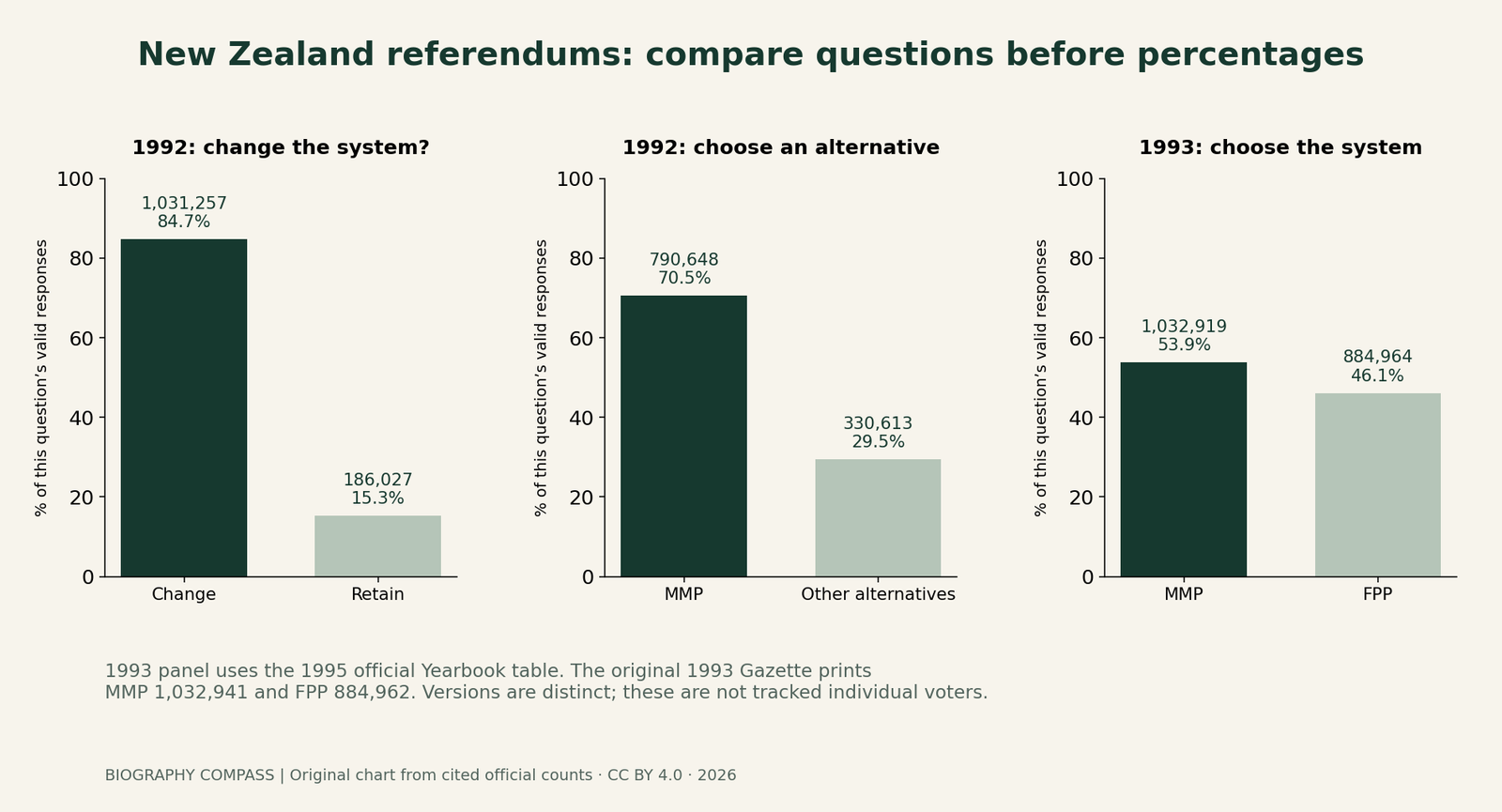
| 1992 Part A | Retain FPP / change | 186,027 / 1,031,257 | 84.7% chose change; indicative |
| 1992 Part B | MMP / all four alternatives | 790,648 / 1,121,261 | 70.5% chose MMP among valid alternative responses |
| 1993 Gazette declaration | MMP / FPP | 1,032,941 / 884,962 | Original declared result; published 16 December |
| 1995 official results table | MMP / FPP | 1,032,919 / 884,964 | Later official totals; 53.86% / 46.14% |
Chronology
A timeline of the turning points
Royal Commission recommendation
The commission recommended MMP and a referendum before adoption.
Indicative poll
Voters considered change in Part A and four alternatives in Part B.
Original result published
The Gazette printed the electorate counts and national totals.
Legislation assented to
The referendum law and Electoral Act set out the poll and conditional implementation.
Binding poll
Voters chose between FPP and MMP alongside the general election.
Declaration dated and published
The Chief Electoral Officer dated the notice 14 December; it appeared in the Gazette on 16 December.
Early provisions commenced
The declaration activated the specified early parts the next day.
Remaining conditional provisions commenced
The balance specified by section 2(1) took effect.
First MMP general election
The separate existing guide explains voting, seats and coalition formation.
The first vote narrowed the choice
The 1992 referendum was indicative: it did not itself put MMP into legal operation. Part A asked whether to keep FPP or change the system. Part B asked which of four alternatives voters preferred. The government promised a binding vote between FPP and the leading alternative if change won. The Electoral Commission places the process after the 1986 Royal Commission’s recommendation of MMP. This was a sequence of decisions about reform, rather than one ballot simultaneously deciding the system and electing a Parliament under it.
Read the 1992 totals with two denominators
The Gazette published on 29 October 1992 records 186,027 votes for retaining FPP and 1,031,257 for change, a Part A total of 1,217,284. For Part B it records 62,278 for supplementary member, 194,796 for single transferable vote, 790,648 for MMP and 73,539 for preferential voting. These sum to 1,121,261. MMP therefore took about 70.5% of valid alternative-system responses; change took about 84.7% in Part A. The different totals are visible in the original record. Part B is not evidence that every person favouring change also selected MMP.
Sources for this section: [1]
The second vote had a statutory consequence
On 6 November 1993, the referendum held with the general election offered a direct choice between FPP and the MMP system described in the Electoral Act 1993. The Electoral Referendum Act made this vote binding and required the Chief Electoral Officer to declare whether the MMP proposal carried. The original declaration, dated 14 December and published on 16 December, states that it did. Both the poll’s legal design and the declared majority mattered: the outcome operated through legislation that Parliament had already enacted in anticipation of either result.
Keep original and later official counts identifiable
The December 1993 Gazette prints 1,032,941 MMP votes and 884,962 FPP votes. The Department of Justice table in the 1995 Official Yearbook instead reports 1,032,919 and 884,964, respectively, or 53.86% and 46.14%. The sources read here do not establish the reason for the small difference. It should not be silently described as a particular recount or transcription correction. Both records show MMP winning. For calculations below, use the later Yearbook figures together; for the legal declaration and its date, use the original notice. Source version is part of the evidence.
Assent, declaration and commencement were separate dates
The Electoral Act received assent on 17 August 1993, before the referendum. Section 2 provided conditional commencement. Specified early parts took effect on the day after publication of a declaration that MMP had carried: 17 December 1993. Most remaining conditional provisions took effect on 1 July 1994. Electoral administration, procedures and boundaries then had to be prepared before the first MMP general election in October 1996. This staged chronology avoids calling election day the date the law was signed, or describing assent as though voters had already approved the change.
Worked exercise: which percentage answers which question?
A student writes: “MMP had 84.7% support in 1992 and then lost support to 53.86% in 1993.” Test that claim. First calculate 1,031,257 ÷ 1,217,284 × 100, then 790,648 ÷ 1,121,261 × 100. Finally use the 1995 Yearbook figures to calculate the MMP margin over FPP. The answers are about 84.7% for changing the system, 70.5% for MMP among the alternative-system responses, and 147,955 more votes for MMP in 1993. The student compares unlike questions. Even the two MMP percentages describe different choices and electorates at different polls; they cannot track individual voters’ changing opinions.
Continue the chronology
Related history guides
Connected biographies
People in the reform era

1935–2025
Jim Bolger
Prime minister, National Party leader and public-institution chairJim Bolger served as New Zealand’s prime minister from 2 November 1990 to 8 December 1997. His government combined economic restructuring with electoral reform and major Treaty settlements; he later worked in diplomacy and public governance.Read biography
1945–
Winston Peters
New Zealand First leader and Minister of Foreign AffairsWinston Peters founded New Zealand First in 1993 after a parliamentary career in the National Party. He has held senior office in governments led by both major parties, with repeated departures from and returns to Parliament.Read biography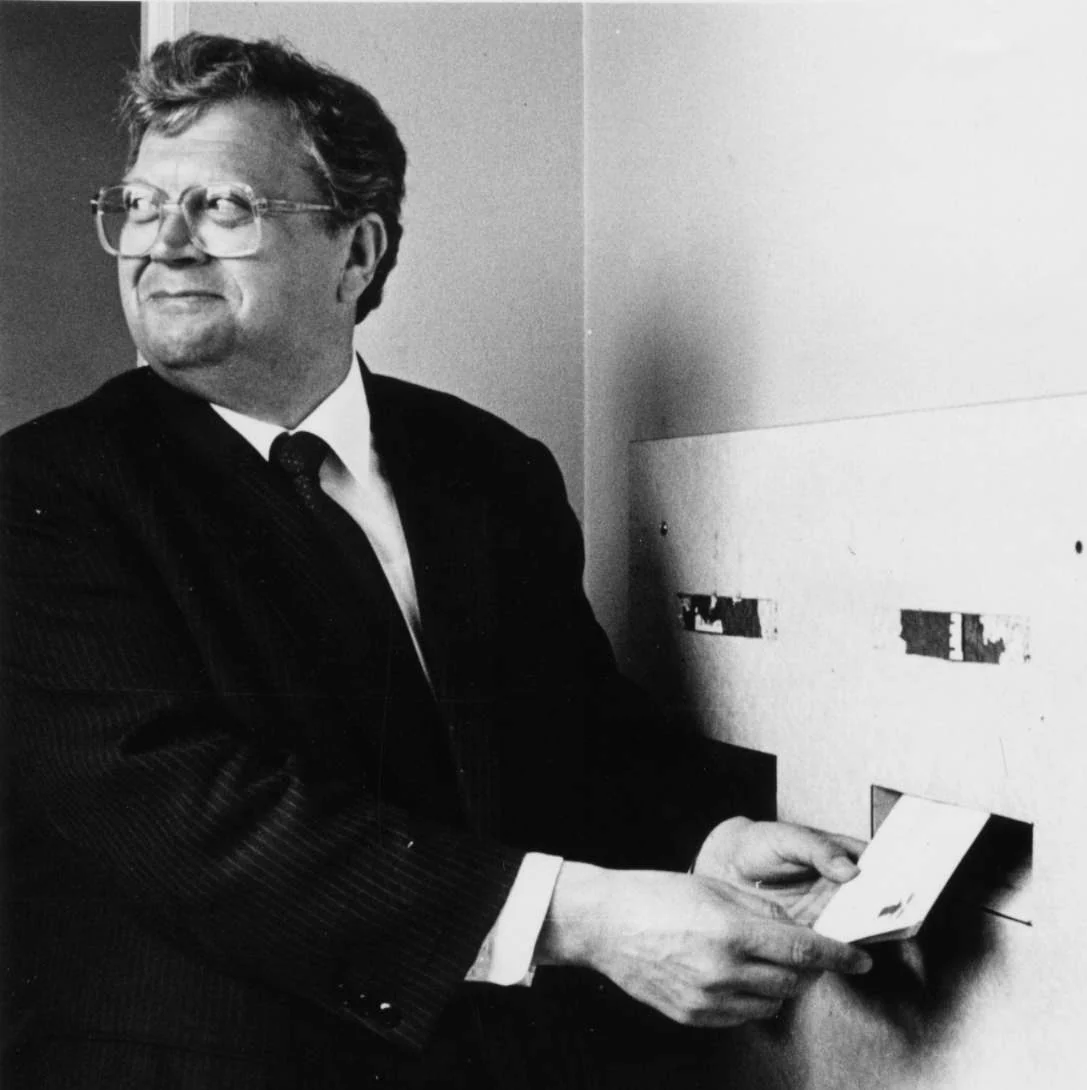
1942–2005
David Lange
Lawyer, Labour leader and prime ministerDavid Lange served as New Zealand’s prime minister from 26 July 1984 to 8 August 1989. A lawyer and accomplished speaker, he led a government remembered for nuclear-free policy, social change and divisive economic reform.Read biography
1950–
Helen Clark
Former New Zealand prime minister and UNDP administratorHelen Clark led New Zealand’s government from 1999 to 2008 and the United Nations Development Programme from 2009 to 2017. Her career links parliamentary coalition management, public policy and international development institutions.Read biographyQuick answers
Common questions
- Did the 1992 referendum legally introduce MMP?
- No. It was indicative and selected the alternative to face FPP at the binding 1993 poll.
- Was the 1993 general election itself held under MMP?
- No. The first MMP general election was in 1996.
- Why are both versions of the 1993 counts shown?
- The original Gazette and later official Yearbook give slightly different totals. Their versions are labelled, and no unsupported explanation for the difference is asserted.
Primary and institutional sources
How this history was checked
Original Gazette declarations anchor the ballot counts and legal declaration. The later official statistical table is kept separately labelled; the exercise and comparison are original explanations. This article was reviewed on 27 October 2026.
- New Zealand Gazette / Chief Electoral Office; Victoria University archiveDeclaration of Result of Electoral Referendum, issue 174, 29 October 1992, pp. 3543–3544
- New Zealand Gazette / P. Whelan, Chief Electoral Officer; Victoria University archiveDeclaration of Result of Electoral Referendum, issue 181, 16 December 1993, pp. 3753–3754
- Statistics New Zealand / Department of Justice1995 Official Yearbook, table 3.14: Results of Electoral Referendum Poll 1993
- Parliamentary Counsel Office / New Zealand LegislationElectoral Referendum Act 1993, sections 2 and 19
- Parliamentary Counsel Office / New Zealand LegislationElectoral Act 1993, section 2 commencement and annotation
- Electoral CommissionA Royal Commission and two referendums
- New Zealand Parliament25 years since MMP referendum, 2018