
The short answer
The election of 12 October 1996 elected a more proportional Parliament. It did not select a coalition on the ballot paper. Following the path from referendum to seats to government helps explain both the new rules and the uncertainty that followed.
Original results-reading aid
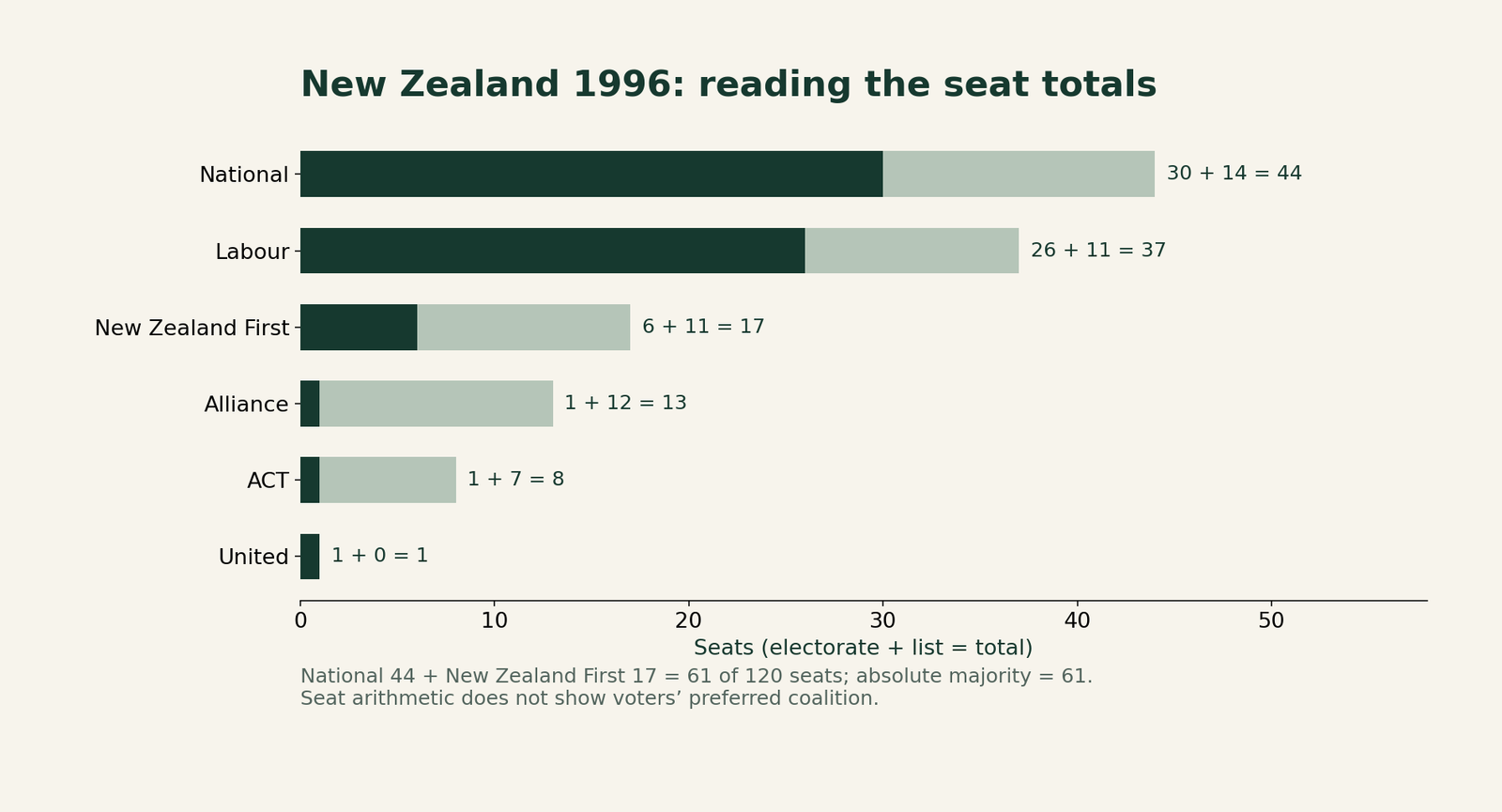
Electorate seats are part of the total
These factual counts are reorganised from the official summary. The final column is the sum of the first two.
| Country | Electorate seats | List seats | Total seats |
|---|---|---|---|
| National | 30 | 14 | 44 |
| Labour | 26 | 11 | 37 |
| New Zealand First | 6 | 11 | 17 |
| Alliance | 1 | 12 | 13 |
| ACT | 1 | 7 | 8 |
| United | 1 | 0 | 1 |
Chronology
A timeline of the turning points
Indicative referendum
Voters favoured changing FPP; MMP was the most supported alternative.
Binding decision
53.9% of valid votes supported MMP.
First MMP election
Six parties won representation; no party held a majority.
Coalition announced and agreement released
New Zealand First chose National on 10 December; parties publicly signed/released the written agreement on 11 December.
Coalition ministry sworn in
The full incoming administration took office at Government House.
Two referendums answered different questions
The move to MMP followed a Royal Commission’s recommendation and two public votes. The 1992 indicative referendum asked whether to keep first-past-the-post or change the system; 84.7% of valid responses favoured change. A separate part asked voters to choose among four alternatives, with MMP receiving 70.5%. Those percentages answer different questions. They are not competing measures of the same choice. The binding referendum held with the 1993 general election then offered a direct choice between FPP and MMP. MMP won 53.9%, enabling the new system to be used at the next general election.
Sources for this section: [1]
Two votes had different jobs
In the 1996 system, an electorate vote selected a local MP, while the party vote principally determined a party’s overall share of seats. A party normally needed at least 5% of party votes or an electorate victory to qualify for a proportional allocation. Electorate seats counted within its overall entitlement; list seats filled the difference. Parliament had 120 members, including 60 general-electorate and five Māori-electorate MPs. The list was therefore part of the same proportional system, rather than a separate election producing a second, additional parliamentary entitlement.
Read the total before reading the list column
The official summary records National with 30 electorate and 14 list seats, making 44 overall. Labour had 26 plus 11, making 37. New Zealand First’s six plus 11 made 17; the Alliance’s one plus 12 made 13; ACT’s one plus seven made eight; United held one electorate seat and no list seats. Adding those party totals gives 120. National led the party vote with 33.84%, but its 44 seats were fewer than the 61 needed for an absolute majority. The largest party and a majority party were different outcomes.
Sources for this section: [3]
A worked reading exercise
Use those figures to test three statements. First: National won 30 local seats and then received 44 additional list seats. Second: National and New Zealand First together had an absolute majority. Third: the seat table proves which coalition voters wanted. Which statements survive the evidence?
Sources for this section: [3]
What the arithmetic can and cannot establish
Suggested answer: the first statement double-counts National’s entitlement. Its 44 total already includes the 30 electorate seats, leaving 14 list seats. The second statement is correct arithmetic: 44 + 17 = 61, one seat above half of 120. The third goes beyond the table. Votes for parties do not supply a ranked coalition preference or demonstrate that party leaders will agree. For comparison, Labour, the Alliance and New Zealand First totalled 67 seats; that sum alone did not establish an agreed government. This exercise calculates seat combinations, rather than reconstructing individual voters’ intentions.
Government formation had its own chronology
Governor-General Sir Michael Hardie Boys’s 1997 account explains that party negotiations had to identify an administration able to command parliamentary confidence. The incumbent government continued under caretaker conventions while those talks proceeded. On 10 December 1996 New Zealand First announced that it would join National; the written agreement was publicly signed and released on 11 December. The new ministry was announced on 15 December and sworn in on 16 December. Keeping these events separate prevents an election date, a political agreement and formal appointments from being mistaken for the same constitutional act.
Sources for this section: [6]
The first election began a longer adjustment
The new rules changed representation without eliminating political disagreement or party instability. NZHistory records that the six-party Parliament elected in 1996 had become ten parties plus three independents by 1999. That later fragmentation is part of evaluating the period, but it does not alter the original result. Read the official count for who won seats, the rules for how those seats were allocated and the formation records for how a government emerged. Each source answers a different historical question.
Connected biographies
Political leaders and the new system

1950–
Helen Clark
Former New Zealand prime minister and UNDP administratorHelen Clark led New Zealand’s government from 1999 to 2008 and the United Nations Development Programme from 2009 to 2017. Her career links parliamentary coalition management, public policy and international development institutions.Read biography
1935–2025
Jim Bolger
Prime minister, National Party leader and public-institution chairJim Bolger served as New Zealand’s prime minister from 2 November 1990 to 8 December 1997. His government combined economic restructuring with electoral reform and major Treaty settlements; he later worked in diplomacy and public governance.Read biography
1945–
Winston Peters
New Zealand First leader and Minister of Foreign AffairsWinston Peters founded New Zealand First in 1993 after a parliamentary career in the National Party. He has held senior office in governments led by both major parties, with repeated departures from and returns to Parliament.Read biographyQuick answers
Common questions
- Did 1996 voters directly choose a coalition?
- They cast electorate and party votes. Parties then negotiated a government able to command parliamentary confidence.
- Were list seats added on top of a party’s full entitlement?
- No. Electorate seats formed part of the total; list seats filled the difference.
- Why do coalition accounts use both 10 and 11 December?
- The decision and announcement came on 10 December. Hardie Boys records the public signing and release on 11 December.
Primary and institutional sources
How this history was checked
Start with the official rules and final count, then read the Governor-General’s contemporary account of government formation. The exercise is an original teaching aid using historical seat counts. This article was reviewed on 27 October 2026.
- Electoral CommissionA Royal Commission and two referendums
- Statistics New ZealandNew Zealand Official Yearbook 1996: electoral system
- Chief Electoral Office1996 official results: summary of party list and electorate seats
- Electoral Commission1996 official results archive and allocation records
- New Zealand Parliament25 years since the MMP referendum, 2018
- Governor-General Sir Michael Hardie BoysHarkness Henry Lecture, 31 July 1997
- Manatū Taonga / NZHistoryNew Zealanders go to the polls in first MMP election