
The short answer
Two ballots can form one political process while answering different questions. Reading the voting mechanism before the result prevents an alternative’s selection from being mistaken for a decision to adopt it.
Compare the claims
Two questions, then an arithmetic check
Keep the conclusion within the record’s scope.
| Evidence | What it establishes | What still needs evidence |
|---|---|---|
| First ballot | Selects an alternative through rankings | Does not itself adopt a replacement |
| Second ballot | Chooses between the alternative and existing flag | Does not reconstruct every earlier preference |
| Percentage | Describes a specified denominator | Cannot be compared safely without the category definition |
Selection came before adoption
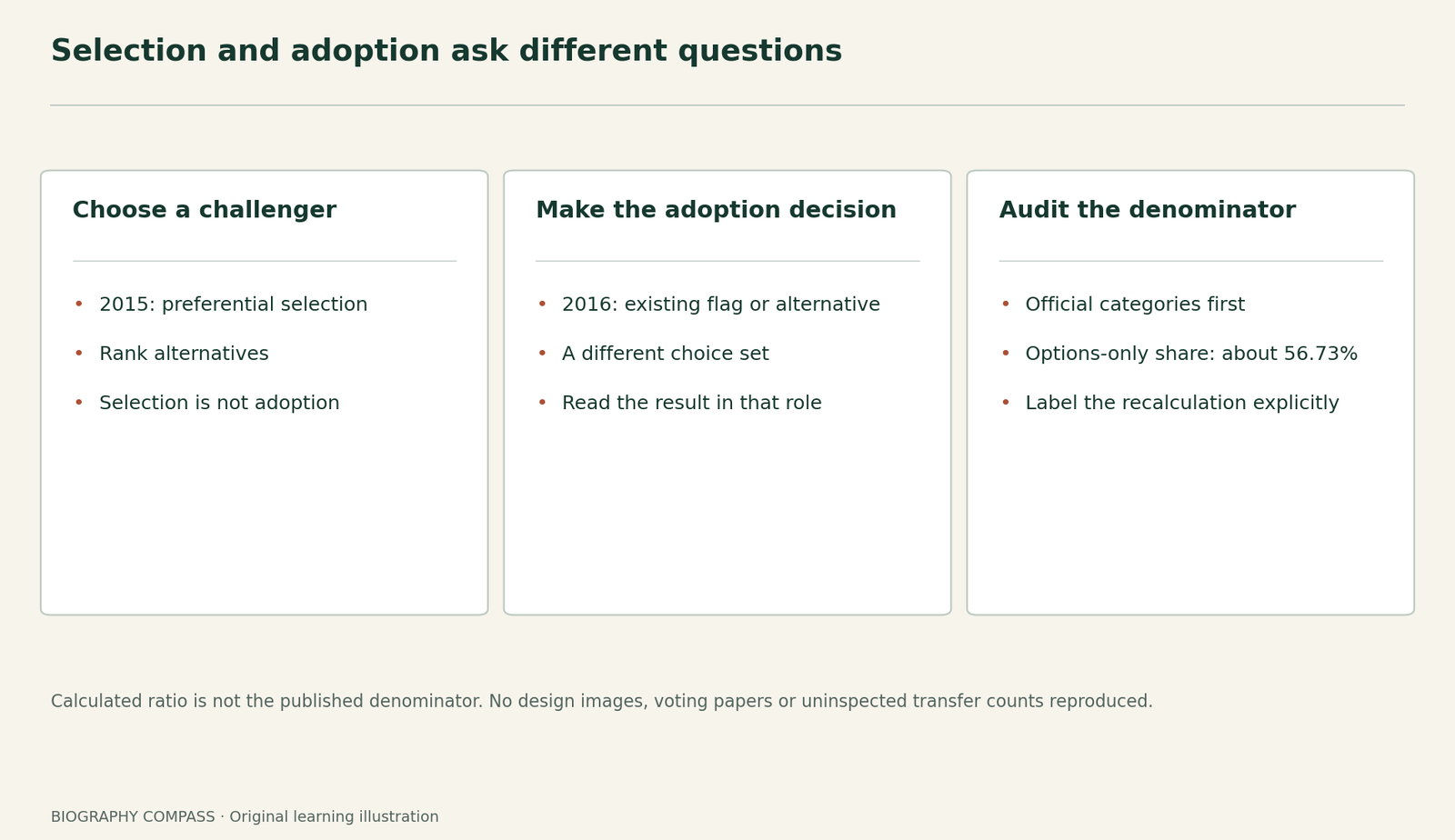
In the first postal referendum, voters ranked alternatives. They could rank as many or as few as they wished, without skipped or repeated numbers. If no option reached 50% or more, the least-supported option was eliminated and next preferences redistributed. The second referendum offered the selected alternative against the existing flag.
This matters because a first preference is not necessarily a final-round preference, and choosing the challenger is not the same institutional act as replacing the incumbent design. A headline giving one “winner” can conceal which of these questions the ballot answered.
Sources for this section: [1]
Read each result in its own role
The first final-results page names Silver Fern (Black, White and Blue) as the preferred alternative. It reports turnout of 48.78%.
The second page records 1,208,702 votes for the existing flag and 921,876 for the alternative. Its displayed percentages are 56.6% and 43.2%.
The sequence is therefore consistent, not contradictory: an alternative could win the selection procedure and then lose the adoption contest. The result is a statement about those ballots; it does not establish how every participant would have ranked every design in a different contest.
Worksheet: audit the denominator
The second table lists 5,044 informal votes within Total Valid Votes of 2,135,622, then 5,273 invalid votes and 2,140,895 votes overall.
Check three things. First, add the two design totals and the informal category. Second, divide the existing-flag total by the table’s stated valid-vote total. Third, calculate the percentage using only the two design totals. Explain why the last calculation must carry a different label rather than being presented as a correction of the official percentage.
Sources for this section: [3]
Worked answer and the comparison’s limit
The two choices total 2,130,578. Adding the informal category gives 2,135,622, matching the stated denominator; adding invalid votes gives the overall total. The existing flag’s share is about 56.60% on that published denominator. Among votes allocated to the two choices only, it is about 56.73%.
Both ratios can be calculated, but they answer differently defined questions. Label the latter “among votes allocated to the two choices”; do not silently replace the official category. Likewise, turnout concerns participation, not the proportion choosing a design. This study examines the records’ mechanisms and denominators, not the artistic merits of any flag. It reproduces no flag designs or voting papers.
Continue the chronology
Related history guides
Biography context
Explore New Zealand through connected lives
Connected biographies
People and political choices

Born 1961
John Key
Former prime ministerJohn Key led National through three election victories and governments confronting recession and earthquake recovery.Read biographyQuick answers
Common questions
- Why can two different percentages both be arithmetically correct?
- They may use different denominators. State the included categories before comparing them.
- Does selecting a challenger prove it will defeat the existing option?
- No. Selection and adoption are separate questions with different choice sets.
Primary and institutional sources
How this history was checked
The official mechanism explanation and short final-results pages were read. The separate round-by-round results PDF was not inspected. This article was reviewed on 30 October 2026.